

Bisphosphonate & Calcium Timing Calculator
How to Use This Tool
Enter the time you take your bisphosphonate and calcium supplement. We'll check if your timing is safe based on medical guidelines.
- Recommended minimum: 30-60 minutes between bisphosphonate and calcium
- Recommended maximum: Wait 2 hours for extra safety
- Important: Bisphosphonate should be taken on empty stomach with water
Enter times above to see if your medication timing is safe.
Getting the most out of your osteoporosis medication shouldn’t feel like solving a puzzle. But if you’re taking bisphosphonates and calcium supplements at the same time, you might be unknowingly sabotaging your treatment. The problem isn’t that either one doesn’t work-it’s that they cancel each other out when taken together. This isn’t a myth. It’s chemistry. And it’s happening to thousands of people every day.
Why Bisphosphonates and Calcium Don’t Mix
Bisphosphonates-like alendronate, risedronate, and zoledronic acid-are designed to stick to bone tissue and slow down bone loss. But they’re also incredibly picky about what they absorb. These drugs have a chemical structure that clings tightly to calcium. That’s great when they’re in your bones. Terrible when they’re in your stomach. If you take a calcium supplement-even a small one-within hours of your bisphosphonate, the two bind together in your gut. They form an insoluble complex that your body can’t absorb. Studies show this cuts bisphosphonate absorption by 90% to nearly 100%. That means you might as well have skipped the pill. Your bones get no benefit. The drug just passes through you, useless. This isn’t just theory. The FDA, the Endocrine Society, and the National Osteoporosis Foundation all agree: calcium and bisphosphonates must be separated by at least 30 to 60 minutes. Some experts recommend waiting up to two hours for safety. And it’s not just calcium. Iron, magnesium, antacids, and even mineral-rich water can do the same thing.How Your Body Actually Absorbs These Drugs
Bisphosphonates are among the worst-absorbed drugs in medicine. Under perfect conditions-fasting, plain water, no food-only about 0.6% to 1.2% of the pill makes it into your bloodstream. That’s less than one in a hundred. And if you eat breakfast, drink milk, or take a calcium tablet? That number drops to nearly zero. Here’s what works:- Take your bisphosphonate first thing in the morning, right after waking up.
- Swallow it with 6 to 8 ounces of plain water-no juice, no coffee, no tea.
- Stay upright-sitting or standing-for at least 30 minutes after taking it. Lying down increases the risk of esophageal irritation.
- Wait 30 to 60 minutes before eating, drinking anything else, or taking any other medication-including calcium.
Calcium Supplements: Which One Should You Take?
Not all calcium is the same. Calcium carbonate needs stomach acid to absorb well, so it’s best taken with food. Calcium citrate doesn’t need acid, so it can be taken anytime-even on an empty stomach. But here’s the catch: both block bisphosphonates if taken too close. If you’re taking calcium carbonate, aim to take it with lunch or dinner. That gives you a natural buffer between your morning bisphosphonate and your calcium. Calcium citrate? You can take it at bedtime, as long as it’s at least 30 minutes after your last meal and at least 60 minutes after your bisphosphonate. Some people try to save time by using a calcium-vitamin D combo pill. Don’t. Even if the calcium dose is small, it’s still enough to interfere. The same goes for multivitamins with calcium. Read the label. If it says “calcium,” avoid it for at least an hour after your bisphosphonate.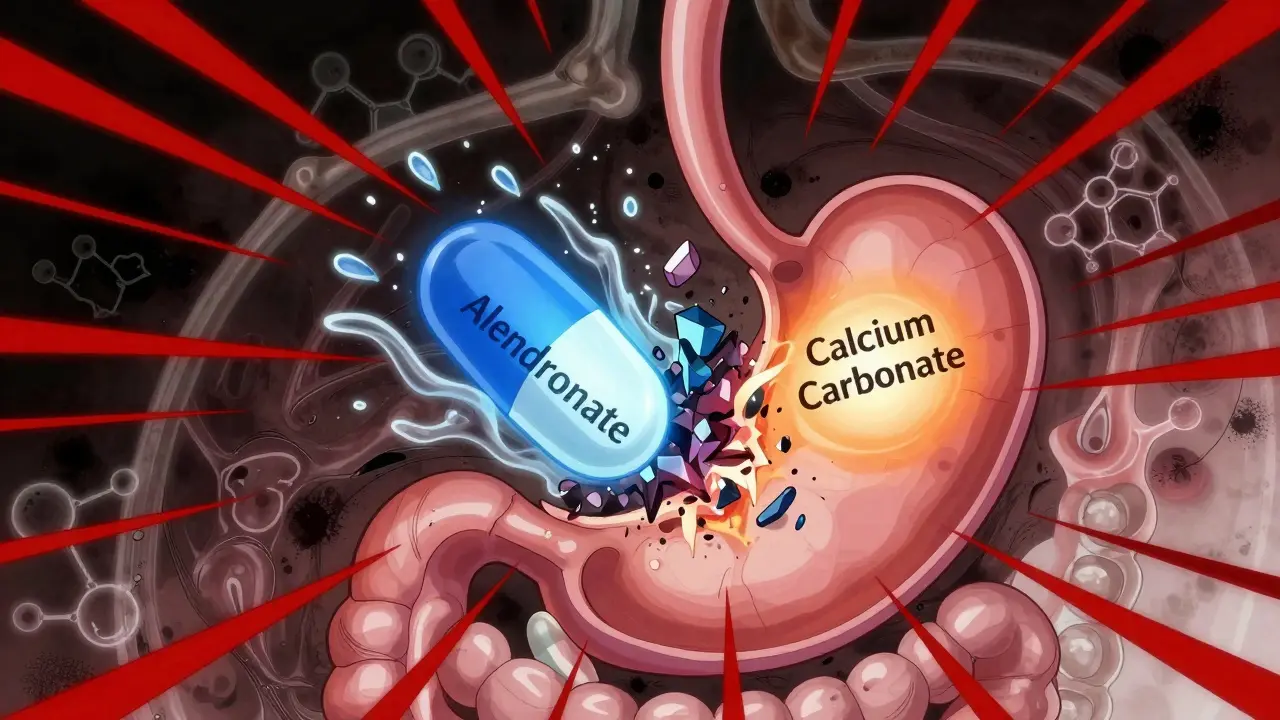
What Happens When You Get It Wrong
You might not feel anything right away. No stomach pain, no dizziness. That’s the problem. The damage is silent. A 2023 study of 1,200 patients found that 68% had accidentally taken calcium and bisphosphonates together at least once. Over 40% of those patients reported nausea or heartburn afterward-but only because the undissolved drug sat in their esophagus, not because the calcium caused it. The real risk? Over time, your bone density doesn’t improve. Your fracture risk stays high. You keep taking the pill, thinking it’s working, while your bones keep weakening. Patient forums are full of stories. One woman in Bristol took her alendronate at 7 a.m. and her calcium at 7:30 a.m. for three years. She broke her hip at 71. Her doctor found her bisphosphonate levels were barely detectable. She wasn’t non-compliant-she just didn’t know the rules.Real Solutions: How People Are Getting It Right
The good news? Most people can nail this with a simple routine. Strategy 1: The 5 a.m. RuleSome patients wake up at 5 a.m. to take their bisphosphonate. They wait 60 minutes, then go about their morning. They take calcium at breakfast or lunch. This works because they’re not rushing. They’ve got time. Strategy 2: The Fixed Calcium Time
Pick one time every day to take calcium-say, 7 p.m. with dinner. Then take your bisphosphonate at least 30 minutes before that. If you take it at 6:30 p.m., you can eat dinner at 7. No guesswork. No risk. Strategy 3: Switch to IV
If you’re constantly forgetting or mixing up timing, ask your doctor about zoledronic acid (Reclast). It’s given as a yearly IV infusion. No pills. No fasting. No calcium conflicts. One 15-minute appointment a year. Adherence rates jump from 52% to 78% with this option.
What Your Doctor Should Be Telling You
Too often, patients are handed a prescription and told, “Take this once a week.” That’s it. No explanation. No warning. The American Academy of Family Physicians says doctors should spend 12 to 15 minutes during the first visit explaining how to take bisphosphonates. That includes:- Demonstrating the right way to swallow the pill
- Showing how long to wait before eating
- Writing down the calcium schedule
- Asking the patient to repeat the instructions back

Vitamin D Is the Hidden Key
Taking calcium and bisphosphonates correctly won’t help if you’re low in vitamin D. Your body needs vitamin D to absorb calcium from food or supplements. Without it, even perfect timing won’t fix your bone loss. The Endocrine Society recommends checking your 25-hydroxyvitamin D level before starting bisphosphonates. The target? At least 30 ng/mL. If you’re below that, you’re at risk for hypocalcemia-low blood calcium-which can cause muscle cramps, numbness, and even heart rhythm problems. Most people need 800-1,000 IU of vitamin D daily. If you’re over 65, live in the UK, or rarely go outside, you might need more. Talk to your doctor about testing and dosing.What’s Next? Better Drugs Are Coming
Scientists are working on ways to fix the absorption problem. One new drug, RAY121, uses a special enhancer to boost bisphosphonate absorption by over 15 times. It’s still in trials, but early results are promising. Other companies are testing pills that separate the bisphosphonate and calcium into different layers, releasing them at different times in the gut. If they work, you could take them together. No waiting. But until then, the old rules still apply. And they’re not going away.Bottom Line: Timing Is Everything
Bisphosphonates are powerful. But they’re fragile. They need space. They need silence. They need you to be careful. If you’re taking calcium supplements and bisphosphonates:- Take the bisphosphonate first-on an empty stomach, with plain water, upright.
- Wait 30 to 60 minutes before eating, drinking, or taking anything else.
- Take calcium at least 30 minutes after your bisphosphonate, preferably with a meal.
- Don’t mix them in the same pill or same time.
- If you’re struggling, ask about the yearly IV option.
Can I take calcium and bisphosphonates in the same day?
Yes, but not at the same time. Take your bisphosphonate first, on an empty stomach with plain water, and wait at least 30 to 60 minutes before taking calcium. Most people find it easiest to take calcium with lunch or dinner.
What if I forget and take them together?
If you accidentally take calcium with your bisphosphonate, skip that dose and wait until the next scheduled day. Don’t double up. Taking two pills in one day won’t make up for the lost absorption-it just increases your risk of side effects like stomach upset or esophageal irritation.
Is calcium citrate better than calcium carbonate for people on bisphosphonates?
Calcium citrate is easier to absorb on an empty stomach and may be better for people with low stomach acid. But both forms block bisphosphonate absorption equally when taken too close together. The key isn’t which calcium you choose-it’s when you take it. Separate them by at least 30 minutes.
Can I take my bisphosphonate at night instead of in the morning?
The guidelines recommend taking bisphosphonates in the morning because you’re more likely to be fasting and upright. Taking them at night after dinner increases the risk of lying down too soon, which can irritate your esophagus. If you must take it at night, wait at least two hours after eating and stay upright for 30 minutes. But morning is still the safest option.
Do I need to stop calcium supplements completely?
No. Calcium is still important for bone health. But you need to time it correctly. Take it at least 30 minutes after your bisphosphonate. If you’re on a once-weekly or once-yearly bisphosphonate, you have more flexibility. Just make sure the two never touch in your stomach.
Why do some people say they took calcium and bisphosphonates together and felt fine?
Feeling fine doesn’t mean it worked. The problem isn’t immediate symptoms-it’s long-term bone loss. If you take calcium with your bisphosphonate, you’re likely absorbing less than 10% of the drug. Your bones won’t get the protection they need, even if you don’t feel sick. This is why doctors stress timing: because the damage is invisible until it’s too late.
Are there alternatives to bisphosphonates if timing is too hard?
Yes. If you can’t stick to the strict timing, ask your doctor about denosumab (Prolia), which is a twice-yearly injection, or zoledronic acid, which is given once a year by IV. Both bypass the gut entirely, so calcium timing doesn’t matter. There’s also romosozumab (Evenity), which builds bone faster and has higher adherence rates-but it’s more expensive.
Comments
Marian Gilan
so like... what if the pharma companies *wanted* us to mess this up? i mean, think about it. if we take the pill wrong, we gotta go back for more. more pills. more doctor visits. more $$$ for them. and they know most folks are too tired or confused to read the fine print. they don't care if your bones crumble as long as your wallet keeps bleeding. #bigpharma #iwaswarned
On January 26, 2026 AT 20:40
Conor Murphy
this is so helpful 😊 i was taking my calcium with breakfast and my bisphosphonate at 7am-no wonder my bone scan looked like a ghost town. switched to taking calcium at 8pm now and my doc actually smiled last visit. thank you for writing this like a human, not a textbook.
On January 28, 2026 AT 01:49
Conor Flannelly
there’s a quiet tragedy here: medicine is designed for the perfectly compliant, the mentally nimble, the well-resourced. but most of us are juggling jobs, kids, aging parents, and chronic fatigue. the 30-minute rule? it’s beautiful in theory. in practice? it’s a luxury. maybe the real problem isn’t patient error-it’s that we’re asking broken people to perform perfect rituals. the IV option should be the default, not the last resort.
On January 28, 2026 AT 10:26
Patrick Merrell
you people are such sheep. they tell you to wait 30 minutes? wait 2 hours. they say plain water? drink distilled. they say stay upright? stand on your head. if you don’t follow every single tiny rule to the nanosecond, you’re just a failure. and if your bones break? that’s your fault. not the system’s. not the doctor’s. yours. period.
On January 29, 2026 AT 11:40
Sally Dalton
omg i just realized i’ve been taking my calcium with my multivitamin at lunch and my bisphosphonate at 7am… so like… 5 hours apart? wait no-did i even take it on an empty stomach?? i think i had a sip of coffee… 😭 i’m so sorry my bones
On January 31, 2026 AT 01:50
Betty Bomber
i take mine at night and lie down right after. i know i shouldn’t. but i’m 72 and tired. and my dog needs to go out. and my back hurts. so i do it anyway. if i break a hip, at least i’ll be asleep when it happens.
On February 1, 2026 AT 02:52
Curtis Younker
okay hear me out-this is the most life-changing health tip i’ve ever read. i used to be the guy who took his meds with his coffee and scrambled eggs and then napped. now? i wake up at 5am, drink a glass of water, swallow the pill, stand like a statue for 45 minutes while i stare at the wall and listen to birds. then i make pancakes. i feel like a superhero. my bones are thanking me. and honestly? i kinda miss the 5am quiet. it’s the only time my brain doesn’t feel like a browser with 47 tabs open.
On February 1, 2026 AT 12:47
Nicholas Miter
i tried the 5am thing. lasted 3 days. then i missed my alarm, took the pill at 8am with oatmeal, and felt guilty for a week. turns out, perfection isn’t sustainable. i switched to the yearly iv. no fasting. no waiting. just a 15-minute nap in a chair while someone else does the hard part. best decision i ever made. sometimes the system’s broken. it’s okay to opt out.
On February 2, 2026 AT 09:03
Skye Kooyman
vitamin d levels matter more than people think i got mine checked after reading this and was at 18 ng/ml now i take 2000iu daily and my calcium seems to be working better
On February 3, 2026 AT 15:20
James Nicoll
so let me get this straight. we’re supposed to be scientists at 6am, monks at 7am, and time-travelers for the next hour just to absorb a pill that’s 1% effective anyway? meanwhile, the drug company’s CEO is on a yacht in the mediterranean. i’m not mad. i’m just disappointed. also, if RAY121 works, can we please rename it ‘The Miracle Pill That Doesn’t Make You Hate Life’?
On February 4, 2026 AT 19:42