
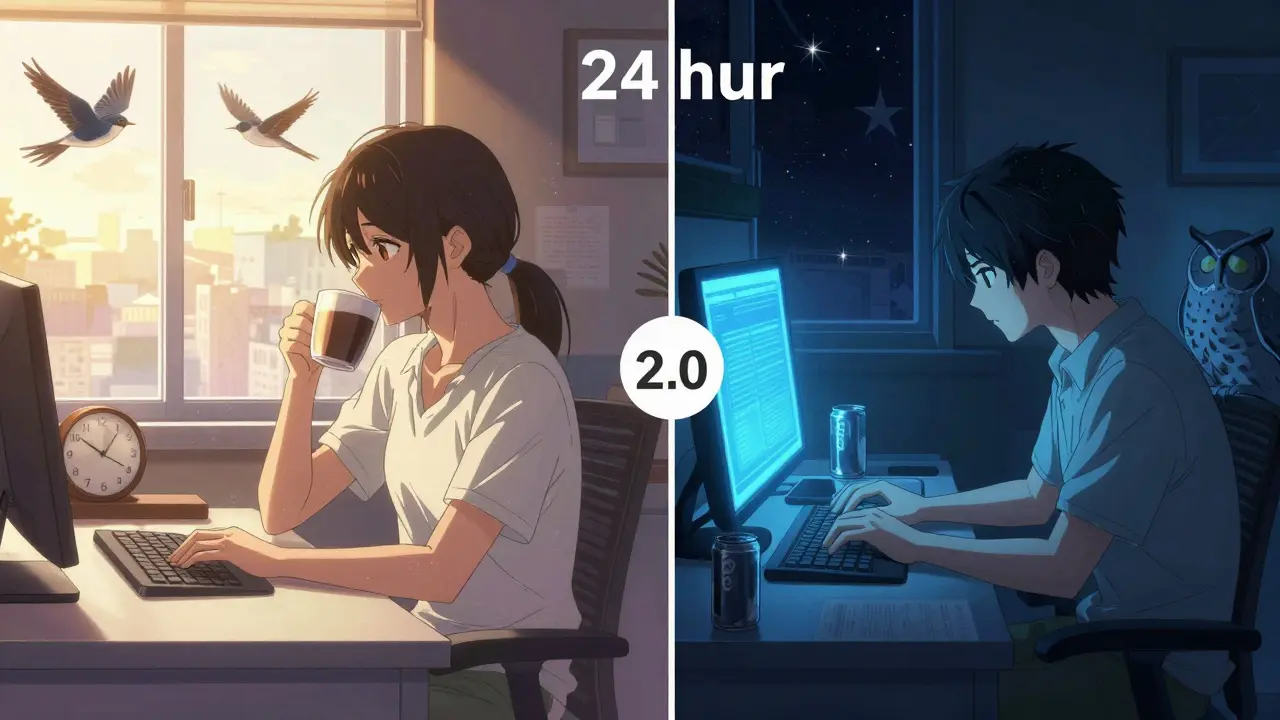
What if the reason you’re exhausted at 10 a.m. isn’t because you’re lazy - but because your body thinks it’s still midnight?
Most of us are told to wake up early, get up with the sun, and crush the day before lunch. But for nearly a third of people, that’s like forcing a cat to swim. Your internal clock doesn’t care about your boss’s schedule. It cares about light, genes, and decades of evolution. This is where chronotype comes in - your biological preference for when you sleep and wake. And it’s not just about being a morning person or a night owl. It’s about your brain, your health, and your productivity.
What Exactly Is a Chronotype?
Your chronotype isn’t a mood. It’s not a habit you picked up from binge-watching Netflix. It’s your body’s hardwired rhythm - shaped by your genes and synced to the sun. Scientists measure it using something called the sleep midpoint: the exact middle of your sleep window on days when you don’t have an alarm. If you fall asleep at 1 a.m. and wake at 9 a.m., your sleep midpoint is 5 a.m. If you fall asleep at 11 p.m. and wake at 7 a.m., it’s 3 a.m. That’s a two-hour difference - and that’s just the average.
There are three main types:
- Morning larks - sleep early, wake early. Their midpoint is usually before 3:30 a.m.
- Night owls - sleep late, wake late. Their midpoint is often after 5:30 a.m.
- Intermediate types - the majority. They fall somewhere in between.
Studies show about 40% of people are larks, 30% are owls, and the rest are in the middle. But here’s the catch: society runs on lark time. Schools start at 8 a.m. Work begins at 9. Meetings are scheduled before lunch. For owls, that’s not just inconvenient - it’s damaging.
Why Night Owls Are Struggling (And It’s Not Their Fault)
Imagine being forced to run a marathon at 5 a.m. every day - even though your body doesn’t hit peak performance until 7 p.m. That’s what it’s like for night owls in a 9-to-5 world.
Research from Baylor University found that evening-type college students who had to wake up early for class got 1.3 fewer hours of sleep per night than their morning-type peers. They were more likely to nap during the day, drink caffeine after 4 p.m., and scroll through social media in bed - all things that make sleep worse. Their sleep quality score was 23% lower. Their grades? Lower too.
It’s not just students. A 2023 survey of remote workers showed that night owls in traditional office jobs reported feeling “chronically drained” by midweek. One software developer on Reddit wrote: “I lose three productive hours every day fighting sleepiness in 8 a.m. standups. My best ideas come after 10 p.m. - but I’m too tired to write them down.”
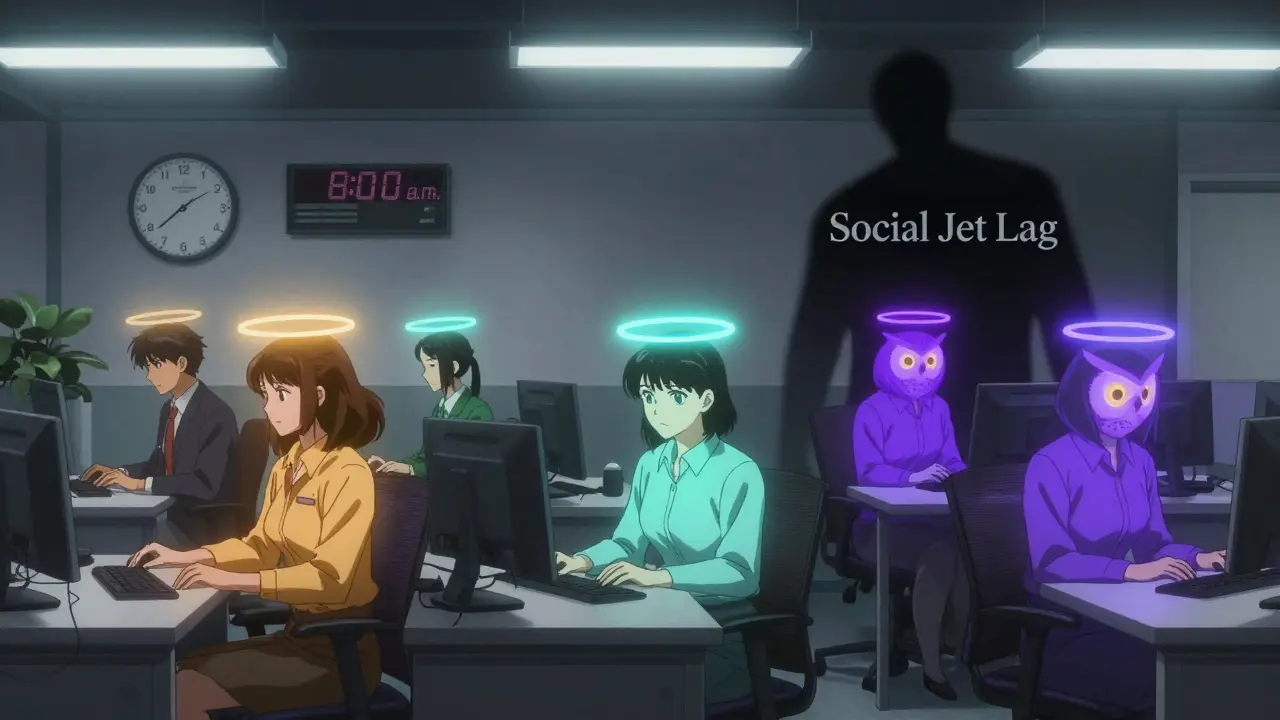
And it’s not just about tiredness. Night owls face real health risks. A study of over 430,000 people found they had a 10% higher risk of early death. They’re 27% more likely to be obese, 30% more likely to develop type 2 diabetes, and 29% more likely to suffer from depression. Why? Because their bodies are constantly out of sync with the world around them. This mismatch is called “social jet lag” - and it’s real.
Are Morning Larks Really Better Off?
It’s tempting to think larks have it easy. They wake up refreshed. They get stuff done before noon. They’re the ones posting sunrise photos on Instagram.
But here’s what you don’t hear: larks aren’t inherently smarter, healthier, or more disciplined. They just live in a world designed for them. And even they suffer when forced into unnatural schedules.
What’s more surprising? A 2023 study from Imperial College London found that among older adults, night owls actually performed better on cognitive tests than morning larks. That flips the old assumption that early risers are mentally sharper. The truth? Chronotype affects cognition differently as we age. What works for a 25-year-old might not work for a 65-year-old.
And larks aren’t immune to problems. They’re more likely to skip meals if they wake up too early. They’re also more likely to overwork - thinking “I’m up, so I should be productive.” That leads to burnout too.
There’s no “best” chronotype. There’s only what matches your biology - and what society lets you do about it.
How Your Environment Rewires Your Clock
Here’s the good news: your chronotype isn’t set in stone. It can shift - if you change your environment.
In 2013, researchers at the University of Colorado took a group of night owls and larks on a week-long camping trip - no phones, no lights, just the sun. By day five, everyone’s sleep schedules had synced to natural daylight. The night owls went to bed earlier. The larks stayed up a little later. The gap between them? Gone.
That’s not magic. It’s biology. Light is the strongest signal your body uses to set its clock. When you’re exposed to bright light in the morning - especially sunlight - your brain shuts off melatonin, the sleep hormone. When you’re exposed to artificial light at night - especially blue light from screens - your brain thinks it’s still daytime.
Over the past decade, average sleep times have shifted later by about 15 minutes. Why? More screen time. Less daylight. More indoor living. We’re slowly turning into a nation of night owls - even if we pretend we’re not.
And here’s the kicker: women are more likely to be larks. SleepWatch data shows 75% more women fall into the early-riser category than men. That might explain why women report higher levels of sleep satisfaction - they’re more likely to live in alignment with their biology.
How to Adjust Your Schedule (Without Quitting Your Job)
You can’t change your genes. But you can change your habits. And small changes add up.
Here’s what actually works, based on real studies:
- Get bright light within 30 minutes of waking - even if it’s cloudy. Sit by a window. Step outside. Use a 10,000-lux light box if you have to. This tells your brain: “It’s morning.”
- Keep your bedtime consistent - even on weekends. If you sleep until noon on Saturday, you’ll feel like a zombie on Monday. Your body doesn’t reset overnight.
- Stop screen use 90 minutes before bed - blue light delays melatonin by up to 90 minutes. Swap scrolling for reading a book or listening to a podcast.
- Cut caffeine after 2 p.m. - if you’re a night owl, you might think you need it to stay awake. But caffeine can stay in your system for 8 hours. That 4 p.m. coffee? It’s stealing your sleep.
- Make your bedroom pitch black - even a small LED from a charger can disrupt sleep. Use blackout curtains. Cover lights. Your body needs darkness to repair itself.
People who follow these five steps for four weeks see measurable improvements in sleep quality, energy levels, and even mood. One study showed 68% of users shifted their chronotype by at least one category - from owl to intermediate, or intermediate to lark - in just one month.

What Employers Are Starting to Do
Companies are catching on. A 2023 Gartner survey found that 42% of global organizations now offer flexible hours based on chronotype. Remote-first companies are leading the way: 67% let employees choose their core work hours. In contrast, only 38% of office-based companies do.
Why? Because it works. When people work during their biological peak, productivity jumps by up to 18%. Turnover drops. Mental health improves. One tech firm in Bristol switched to “core hours” from 11 a.m. to 3 p.m. - and saw a 30% drop in sick days.
It’s not just about fairness. It’s about economics. The RAND Corporation estimates misaligned work schedules cost the U.S. economy $411 billion a year in lost productivity. That’s bigger than the entire UK healthcare budget.
By 2030, the National Sleep Foundation predicts 65% of knowledge-based workplaces will have chronotype-friendly policies. The future isn’t 9-to-5. It’s 10-to-4 for owls. 7-to-3 for larks. And that’s okay.
Your Chronotype Isn’t a Flaw - It’s a Feature
You’re not broken because you can’t wake up at 6 a.m. You’re not lazy because you work best at midnight. You’re just wired differently.
The goal isn’t to become a morning person. The goal is to understand your rhythm - and design your life around it. That means:
- Booking meetings during your peak hours
- Protecting your sleep like it’s your most valuable asset
- Speaking up when your schedule doesn’t fit your biology
- Accepting that your “off” hours aren’t failures - they’re just not your time
There’s no universal schedule that works for everyone. But there is a better way: one that respects your body, not just your calendar.
Can you change your chronotype?
Yes, but slowly. Your chronotype is partly genetic, but it’s also shaped by light, routines, and habits. With consistent changes - like morning sunlight, no screens before bed, and fixed wake times - you can shift your sleep midpoint by 1-2 hours over 2-4 weeks. Most people move from extreme owl to intermediate, or intermediate to lark. Going from extreme owl to extreme lark is rare.
Why do I feel worse on Monday mornings?
That’s social jet lag. If you sleep later on weekends, your body shifts into a different rhythm. When Monday hits, you’re trying to force yourself back to a schedule your body doesn’t recognize. The bigger the gap between your weekend and weekday sleep times, the worse you feel. Keeping your wake time within an hour of your weekday schedule helps.
Is being a night owl unhealthy?
Not inherently - but being forced into a lark schedule is. Night owls who get enough sleep and work during their peak hours have no increased health risks. The problem isn’t staying up late. It’s being awake when your body thinks it should be asleep. That mismatch causes stress, poor sleep, and long-term health issues.
Should I take melatonin to fix my sleep schedule?
Melatonin can help reset your clock, but only if used correctly. Take it 2-3 hours before your desired bedtime, not right before sleep. It’s not a sleeping pill - it’s a timing signal. For most people, adjusting light exposure and routines works better than supplements. Talk to a doctor if you’re considering long-term use.
Do children have chronotypes too?
Yes. Babies and toddlers naturally wake early. Around puberty, most teens shift toward night owl patterns - which is why early school start times are especially harmful to adolescents. Their bodies are biologically wired to sleep later. Forcing them to wake at 6:30 a.m. is like asking an adult to wake at 4 a.m.
What’s the best time to exercise if I’m a night owl?
Late afternoon or early evening - between 4 p.m. and 7 p.m. - is ideal. That’s when body temperature peaks, muscles are warmest, and reaction times are fastest. Morning workouts can feel like a struggle. Don’t force it. Match your activity to your rhythm.
What to Do Next
Start by tracking your sleep for one week. Note when you fall asleep and wake up - no alarms. Use a simple notebook or a free app like SleepCycle or SleepWatch. Then calculate your sleep midpoint. If it’s before 3:30 a.m., you’re a lark. After 5:30 a.m., you’re an owl. In between? You’re intermediate.
Once you know your type, make one change this week: get 10 minutes of sunlight right after waking. Turn off screens 90 minutes before bed. That’s it. Don’t try to overhaul your life. Just align one habit with your biology.
Your body knows what time it is. The question is - are you listening?
Comments
Neil Thorogood
I used to think I was lazy until I learned I’m a night owl. Now I schedule my entire life around 10 p.m. - 4 a.m. 🌙💻 My boss thinks I’m ‘unreliable’… until I deliver a 3 a.m. presentation that blows everyone away. My brain doesn’t wake up until the world’s asleep. 🤷♂️
On January 26, 2026 AT 00:26
Robin Van Emous
This is so important. I grew up in a household where waking up early was moral virtue. But I’m an owl. For years I felt broken. Then I started working remotely. Now I sleep at 2 a.m., wake at 10 a.m., and get more done in 6 hours than I used to in 10. It’s not about discipline. It’s about biology. 🌿
On January 26, 2026 AT 12:02
Angie Thompson
OMG YES!! I’m a lark but my partner’s a full-on owl and we used to fight over bedtime. Now we have ‘quiet hours’ - I read at 9 p.m., they code till 2 a.m. No judgment. No guilt. Just respect. 🌞🌙 And guess what? Our relationship is better than ever. Sleep harmony = life harmony 💖
On January 28, 2026 AT 11:06
James Nicoll
Society runs on lark time? Wow. Groundbreaking. Next you’ll tell me that left-handed people are oppressed because scissors are designed for righties. The real problem isn’t chronotypes - it’s that we still treat humans like factory machines. Wake up. Literally.
On January 29, 2026 AT 03:16
Faisal Mohamed
The circadian rhythm is a neuroendocrine feedback loop modulated by zeitgebers - primarily photic entrainment via melanopsin-rich ipRGCs. The social jet lag hypothesis posits a chronic phase delay in owls due to allostatic load from misaligned zeitgebers. TL;DR: stop blaming the person. Fix the system.
On January 30, 2026 AT 02:57
Sally Dalton
i just wanna say thank you for writing this. i’ve felt so guilty for needing to sleep until noon on weekends. now i know it’s not laziness. it’s my body being a night owl. i’m gonna try the sunlight thing tomorrow. 🌞❤️
On January 31, 2026 AT 00:59
Rakesh Kakkad
Respected sir, I must respectfully submit that your article contains several inaccuracies regarding the genetic determinism of chronotype. In the Indian subcontinent, cultural norms and family obligations significantly override biological predispositions. Moreover, the concept of 'chronotype-friendly policies' is a Western privilege. In India, we work 12-hour shifts regardless of sleep midpoint.
On February 1, 2026 AT 11:24
Aishah Bango
Let’s be real - if you’re a night owl and you’re not working in tech, creative media, or freelancing, you’re just choosing to suffer. Why do you think so many owls end up depressed? They’re not lazy. They’re being punished for existing outside the 9-to-5 norm. And if you think it’s ‘just discipline,’ you’ve never worked a job that made you feel like a zombie.
On February 1, 2026 AT 16:14
Simran Kaur
I’m a night owl and a mom of two. I used to cry every Monday because I felt like I failed at being a ‘good morning person.’ Now I wake up at 7 a.m. for the kids, then nap at 3 p.m. and work from 9 p.m. to 1 a.m. I’m more productive than ever. My kids think I’m a vampire. I say I’m a warrior. 💪🌙
On February 2, 2026 AT 06:05
John Wippler
I used to think being a morning person was a sign of moral superiority. Then I turned 40. Now I realize it’s not about virtue - it’s about architecture. Our buildings, our clocks, our calendars - they’re all designed for a myth of productivity. The real revolution isn’t in sleep hacks. It’s in dismantling the 9-to-5 prison. We were never meant to be machines. We were meant to be rhythms.
On February 3, 2026 AT 09:30
SWAPNIL SIDAM
I’m from India and I’m a night owl. My family says I’m lazy. My job says I’m unreliable. But I write my best code at 2 a.m. I’ve stopped trying to be someone I’m not. Now I just work quietly, sleep when I need to, and ignore the noise. My productivity speaks louder than their judgment.
On February 4, 2026 AT 11:26
Geoff Miskinis
This is peak performative wokeism. You’re pathologizing normal human variation under the guise of science. Most people can adapt. The fact that you’re giving night owls a pass for poor time management is irresponsible. Wake up at 6 a.m. Like the rest of us. Or get out of the workforce.
On February 5, 2026 AT 18:06
Ryan W
America’s problem isn’t chronotypes - it’s that we let people get away with being lazy under the guise of ‘biology.’ If you can’t wake up at 7 a.m., maybe you don’t deserve a job. The rest of the world doesn’t care about your sleep midpoint. We have work to do.
On February 6, 2026 AT 10:27