
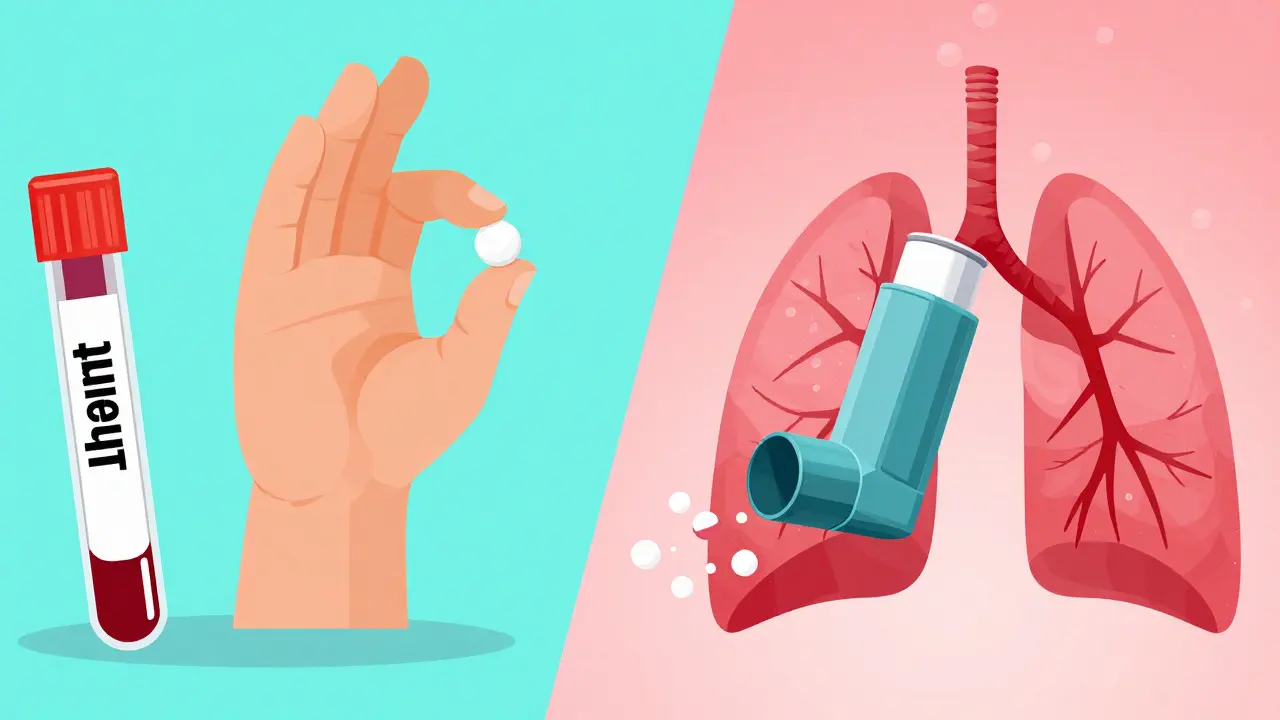
Did you know that while 90% of US prescriptions are filled with generic drugs, complex generics-like inhalers, creams, and injectables-make up less than 15% of approved products? That’s because proving they work exactly like the brand-name version is incredibly difficult. These products aren’t like simple pills; they’re intricate formulations that require specialized testing methods to ensure safety and effectiveness. Let’s break down why.
What exactly are complex generics?
Complex generic formulations are medications with structures or delivery methods too complicated for standard testing. The FDA defines them as products with "complexity or uncertainty regarding the approval pathway." This includes five types: drugs with tricky active ingredients (like peptides or natural compounds), complex formulations (such as liposomes or colloids), delivery systems for local action (like skin creams or eye drops), advanced dosage forms (extended-release injectables or inhalers), and drug-device combinations (like inhalers needing precise dosing).
For example, a topical cream for eczema must penetrate the skin correctly. But measuring blood levels won’t tell you how much drug actually reaches the skin. Similarly, an asthma inhaler must deliver particles of a specific size deep into the lungs. If the particles are too big or too small, the drug won’t work right. These nuances make standard bioequivalence tests inadequate.
The core challenge: bioequivalence testing
Bioequivalence means the generic drug delivers the same amount of medicine at the same rate as the brand. For simple pills, this is done by measuring blood levels. But for complex products, this approach fails. The FDA states that for drugs acting locally (like skin or lung treatments), measuring blood concentration is irrelevant. Instead, you need to test how the drug behaves at the site of action-which is technically challenging.
Take a metered dose inhaler for asthma. The drug must reach deep into the lungs, but standard blood tests can’t capture this. Manufacturers must measure particle size, spray pattern, and how the drug deposits in the lungs. However, there’s no universal method to do this. The FDA notes that "demonstrating bioequivalence for complex drugs is not always straightforward and efficient," especially when direct measurement isn’t possible.

Technical hurdles in manufacturing
Manufacturing complexity is a major issue. Even small changes in ingredients or processes can alter the drug’s performance. A 2020 survey found that 89% of generic manufacturers cite bioequivalence testing as their top challenge. Stability is another problem-factors like heat or humidity can degrade the product. For instance, a topical cream might separate if not formulated correctly, affecting how it penetrates the skin.
Characterizing complex formulations is tough too. Products with over 10 ingredients are hard to analyze. A single change in an excipient (inactive ingredient) can change the drug’s behavior. This is why generic developers often need to reverse-engineer the brand product, which is like "a chef trying to replicate a secret recipe without the ingredients list." A 2024 study showed that temperature changes during manufacturing can cause oxidation in peptide-based drugs, leading to 15% potency loss. This means even minor storage issues can render a batch unusable.
Regulatory differences across regions
Regulatory agencies have different standards. The FDA and the U.S. Food and Drug Administration, which oversees drug approvals in the United States and EMA (European Medicines Agency) require different testing methods for the same product. For example, a topical corticosteroid might need one type of study in the US and another in Europe. This creates duplication costs and delays. A 2016 study showed that these differences force manufacturers to conduct extra trials, adding 18-24 months to development time.
Companies developing drug-device combinations face this especially hard. A single inhaler might need separate validation for particle size in the US and for spray duration in Europe. This inconsistency means manufacturers spend more time and money to get approval in multiple regions.

Solutions and future outlook
The FDA is working on new tools to address these challenges. They’ve published 15 guidance documents since 2022 for specific complex products like inhalers and topical steroids. One promising approach is physiologically-based pharmacokinetic (PBPK) modeling a computer simulation technique that predicts how drugs behave in the body. Research shows PBPK could reduce clinical trials by 40-60% for certain complex drugs.
Industry groups like the Center for Research on Complex Generics (CRCG) are developing standardized testing methods. For liposomal formulations and nanosuspensions, 12 new protocols were published in 2022-2023. Early engagement with regulators has increased approval rates by 35% for companies that participate in the FDA’s Complex Generic Drug Product program. Market analysis indicates that complex generics represent a $120 billion opportunity in the US alone, with about 400 complex drugs currently lacking generic alternatives.
Frequently Asked Questions
What makes a generic drug 'complex'?
Complex generics include medications with intricate structures or delivery methods that can’t be easily tested with standard methods. Examples are inhalers, topical creams, injectables, and drug-device combinations. Unlike simple pills, these products require specialized testing to prove they work like the brand-name drug.
Why can’t we use blood tests for all generics?
For drugs that act locally (like skin creams or inhalers), measuring blood levels doesn’t tell you how much drug reaches the target site. For instance, a topical cream for eczema works on the skin, so blood tests are irrelevant. Instead, manufacturers must use methods like skin penetration studies or in vitro models to assess effectiveness.
How do regulators handle complex generics differently?
Regulatory agencies like the FDA and EMA have varying requirements. A product may need one type of study in the US and another in Europe. This creates duplication, forcing manufacturers to run extra tests. However, efforts are underway to harmonize standards, with the International Council for Harmonisation (ICH) working on new guidelines expected by 2024.
What’s the biggest challenge for manufacturers?
The top challenge is developing reliable testing methods. A 2020 survey found 89% of generic manufacturers cite bioequivalence testing as their main hurdle. This includes characterizing complex formulations, ensuring stability, and meeting varying regulatory standards across regions.
Are there new solutions in development?
Yes. The FDA is investing in tools like PBPK modeling and advanced imaging for skin penetration. Industry-academic partnerships are creating standardized protocols for liposomal and nanosuspension products. These innovations aim to cut development time by 25-30% over the next five years.
Comments
anjar maike
This is fascinating! 😍
On February 5, 2026 AT 05:24
Samantha Beye
This is a well-explained piece. It's good to see the challenges laid out clearly. Maybe we need more public awareness on this issue.
On February 7, 2026 AT 02:08
Andre Shaw
This whole 'complex generics' thing is a red herring. The FDA's got this on lock. Anybody who says it's hard is just trying to justify their own incompetence.
On February 8, 2026 AT 22:45
Lisa Scott
You're clearly clueless. The FDA's own reports say it's a nightmare. It's not straightforward. You're just parroting pharma propaganda. They don't want generics because they control the market. It's all about profits. They're hiding data. The system is rigged.
On February 10, 2026 AT 06:30
Joyce cuypers
This is super interesting! I had no idea about the regulatory differences. But I think we need more transparancy in the process. Also, the FDA's guidances are a step in the right direction but still too slow.
On February 11, 2026 AT 05:54
Kieran Griffiths
Yes, transparency is key. But also, the FDA has been working on new guidelines. They published 15 guidance docs since 2022. It's a slow process but progress is happening. We should support these efforts.
On February 13, 2026 AT 02:23
Carol Woulfe
This whole 'complex generics' thing is a scam. Big Pharma and the FDA are colluding to keep generics off the market. They don't want competition. I've seen reports that they're hiding data to block generics. It's all about profits. The FDA's 'guidance documents' are just window dressing. They're not actually helping. The system is rigged. Every time a generic company tries to get approval, they're met with endless hurdles. It's not about science-it's about money. The FDA has a conflict of interest because they rely on pharma fees. They're not protecting patients, they're protecting profits. This is why drug prices are so high. The public needs to wake up. This isn't a technical problem; it's a corruption problem. The FDA is part of the problem, not the solution. We need real reform, not more 'guidance'.
On February 13, 2026 AT 05:42
Elliot Alejo
I don't think it's a conspiracy. The challenges are real. The science is just hard. For example, inhalers need precise particle sizes. It's not about hiding data but about technical hurdles. We need better testing methods.
On February 14, 2026 AT 12:43
Pamela Power
Your 'science is hard' argument is simplistic. The real issue is regulatory capture. The FDA is too cozy with pharma companies. They don't have the expertise to evaluate these complex drugs properly. The whole approval process is a joke. They rely on outdated methods that don't account for modern formulations. The FDA's own studies show inconsistent results. They're not equipped to handle the science behind liposomes and nanosuspensions. This is why so many generics fail. It's not the manufacturers' fault-it's the regulators. They need to admit their incompetence and overhaul the system. Until then, patients are at risk. The FDA is failing us all. This isn't about science-it's about politics. They're more concerned with pleasing pharma than with public health. The truth is, the FDA is broken. We need a complete overhaul of the regulatory framework. Otherwise, we'll keep seeing these delays and shortages.
On February 15, 2026 AT 03:35
Gregory Rodriguez
Man, this whole thing is a headache. But hey, maybe we'll get it sorted. The FDA's PBPK modeling sounds promising. Or not. Who knows? Probably another bureaucratic mess. But hey, at least they're trying. Right? Maybe.
On February 16, 2026 AT 19:11
Kate Gile
I agree. The new protocols for liposomal products are a step in the right direction. Hopefully, this will speed things up. Collaboration between industry and regulators is key.
On February 18, 2026 AT 07:45