
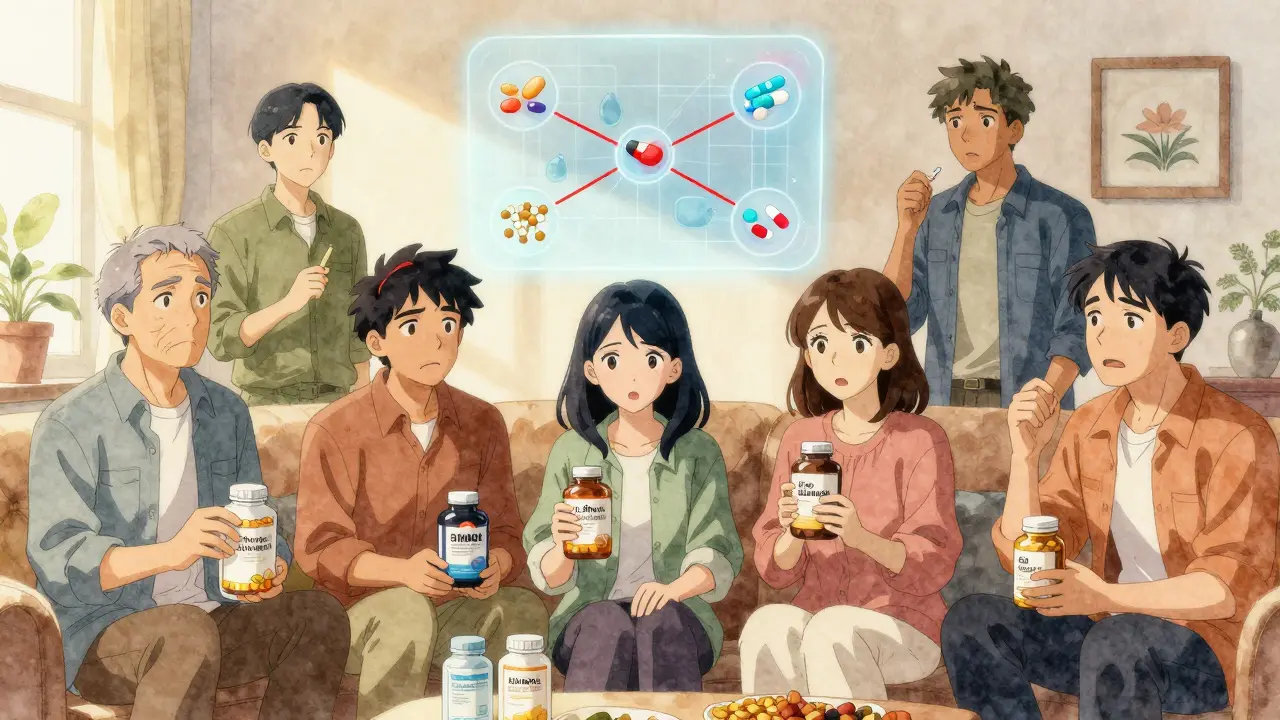
Supplement-Drug Interaction Checker
This tool helps identify potential interactions between supplements and medications. Remember: This is not medical advice. Always consult your healthcare provider for personalized guidance.
More than 77% of American adults take dietary supplements. Vitamins, herbs, fish oil, probiotics, glucosamine - you name it. Many people think these are harmless because they’re "natural." But here’s the problem: your doctor doesn’t always know you’re taking them. And that’s not just an oversight - it’s a silent risk.
Why Your Doctor Needs to Know What You’re Taking
Supplements aren’t regulated like prescription drugs. Under the Dietary Supplement Health and Education Act (DSHEA) of 1994, companies can sell anything labeled as a supplement without proving it’s safe or effective. The FDA can’t block a product before it hits the shelf. They only step in after someone gets hurt. That means a supplement you bought at the grocery store or online might contain hidden ingredients - like prescription drugs, stimulants, or contaminants. In 2022, the FDA received over 16,900 reports of adverse events linked to supplements. Experts believe less than 1% of actual incidents are reported. That’s a massive blind spot. And here’s the real danger: supplements can interact with your medications. St. John’s wort, for example, reduces the effectiveness of 57% of prescription drugs - including birth control, antidepressants, blood thinners, and even chemotherapy. One patient in a 2022 AMA Journal of Ethics case study ended up with dangerous bleeding after taking ginkgo biloba with warfarin. She didn’t think her doctor needed to know about "natural" stuff. She was wrong.The Disclosure Gap Is Real - And Dangerous
Only 33% of people who take herbal or dietary supplements tell their conventional healthcare provider. That’s according to a 2019 study in the Journal of Family Medicine and Disease Prevention. Even worse, among people with chronic conditions like diabetes or high blood pressure - the ones most at risk for interactions - disclosure rates are just 51%. Why? Many patients assume their doctor doesn’t care. Others fear being judged. Some think supplements are too "minor" to mention. But providers rarely ask. A 2018 study found that when doctors simply asked, “What supplements are you taking?”, only 29% of patients disclosed use. When they asked specifically, “What supplements or vitamins are you taking that your pharmacist might not know about?”, disclosure jumped to 72%. The most commonly used supplements with the lowest disclosure rates? St. John’s wort (8.4%), Ginkgo biloba (12.7%), ginseng (15.2%), echinacea (18.9%), and garlic (10.9%). These aren’t fringe products - they’re on every pharmacy shelf.What Happens When You Don’t Tell Your Doctor
Imagine you’re on blood pressure medication. You start taking garlic supplements because you read they’re good for heart health. Garlic can thin your blood. Combined with your prescription, it could drop your pressure too low - leading to dizziness, fainting, or worse. Or you’re on antidepressants and begin taking 5-HTP or St. John’s wort to boost your mood. Both increase serotonin. Too much serotonin can trigger serotonin syndrome - a life-threatening condition with symptoms like rapid heart rate, high fever, seizures, and confusion. Even something as simple as vitamin K can interfere with warfarin, making your blood clot dangerously or not enough. Calcium supplements can block absorption of thyroid medication. Iron can make antibiotics useless. These aren’t hypotheticals. They’re documented cases. The FDA reports 23,000 emergency department visits every year linked to dietary supplements. Most of these could have been avoided with one simple conversation.
How to Talk to Your Care Team - Without Feeling Judged
You don’t need to wait for your doctor to ask. Bring it up. Here’s how:- Start with: “I’ve been taking a few supplements to help with [sleep, energy, joint pain, etc.]. I want to make sure they’re safe with my other meds.”
- Be specific. Don’t say “I take fish oil.” Say “I take 1,000 mg of omega-3 fish oil daily from Nordic Naturals.”
- Bring the bottle. Or take a photo of the Supplement Facts label on your phone.
- Include everything: vitamins, herbs, teas, powders, tinctures, even CBD or melatonin.
- Don’t apologize. You’re not being weird - you’re being smart.
What Your Provider Should Be Doing
The American Medical Association recommends that every healthcare provider screen for supplement use during every visit - not just once a year. That means adding a simple question to intake forms and electronic health records. At Mayo Clinic, they implemented a three-step protocol:- Ask open-ended questions during intake: “What supplements or natural products are you using to manage your health?”
- Document them like prescriptions - name, dose, frequency, reason.
- Use tools like the Natural Medicine Database to check for interactions.
What to Bring to Your Next Appointment
You don’t need to memorize everything. Just prepare a quick list:- Product name (exact brand if possible)
- Dosage (e.g., 500 mg, 2 capsules daily)
- Why you take it (e.g., “for joint pain,” “to help me sleep”)
- How long you’ve been taking it
- Where you bought it (store, website, etc.)
What You Should Never Assume
- “Natural” doesn’t mean safe. Poison ivy is natural. Arsenic is natural. - “I’ve been taking this for years” doesn’t mean it’s harmless. Side effects can build up over time. - “My friend takes it and feels great” isn’t evidence. Everyone’s body reacts differently. - “My pharmacist didn’t say anything” doesn’t mean it’s okay. Pharmacists don’t always know what you’re taking unless you tell them. And please - don’t stop your prescribed medication because you started a supplement. That’s how people end up in the ER.The Bigger Picture: Why This Matters Beyond You
This isn’t just about your health. It’s about the whole system. When patients don’t disclose supplement use, doctors can’t make informed decisions. That leads to misdiagnoses, unnecessary tests, and dangerous drug interactions. Dr. Pieter Cohen of Harvard Medical School calls this “one of the most significant yet underrecognized patient safety issues in modern medicine.” The FDA’s Susan Mayne calls it “the silent epidemic of our healthcare system.” The good news? You can change this. By speaking up, you’re not just protecting yourself - you’re helping your provider do their job better. You’re pushing the system to take supplements seriously.What to Do Next
- Check your cabinet. Write down every supplement you take - even if you think it’s insignificant. - Bring it to your next appointment. Don’t wait for them to ask. Take the lead. - Ask your provider: “Is there any reason I shouldn’t be taking this with my other meds?” - Use free resources. The National Center for Complementary and Integrative Health offers free online courses for patients and providers on supplement safety. This isn’t about being perfect. It’s about being honest. You don’t have to be an expert. You just have to speak up.Do I need to tell my doctor about vitamins and fish oil?
Yes. Even common supplements like vitamin D, calcium, or fish oil can interact with medications. For example, vitamin K can reduce the effectiveness of blood thinners like warfarin. Fish oil can increase bleeding risk when combined with aspirin or NSAIDs. Your doctor needs the full picture to keep you safe.
What if my doctor says supplements are useless?
That’s their opinion - not your safety net. You can say, “I understand you may not recommend them, but I’m taking them and I want to make sure they’re not interfering with my prescriptions.” Focus on drug interactions, not whether the supplement works. That’s the part that matters for your health.
Are online supplements safe?
Many are not. A 2022 FDA analysis found that 80% of weight-loss and bodybuilding supplements sold online contained hidden, unapproved drugs. Even supplements marketed as “organic” or “clean” can be contaminated with heavy metals or pesticides. Always check for third-party testing seals (USP, NSF, ConsumerLab) and avoid products with vague labels like “proprietary blend.”
Should I stop taking supplements before surgery?
Yes - and tell your surgeon. Supplements like garlic, ginkgo, ginseng, and fish oil can increase bleeding risk. Others, like St. John’s wort, can interfere with anesthesia. Most surgeons recommend stopping all supplements at least 7-14 days before surgery. Don’t assume they know what you’re taking - tell them.
Can I trust my pharmacist for supplement advice?
Pharmacists are trained to check for drug interactions, but they only know what you tell them. If you don’t mention a supplement, they can’t warn you. Always give your pharmacist a complete list - including over-the-counter products, herbs, and vitamins. Ask: “Could this interact with any of my prescriptions?”
Is it safe to take supplements while pregnant or breastfeeding?
Some are, but many aren’t. Folic acid and prenatal vitamins are generally safe and recommended. But other herbs like black cohosh, dong quai, or high-dose vitamin A can be harmful. Always talk to your OB-GYN before taking anything - even if it’s labeled “natural.”
Comments
Paul Barnes
Look, I take fish oil, vitamin D, and magnesium daily. My doctor never asked, and I never volunteered it-until I read this. Now I’m bringing the bottle to my next appointment. Not because I’m scared, but because I’m tired of being treated like a dumbass who doesn’t know what’s in his own cabinet.
On January 20, 2026 AT 14:13
Jacob Cathro
bro. i just took some 'natural' energy gummies from gnc and 2 hours later my heart felt like it was trying to escape my chest. turns out they had hidden caffeine + synephrine. FDA didn't ban it. my doc didn't ask. i didn't know to tell. now i'm paranoid af. also, why do we let companies label poison as 'wellness'??
On January 21, 2026 AT 21:34
thomas wall
It is nothing short of irresponsible that the regulatory framework governing dietary supplements remains so egregiously permissive. The public is systematically misled by the semantic sleight-of-hand that equates 'natural' with 'safe.' This is not merely a gap in patient disclosure-it is a systemic failure of medical education, pharmaceutical oversight, and consumer literacy. One must ask: when did we decide that profit margins should outweigh physiological integrity?
On January 22, 2026 AT 05:04
Shane McGriff
I’ve been a nurse for 15 years. I’ve seen people come in with liver failure from 'herbal detox teas,' strokes from ginkgo with aspirin, and seizures from St. John’s wort mixed with SSRIs. And every single time, they say, 'I didn’t think it mattered.' It matters. So much. Bring your bottles. Take a photo. Write it down. Don’t wait for them to ask. You’re not being annoying-you’re saving your own life. And if your doc rolls their eyes? Find a new one. Your health isn’t optional.
On January 22, 2026 AT 17:53
Edith Brederode
OMG YES 🙌 I just told my PCP about my turmeric and ashwagandha last week and she actually pulled up the interaction checker on her screen! We laughed about how weird it is that we know more about our supplements than they do 😅 Thank you for this post-made me feel less guilty for being 'that person' with the supplement list 😊
On January 24, 2026 AT 07:04
Arlene Mathison
My mom took garlic pills for 'heart health' while on blood thinners. She passed out at the grocery store. Turned out her INR was through the roof. She didn’t think it was a big deal because 'it’s just garlic.' Now she carries a card in her wallet that says: 'I take X supplements. Ask me.' I made her do it. Don’t wait for a tragedy to start the conversation. Just do it. Now.
On January 25, 2026 AT 01:36
Emily Leigh
Okay but… who even decided 'natural' = safe? Like, poison ivy is natural. So is radiation. So is the plague. Why are we still letting marketers use this word like it’s a magic shield? And why does no one ever ask: if supplements were so great, why don’t drug companies make them? Because they can’t patent a berry. 💀
On January 25, 2026 AT 22:00
Renee Stringer
I find it deeply troubling that patients are expected to be their own pharmacists. If the system is so broken that we need to memorize ingredient lists and photograph supplement labels just to avoid being poisoned, then the fault lies not with us-but with the institutions that have abdicated their duty to protect public health. I will not apologize for demanding safety.
On January 26, 2026 AT 21:29