

DOAC Medication Interaction Checker
This tool helps you identify potential interactions between your DOAC and other medications. Always consult your doctor or pharmacist before making any medication changes.
- 1 Select your DOAC medication
- 2 Select any other medications you're taking
- 3 View interaction results with safety recommendations
When you're on a blood thinner like apixaban, rivaroxaban, or dabigatran, even a common painkiller or heart medication can change how your anticoagulant works-sometimes with dangerous results. These drugs, known as DOACs (Direct Oral Anticoagulants), were designed to be simpler than warfarin. No weekly blood tests. Fewer food restrictions. But that doesn't mean they're safe to take with anything. In fact, DOAC interactions are one of the most overlooked risks in modern anticoagulation therapy.
Why DOAC Interactions Matter More Than You Think
Most people on DOACs are older and managing multiple health problems. It’s common to be on five or more other medications-statins, blood pressure pills, anti-inflammatories, antidepressants. Each one adds a layer of risk. A 2020 review by the American College of Cardiology found that nearly all DOAC patients take other drugs, and many of those combinations can spike bleeding risk or make the blood thinner useless.
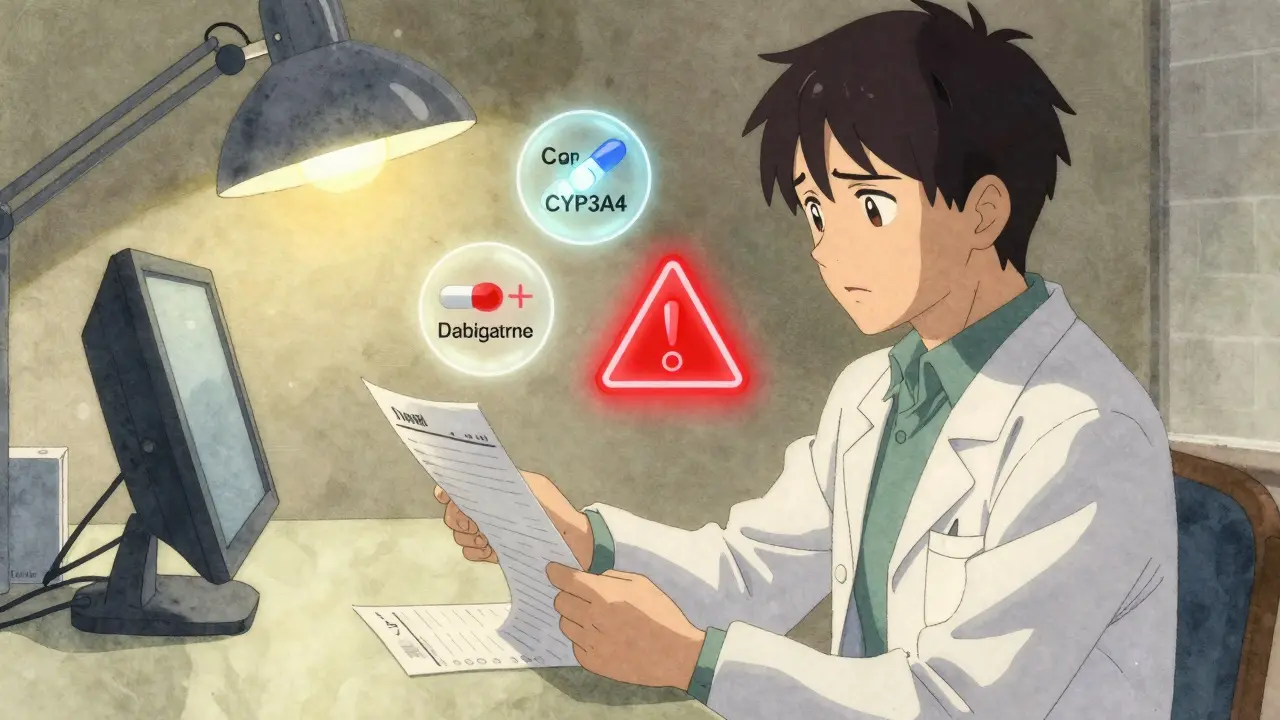
Unlike warfarin, which reacts with vitamin K and dozens of drugs, DOACs have fewer interactions-but the ones they do have are powerful. They’re cleared from your body through two main pathways: the liver enzyme CYP3A4 and the gut transporter P-gp. If another drug blocks or speeds up either of these, your DOAC levels can jump or crash. Too high? Risk of internal bleeding. Too low? Risk of stroke or clot.
Which DOACs Are Most Affected?
Not all DOACs are the same. Their interaction profiles vary significantly:
- Apixaban: About 20-25% metabolized by CYP3A4. P-gp is its main route out. Sensitive to strong inhibitors.
- Rivaroxaban: Half of it goes through CYP3A4. Also heavily reliant on P-gp. Higher risk of interaction than apixaban.
- Dabigatran: Almost entirely cleared by P-gp. Very sensitive to drugs that block this transporter.
- Edoxaban: Similar to apixaban but slightly more affected by P-gp inhibitors.
- Betrixaban: Rarely used now, but follows the same rules as the others.
That’s why mixing dabigatran with dronedarone (a heart rhythm drug) is a bad idea-it can raise dabigatran levels by over 200%. Rivaroxaban with dronedarone? Same problem. That’s why guidelines say: don’t combine them.
Top Medications That Interfere with DOACs
Here are the real-world offenders you need to watch for:
- Dronedarone (Multaq): Strongly blocks P-gp. Avoid with dabigatran and rivaroxaban. If you’re on edoxaban, cut the dose to 30 mg daily.
- Amiodarone (Cordarone): Moderately blocks P-gp. Can raise DOAC levels. Monitor for bruising, dark stools, or dizziness.
- Diltiazem and Verapamil (Calcium channel blockers): Diltiazem weakly blocks CYP3A4 and P-gp. Verapamil mainly hits P-gp. For dabigatran users, reduce the dose to 110 mg twice daily. Apixaban and rivaroxaban are less affected-but still check for bleeding.
- Itraconazole, ketoconazole, clarithromycin: Strong CYP3A4 and P-gp blockers. Avoid entirely if possible.
- Carbamazepine, phenytoin, rifampin: These are strong inducers. They speed up DOAC clearance. Your blood thinner becomes less effective. This can lead to clots.
Even over-the-counter stuff can cause trouble. St. John’s wort, a popular herbal remedy for depression, is a strong inducer. It can slash DOAC levels by 50%. Many patients don’t tell their doctors they’re taking it.
Other Risks: NSAIDs, SSRIs, and Antiplatelets
Some drugs don’t change DOAC levels-but still increase bleeding risk. They work differently, but the result is the same: more bruising, more bleeding.
- NSAIDs (ibuprofen, naproxen): These irritate the stomach lining and thin platelets. Combining them with DOACs doubles the risk of stomach bleeding. Use acetaminophen instead for pain.
- SSRIs (sertraline, fluoxetine): These affect platelet function. Studies show a 30-50% higher bleeding risk when taken with DOACs.
- Aspirin and clopidogrel: Used after heart attacks or stents. When combined with DOACs, bleeding risk jumps sharply. Only use if your doctor says it’s essential.
There’s no magic rule here. It’s about balance. If you have a stent and atrial fibrillation, your doctor might accept the higher bleeding risk. But if you’re just on DOAC for AFib and take ibuprofen for arthritis? That’s not worth it.
Dosing Isn’t One-Size-Fits-All
DOACs aren’t given the same dose for every condition. Rivaroxaban 20 mg once daily is for stroke prevention in AFib. But 2.5 mg twice daily is for preventing heart attacks after a prior event. These different doses have different blood levels. So, a drug interaction that’s safe at one dose might be dangerous at another.
Same with dabigatran: 150 mg twice daily is standard for AFib. But if you’re also on verapamil, you drop to 110 mg. Why? Because verapamil pushes dabigatran levels higher. Reduce the dose to stay in the safe zone.
Renal function matters too. If your kidneys aren’t working well, your DOAC builds up. Add a P-gp blocker? That’s a recipe for bleeding. Always check kidney function before starting or changing a DOAC, especially if you’re on another interacting drug.

What Should You Do?
Here’s your action plan:
- Make a full list of every medication, supplement, and herb you take. Include vitamins, CBD, turmeric, garlic pills.
- Bring it to every appointment-with your cardiologist, GP, and pharmacist. Don’t assume they know what you’re on.
- Ask specifically: “Is this safe with my blood thinner?” Don’t rely on general advice.
- Know your signs of bleeding: Unusual bruising, pink or red urine, black stools, headaches, dizziness, vomiting blood.
- Never stop or change your DOAC without talking to your doctor. Even if you feel fine.
Many patients think, “I’m on a newer drug, so it’s safer.” That’s the trap. DOACs are more predictable-but less forgiving when something interferes. One missed interaction can lead to a stroke, a bleed, or death.
The Bottom Line
DOACs are better than warfarin in many ways-but they’re not magic. Their safety depends on you being informed and your care team being vigilant. Polypharmacy is the norm, not the exception. That means every prescription, every supplement, every OTC pill needs to be checked against your anticoagulant.
There’s no substitute for a pharmacist reviewing your full list. Ask for a medication reconciliation. If your doctor doesn’t offer it, ask for it. The risk isn’t theoretical. It’s happening right now-to people just like you.
Don’t assume your DOAC is safe just because it doesn’t need blood tests. The real test is whether you’re taking the right combination of drugs-and whether you’ve asked the right questions.
Can I take ibuprofen with a DOAC?
It’s not recommended. Ibuprofen and other NSAIDs increase stomach bleeding risk when combined with DOACs. Use acetaminophen (paracetamol) for pain instead. If you need long-term NSAIDs for arthritis or other conditions, talk to your doctor about alternatives like physical therapy or safer pain medications.
Is St. John’s wort safe with DOACs?
No. St. John’s wort strongly speeds up the breakdown of DOACs through CYP3A4 and P-gp. This can reduce your blood thinner’s effectiveness by up to 50%, raising your risk of stroke or clot. Avoid it completely. If you’re using it for depression, ask your doctor about safer antidepressants like sertraline or citalopram.
Do I need blood tests to check my DOAC levels?
Routine blood tests aren’t needed for DOACs like they are for warfarin. But in cases of suspected interaction, kidney failure, overdose, or emergency surgery, a specialized test called anti-Xa or ecarin clotting time can measure DOAC levels. These aren’t available everywhere, but they’re used in hospitals when there’s a safety concern.
What should I do if I start a new medication while on a DOAC?
Stop taking the new drug and contact your doctor or pharmacist immediately. Don’t wait for side effects. Even if the new medicine seems harmless-like an antibiotic or allergy pill-it could interact with your DOAC. Always check before starting anything new, including supplements.
Are DOACs safer than warfarin for older adults?
Yes, overall. DOACs have a lower risk of brain bleeding and don’t require frequent blood tests. But older adults often take multiple medications and have reduced kidney function, which increases interaction risks. So while DOACs are safer on average, they demand more careful management in this group. Always review all medications with a pharmacist.
Comments
Angela Fisher
So let me get this straight… the pharmaceutical companies made these ‘new and improved’ blood thinners so they could stop doing those pesky blood tests and charge us more? 😏 And now we’re supposed to trust them when they say ‘it’s safer’? HA! I’ve seen the docs get paid by the drug reps-every single one of them. They don’t care if you bleed out as long as your insurance keeps paying for the $800 pill. 🤡 And don’t even get me started on St. John’s Wort… they banned it in Europe but here? You can buy it next to the gummy vitamins. They want us dumb. They WANT us to mix it all up. 💊💀
On January 4, 2026 AT 13:22
Shruti Badhwar
While the article provides a clinically accurate overview of DOAC interactions, it lacks emphasis on the critical role of pharmacist-led medication reconciliation. In India, where polypharmacy is rampant among elderly patients with comorbidities, a structured review by a clinical pharmacist reduces adverse events by up to 47% according to a 2022 study in the Indian Journal of Pharmacology. Every patient on anticoagulants should have mandatory quarterly medication reviews-not just when they’re symptomatic. This is not optional; it is standard of care.
On January 5, 2026 AT 16:48
Ian Ring
Okay, I’ve read this three times… and I’m still not sure if I’m supposed to be terrified or just… cautious? 😅 I take apixaban for AFib, and my doc just added diltiazem for blood pressure. Is that a no-go? I didn’t realize my heart meds were playing musical chairs with my blood thinner. I’ll call my pharmacist tomorrow-seriously, why do we have to be our own drug detectives? I pay taxes for this stuff… right? 🤔
On January 6, 2026 AT 17:54
erica yabut
Oh, sweet merciful Jesus. Another ‘educational’ piece from the medical-industrial complex trying to make us feel smart while quietly lining their pockets. DOACs? Please. They’re just warfarin with a PR team and a higher price tag. And let’s not pretend NSAIDs are the villains here-when your doctor prescribes you a cocktail of statins, SSRIs, and calcium channel blockers while you’re on a DOAC, you’re not ‘at risk’-you’re being experimented on. And St. John’s Wort? The only thing more dangerous than the herb is the doctor who didn’t ask if you were taking it. 🧠🩸
On January 8, 2026 AT 13:47
Tru Vista
DOACs + NSAIDs = bad. St. John’s wort = bad. Dronedarone = bad. But no one talks about how 70% of pts on DOACs are over 70 and on 6+ meds. The real issue? Systemic neglect. Doc has 8 mins. Pharmacist doesn’t have access to med list. Patient forgets 3 pills. Boom. Bleed. 🤦♀️
On January 8, 2026 AT 18:23
Vincent Sunio
It is regrettably common to observe laypersons mischaracterizing pharmacokinetic interactions as mere ‘risks,’ when in fact they represent clinically significant, dose-dependent, and often predictable alterations in drug exposure. The notion that DOACs are ‘safer’ than warfarin is a reductive marketing construct; their narrow therapeutic window, coupled with variable renal clearance and transporter inhibition, renders them more susceptible to catastrophic outcomes in polypharmacy. The onus, therefore, lies not on the patient to memorize drug lists-but on the prescriber to perform comprehensive pharmacodynamic mapping. Failure to do so constitutes substandard care.
On January 8, 2026 AT 21:25
JUNE OHM
THEY’RE LYING TO US!! 😡 I’ve been on rivaroxaban for 3 years. My doc said ‘no blood tests needed’-so I stopped going to the clinic. Now I see this? I’ve been taking turmeric capsules ‘for inflammation’ since 2021… are they trying to kill me?? 🇺🇸🇺🇸🇺🇸 I’m calling my senator. This is a COVER-UP. Big Pharma + Big Doctor = THEY WANT US DEAD. 🚨💊 #DOACscam #StopTheLies
On January 10, 2026 AT 12:12
Philip Leth
Man, I’m a nurse in Texas, and I’ve seen this play out so many times. Grandmas on 12 meds, taking ibuprofen for their knees, and never telling anyone. One guy bled into his gut from a combo of apixaban + naproxen + fish oil. He didn’t even know fish oil thins blood. 😅 We need more community education-like, actual flyers at the grocery store. Not just ‘read this PDF’ stuff. Real talk. In Spanish, in ASL, in big fonts. People aren’t dumb-they’re just overwhelmed.
On January 12, 2026 AT 06:04
Angela Goree
So… let me get this straight-my doctor gave me a drug that’s ‘easier’ than warfarin… but now I have to become a pharmacologist just to not die? And if I take an Advil for my back? I’m a walking time bomb? And if I take St. John’s Wort for my anxiety? I’m gonna have a stroke? What kind of world are we living in where the safest option is the one that requires the most vigilance?? 😭
On January 12, 2026 AT 18:06
Shanahan Crowell
I love how this post ends with ‘ask your pharmacist.’ That’s the real MVP here. I used to think pharmacists just handed out pills. Now I know they’re the last line of defense. My mom’s on dabigatran + verapamil-her pharmacist caught the interaction before she even filled the script. Reduced her dose to 110 mg. Saved her life. Seriously-go thank your pharmacist today. They’re the unsung heroes of modern medicine. 🙌
On January 14, 2026 AT 10:27