
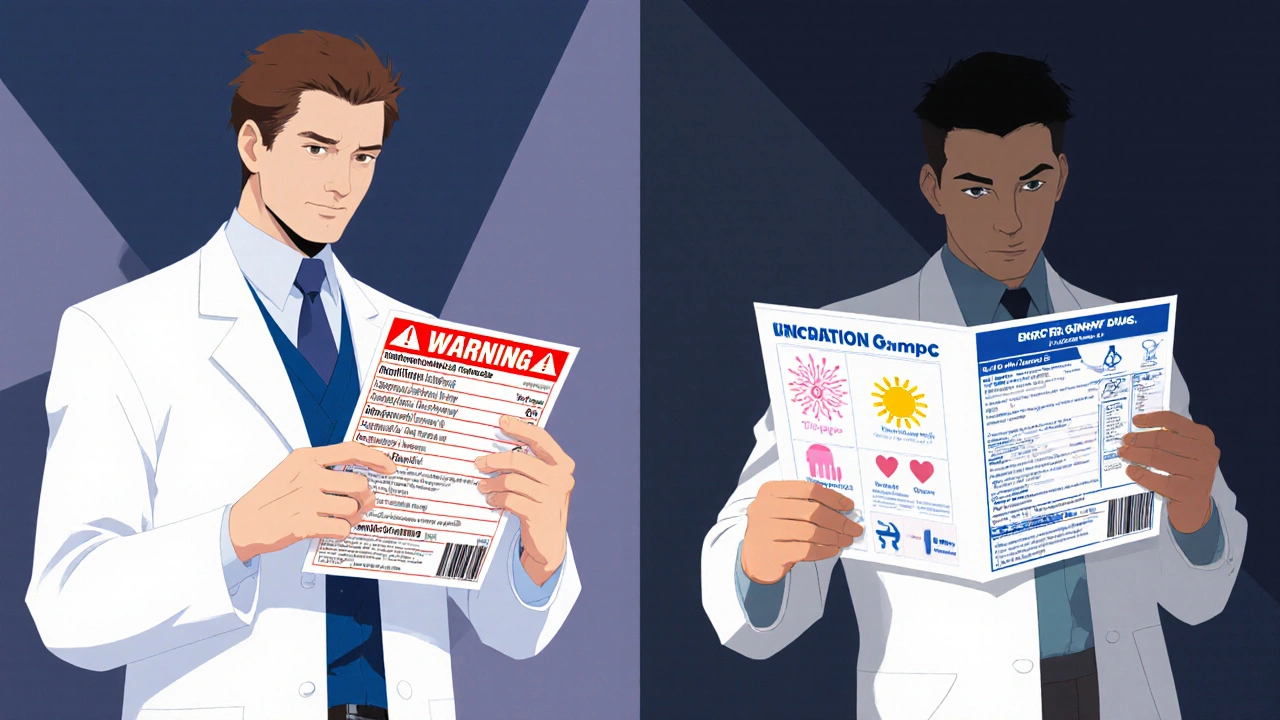
FDA vs EMA Drug Label Comparison Tool
Compare Labeling Differences
Select an aspect of drug labeling to compare how FDA and EMA approaches differ:
No comparison selected
Select a comparison category from the dropdown above to see differences between FDA and EMA labeling approaches.
When a new drug hits the market, the label isn’t just a piece of paper stuck to the box. It’s a legal document that tells doctors how to prescribe it, pharmacists how to dispense it, and patients how to use it safely. But if that same drug is sold in the U.S. and the EU, the labels can look wildly different-even when the drug is identical. This isn’t a mistake. It’s the result of two powerful regulatory systems with different rules, priorities, and philosophies: the U.S. Food and Drug Administration (FDA) and the European Medicines Agency (EMA).
Why the Labels Don’t Match
You might assume that since both agencies use the same clinical trial data, their labels would be nearly identical. But that’s not how it works. The FDA and EMA don’t just review data-they interpret it. And their interpretations often lead to different conclusions about what the data means for patients. For example, in a 2019 analysis of 21 drugs approved by both agencies, over half of the differences in approved uses came down to how each agency weighed the strength of the evidence. One drug might show modest benefit in a small trial. The EMA might say that’s enough for a narrow indication, especially if there’s no other option. The FDA might say the data isn’t strong enough to justify approval at all-or only approve it for a much smaller patient group. This isn’t about one agency being stricter. It’s about different standards for proof. The EMA is more willing to approve drugs under "exceptional circumstances," like for ultra-rare diseases where large trials aren’t possible. The FDA rarely does this. Instead, it often asks for more data upfront, even if that delays approval.What’s on the Label? The Big Differences
The labels themselves-called the Summary of Product Characteristics (SmPC) in the EU and Prescribing Information (PI) in the U.S.-contain the same basic sections: indications, dosing, side effects, warnings. But what’s included, and how it’s worded, varies a lot. Pregnancy and breastfeeding: The FDA tends to be more cautious. In one study, for two drugs with clear human data showing low risk, the FDA still warned against use during pregnancy. The EMA used a standard, less alarming phrase. That’s not because the EMA is less careful-it’s because it trusts doctors to use clinical judgment, while the FDA leans toward blanket warnings to avoid liability. Patient-reported outcomes: This is where the gap is widest. Between 2006 and 2010, 47% of drugs approved by both agencies had EMA labels that included claims about how patients felt-like improved energy, reduced pain, or better sleep. Only 19% had those same claims on FDA labels. The EMA accepts patient feedback as direct evidence of benefit. The FDA mostly wants hard clinical outcomes: survival rates, tumor shrinkage, hospital stays. Patient-reported results? Often seen as "soft." Vaccines: Even here, where you’d expect alignment, labels diverge. A 2020 study of 12 vaccines approved by both agencies found no trend toward harmonization over time. One vaccine might say "may cause fever" in the U.S. but "commonly causes fever" in the EU. The wording affects how doctors talk to parents-and how patients decide whether to vaccinate.Language and Logistics: A Hidden Burden
If you’re a pharmaceutical company trying to sell a drug in both markets, the paperwork alone is exhausting. The FDA only accepts submissions in English. The EMA? It requires every single document-label, patient leaflet, package insert-to be translated into all 24 official EU languages. That’s not just a translation cost. It’s a legal risk. One mistranslated word in a patient leaflet in Poland or Slovakia could lead to a compliance violation. Companies report that multilingual labeling adds 15-20% to development costs. It also slows down time-to-market. A drug approved in the U.S. in January might not be available in Germany until October because of the translation and review process. And it’s not just language. The format matters too. Both agencies use the eCTD (electronic Common Technical Document) system, but their technical specs differ. A file that passes FDA validation might get rejected by the EMA for a minor formatting issue. Regulatory teams spend weeks fixing these glitches.
Risk Management: REMS vs RMP
When a drug has serious risks-like liver damage or birth defects-the agencies don’t just warn about it. They impose controls. The FDA uses Risk Evaluation and Mitigation Strategies (REMS). These are strict. They can require:- Only one pharmacy to distribute the drug
- Doctors to complete special training before prescribing
- Patients to enroll in a registry and sign forms
Approval Speed and Post-Market Rules
The EMA approves drugs faster on average. In one study, 92% of EMA applications got approved on the first try. The FDA’s rate was 85%. Why? The FDA turns down more applications outright because it wants more complete data before approval. But here’s the catch: the EMA often approves with conditions. If a drug gets approved under exceptional circumstances, the company must keep collecting data after launch. That’s called a post-marketing commitment. The FDA usually wants that data before approval. So the EMA might give you a green light faster-but you’re locked into long-term studies. The FDA might make you wait longer to start selling-but once you’re approved, the post-market obligations are lighter.What This Means for Patients and Doctors
The real impact isn’t in the boardrooms. It’s in the clinic. A doctor in London might prescribe a drug for fatigue because the EMA label says it improves patient-reported energy. A doctor in New York might not, because the FDA label doesn’t mention it. A mother in France might be told her child can safely take a vaccine during pregnancy. A mother in Chicago might be told to avoid it. Patients traveling between the U.S. and Europe often get confused. They might bring their medication from home, only to find the label doesn’t match what their new doctor expects. Pharmacists can’t always explain why the dosing or warnings are different. Even clinical guidelines don’t always align. Some U.S. guidelines cite FDA labels. European ones cite EMA. That means two doctors, looking at the same trial data, could end up with two different treatment recommendations.
Are They Getting Closer?
Yes-and no. The FDA and EMA have made progress. They share confidential data through a 2020 confidentiality agreement. They hold joint scientific advice meetings-up 47% since 2018. The ICH guidelines help align trial designs across regions. But the core differences remain. The EMA is a network of 27 national agencies, each with its own cultural and legal context. The FDA is a single federal agency with a legal mandate to be cautious. The EU prioritizes access, especially for rare diseases. The U.S. prioritizes proof. Experts agree: full harmonization is unlikely. The gap is narrowing, but it’s not disappearing. Companies now spend 30% more time preparing dual submissions than single ones. And 65% of big pharma firms have dedicated teams just to track these differences.What Should You Do?
If you’re a patient: Always check the label that came with your medication. Don’t assume the U.S. and EU versions are the same. If you’re traveling, bring your original packaging and ask your doctor to review it. If you’re a healthcare provider: Be aware that international drug labels differ. Don’t assume a drug’s use in Europe applies to your U.S. patients-or vice versa. Check both labels if you’re treating someone with international exposure. If you’re in pharma: Build flexibility into your labeling strategy. Don’t just translate. Adapt. Understand that what works for the FDA might not satisfy the EMA-and vice versa. Invest in regulatory intelligence. It’s not optional anymore.Bottom Line
The EMA and FDA aren’t just two regulators. They’re two different ways of thinking about medicine, risk, and patient care. One favors speed and access. The other favors certainty and control. Neither is right or wrong. But if you don’t understand the difference, you risk misusing a drug, delaying its availability, or wasting millions in development costs. The labels may look similar at first glance. But beneath the surface, they tell very different stories.Why do EMA and FDA labels differ even when the drug is the same?
Because the agencies interpret clinical data differently. The EMA often accepts smaller studies or patient-reported outcomes as proof of benefit, while the FDA typically requires larger trials with hard clinical endpoints. They also have different legal frameworks: the EMA operates as a network of national agencies, and the FDA is a centralized federal body with a more cautious mandate.
Can a drug approved in the EU be prescribed in the U.S. based on the EMA label?
No. Only FDA-approved labels are legally recognized in the U.S. Even if a drug is sold in both regions, U.S. doctors must follow the FDA’s Prescribing Information. Using the EMA label as a guide could lead to off-label prescribing risks or legal liability.
Do EMA and FDA agree on vaccine labeling?
Not consistently. A 2020 study of 12 vaccines approved by both agencies found no pattern of alignment over time. Wording about side effects, dosing schedules, and contraindications often differs, even when based on the same data. This can confuse patients and providers across borders.
Why does the EMA require translations into 24 languages?
The EU is made up of 27 member states, each with its own official language. To ensure patient safety and legal compliance across all countries, the EMA requires that every drug label, patient leaflet, and packaging insert be available in all 24 official EU languages. This is not required by the FDA, which only needs English.
Which agency is stricter: EMA or FDA?
It depends. The FDA is stricter about requiring complete data before approval, leading to more initial rejections. The EMA is stricter about post-market obligations, often approving drugs with conditions that require ongoing data collection. Neither is universally stricter-they just enforce different standards.
How do these differences affect drug development costs?
Developing labels for both agencies increases costs by 30% on average. Companies must prepare separate documentation, translate into 24 languages for the EMA, and often generate additional data to meet each agency’s specific requirements. Multilingual labeling alone adds 15-20% to development budgets.
Is there a trend toward harmonization between EMA and FDA?
Yes, but slowly. Joint advice sessions have increased by 47% since 2018, and both agencies now share confidential data. However, fundamental differences in legal structure, risk tolerance, and approval philosophy mean full harmonization is unlikely. Experts predict a narrowing gap, not full alignment.
Comments
swatantra kumar
Wow, this is wild. So the EU lets patients say they feel better, and the FDA says ‘prove it with numbers’? 😅 Meanwhile, I’m over here trying to explain to my grandma why her blood pressure med looks different in Canada vs. India. We’re all just trying not to die, right?
On November 20, 2025 AT 23:07
Nick Naylor
Let’s be clear: the FDA doesn’t ‘delay’ approvals-it prevents reckless, underpowered trials from poisoning Americans. The EMA’s ‘exceptional circumstances’ loophole is a regulatory backdoor for junk science. If your trial has n=12 and you call it ‘life-saving,’ you’re not a scientist-you’re a marketer with a PowerPoint. The U.S. demands rigor. End of story.
On November 22, 2025 AT 11:28
Brianna Groleau
I just got back from a trip to Berlin, and my pharmacist there handed me a 40-page booklet about my antidepressant-with tiny print in German, French, and Dutch. Meanwhile, my U.S. prescription came with a sticky note that said ‘take once daily.’ I cried. Not because I’m dramatic-but because I realized: one system trusts doctors to think. The other trusts lawyers to write. Who’s really protecting patients?
On November 23, 2025 AT 18:47
Sarah Swiatek
It’s not about who’s ‘stricter.’ It’s about what kind of society you want. The EMA says: ‘We’ll let people try this, even if we’re not 100% sure-because waiting might kill them.’ The FDA says: ‘We’ll wait until we’re 99.9% sure-because one mistake could kill someone.’ One is compassionate pragmatism. The other is bureaucratic fear. Neither is evil. But if you’re a patient with a rare disease? You’re stuck in the middle of a philosophical war dressed up as regulation.
On November 25, 2025 AT 05:57
Dave Wooldridge
They’re hiding something. Why would the EMA allow ‘patient-reported outcomes’ as evidence? Because Big Pharma bribed them. The FDA’s ‘hard endpoints’ are the only real science. The EU’s ‘improved energy’ nonsense? That’s just placebo marketing with a fancy name. And don’t get me started on the 24 languages-that’s a Trojan horse for EU federal control. They’re not translating-they’re indoctrinating.
On November 25, 2025 AT 06:54
Rebecca Cosenza
Patients should never be guinea pigs for regulatory experiments. If your label says ‘may cause fever,’ and it actually causes seizures, who’s liable? The FDA’s caution isn’t red tape-it’s moral responsibility. 🚫
On November 25, 2025 AT 08:10
Cinkoon Marketing
Honestly? I think this whole thing is just a cost center for consultants. Why can’t they just use one format? It’s not like the data changes. Also, I saw a meme that said ‘EMA = European Medicines Agency, FDA = Fancy Drug Approval’ and I laughed too hard to care anymore.
On November 26, 2025 AT 23:07
robert cardy solano
My uncle’s on a drug that’s approved in the U.S. but not the EU. He’s been taking it for 8 years. His doctor in Florida says ‘keep going.’ His cousin in Spain says ‘stop immediately.’ No one’s wrong. No one’s right. Just… confused. And that’s the real tragedy.
On November 27, 2025 AT 05:26
Pawan Jamwal
USA has the best science. EMA is just copying because they can’t innovate. 24 languages? That’s not patient safety-that’s bureaucracy on steroids. India uses ONE language for meds and we don’t have a single death from labeling errors. Who’s really efficient? 🇮🇳💪
On November 27, 2025 AT 06:58
Bill Camp
The FDA is the only agency that matters. If you’re not FDA-approved, you’re not real medicine. The EMA’s ‘flexible’ RMPs? That’s just corporate laziness with a fancy acronym. And don’t get me started on the translations-why should I pay for 24 versions of the same warning? It’s a scam. The U.S. leads. The rest follow-or get left behind.
On November 27, 2025 AT 09:21
Lemmy Coco
i just read this whole thing and my brain hurts. why cant they just agree on one thing? like… the word ‘common’? and also i think the ema is kinda cool for letting people say how they feel but also the fda is right to be careful? idk. i’m just here for the meds. 🤷♂️
On November 28, 2025 AT 09:26
rob lafata
You think this is bad? Wait till you see how they handle off-label use. The FDA’s REMS? That’s not risk management-it’s corporate slavery. Imagine being forced to enroll in a registry just to get a drug your doctor says you need. Meanwhile, the EMA lets you walk into any pharmacy and pick it up like candy. One system protects profits. The other protects people. Guess which one the lobbyists love?
On November 30, 2025 AT 08:50
Matthew McCraney
They’re all in on it. The FDA, EMA, WHO-they’re all owned by Big Pharma. The ‘differences’? A distraction. They want you to think it’s about science. It’s not. It’s about control. The 24 languages? To confuse you. The patient-reported outcomes? To make you think you’re heard. The REMS? To track you. They’re not regulators. They’re surveillance tools with white coats.
On December 1, 2025 AT 21:54