
When Medications Stop Working, Surgery Becomes an Option
If you’ve been taking two or more anti-seizure medications for months or years and still have seizures, you’re not alone-and you’re not out of options. About 1 in 3 people with epilepsy don’t respond to drugs. This isn’t failure on your part. It’s a medical reality called drug-resistant epilepsy. The International League Against Epilepsy defines it clearly: if two well-chosen, properly dosed medications haven’t stopped your seizures, you’re in the drug-resistant group. And for many of these people, surgery isn’t a last resort-it’s the best chance for a real life change.
For decades, doctors waited two years after two failed medications before even considering surgery. Now, guidelines say: don’t wait. As soon as it’s clear drugs aren’t working, you should be referred to a specialized epilepsy center. The sooner you’re evaluated, the better your chances of becoming seizure-free-and the more likely you are to protect your brain from long-term damage caused by repeated seizures.
Who Is a Good Candidate for Epilepsy Surgery?
Not everyone with drug-resistant epilepsy is a candidate. Surgery works best when seizures start in one clear area of the brain, called a seizure focus. The most common type is mesial temporal lobe epilepsy with hippocampal sclerosis. In these cases, removing a small part of the temporal lobe can lead to seizure freedom in 65-70% of patients within two years.
To qualify, you need three things:
- You or your caregiver must understand what surgery involves and agree to the process.
- Your seizures must be disabling-frequent enough, severe enough, or disruptive enough to affect your job, school, driving, or relationships. Typically, that means at least one disabling seizure per month.
- Tests must show a clear, localized seizure origin that can be safely removed or disconnected.
For children, the triggers are even clearer: if they have tuberous sclerosis, infantile spasms, or Rasmussen’s encephalitis, surgery may be recommended right away-even if they’ve only tried one medication. These conditions rarely respond to drugs, and delaying surgery can hurt brain development.
But surgery won’t help if seizures come from many areas at once-like in generalized epilepsy. In those cases, less invasive options like neurostimulators (RNS or VNS) might be better.
The Evaluation Process: What to Expect Before Surgery
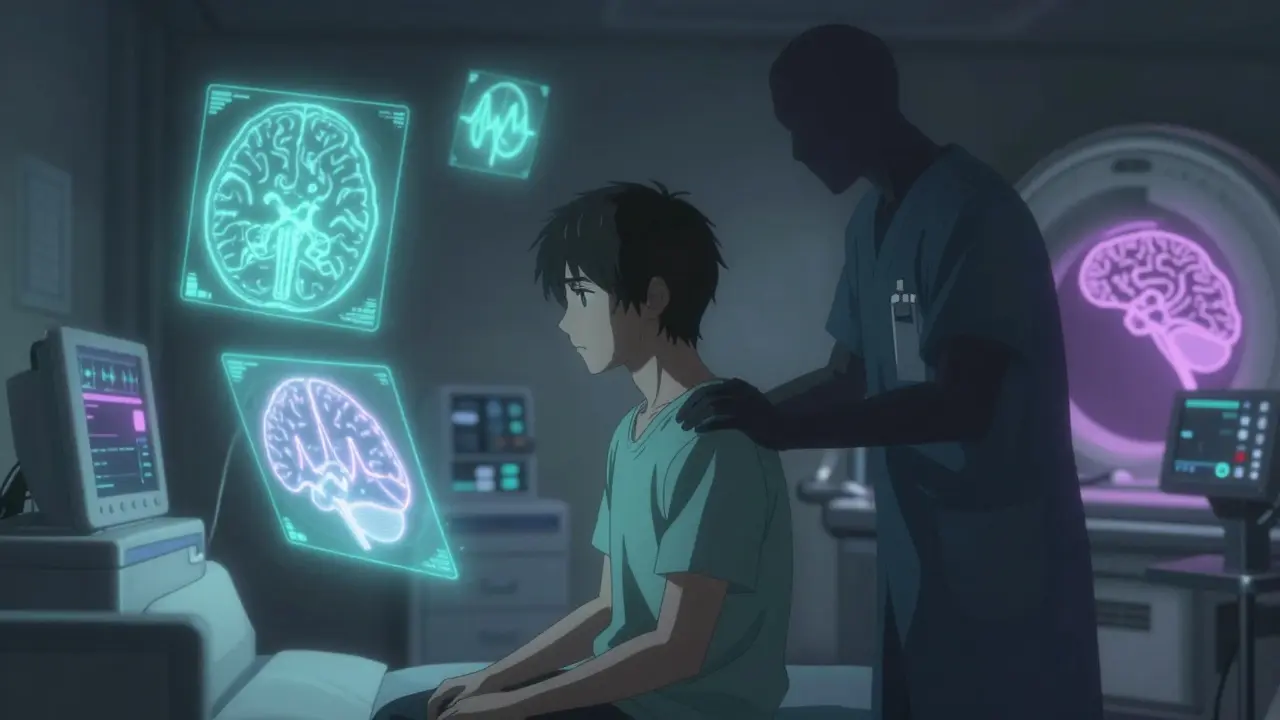
Getting approved for surgery isn’t a quick appointment. It’s a deep dive into your brain’s activity. At a Level 4 epilepsy center, you’ll work with a team: epileptologists, neurosurgeons, neuropsychologists, and specialized nurses. The process usually takes 2 to 6 weeks and includes:
- Video-EEG monitoring: You’ll stay in the hospital for 5-7 days while your brain waves and seizures are recorded on camera. This helps pinpoint exactly where seizures start.
- High-resolution MRI: A 3T scanner with 1mm slices looks for subtle brain abnormalities like scar tissue or malformations.
- FDG-PET scan: This shows areas of the brain with low metabolism-often the seizure focus.
- Neuropsychological testing: Memory, language, and thinking skills are tested to predict how surgery might affect them.
- Intracranial EEG (sometimes): If non-invasive tests aren’t clear, electrodes are placed directly on the brain surface to map seizure activity with extreme precision.
Doctors use all this data to build a map of your brain. They don’t just look for where seizures start-they look for what areas are critical for speech, movement, or memory. The goal isn’t just to stop seizures. It’s to stop seizures without losing who you are.

What Are the Real Risks of Epilepsy Surgery?
Any brain surgery sounds scary-and it’s not without risk. But the risks need to be weighed against the risks of continuing seizures.
For a standard temporal lobectomy (the most common surgery), the risks include:
- Temporary side effects (5-10%): Swelling, headaches, or mild weakness that fades within weeks.
- Permanent deficits (1-2%): Trouble remembering names, finding words, or visual field loss (like missing part of your side vision). These are rare but real.
- Memory issues: Especially if the surgery is on the left side (where language and memory overlap in most people), some patients report trouble recalling new information. For others, memory improves because they’re no longer having seizures that disrupt learning.
Less common procedures like laser ablation (LITT) have lower complication rates-around 2.3%-but also slightly lower success rates (55% seizure freedom at one year vs. 65-70% with traditional removal). The trade-off is smaller incisions, shorter hospital stays, and faster recovery.
And then there’s the risk of doing nothing. People with uncontrolled epilepsy face a 1 in 1,000 chance each year of sudden unexpected death (SUDEP). Seizures can cause falls, injuries, drowning, or accidents while driving. For many, surgery isn’t about avoiding a 2% risk-it’s about avoiding a 1% annual risk of dying.
What Are the Chances of Being Seizure-Free?
Success depends on the type of epilepsy. For temporal lobe epilepsy with hippocampal sclerosis, about 60-80% of patients become completely seizure-free after surgery. That’s compared to less than 5% who ever become seizure-free with medication alone.
For other focal epilepsies-like those caused by cortical dysplasia or tumors-success rates are 50-70%. But if your seizures start in multiple areas or spread quickly across the brain, surgery may only reduce seizures by half, not eliminate them.
Long-term data shows that if you’re seizure-free for one year after surgery, you’re likely to stay that way. Studies following patients for 10+ years show that 60-70% remain seizure-free. That’s not a guarantee, but it’s a strong chance.
And it’s not just about no seizures. People report life-changing improvements: driving again after 15 years, returning to work, going out without a caregiver, or finally sleeping through the night. In one study, 79% of patients regained the ability to drive after surgery.

Why Don’t More People Have Surgery?
Here’s the shocking part: only about 2% of people who could benefit from epilepsy surgery actually get it. In the U.S., an estimated 1.2 million people have drug-resistant epilepsy. Less than 5,000 surgeries are done each year.
Why? Three big reasons:
- Fear: Half of patients who are referred decline evaluation because they’re terrified of brain surgery. Many think it means losing their memory, personality, or ability to speak.
- Delayed referrals: A survey found 63% of patients waited over five years after becoming drug-resistant before even being evaluated. Some waited a decade.
- System gaps: Most neurologists aren’t trained to recognize surgical candidates early. Only 52 centers in the U.S. are certified as Level 4 epilepsy centers-and most are in big cities. Insurance denials are common, and the approval process can take 27 days on average.
And yet, the cost of not acting is higher. A 2023 study found that successful epilepsy surgery pays for itself in three years through fewer hospital visits, less medication, and increased work productivity. Over 10 years, each successful surgery saves society over $1.2 million.
What Comes After Surgery?
Surgery isn’t the end-it’s the start of a new phase. You’ll still take anti-seizure medications at first. Doctors slowly reduce them over 6-12 months if you’re seizure-free. Some people stay on low doses forever. Others get off them completely.
Follow-up care is critical. You’ll need regular EEGs, MRI scans, and neuropsychological check-ins. Many centers offer patient navigators who help with insurance, transportation, and emotional support. Since 2020, programs like this have cut no-show rates for evaluations by more than half.
And if surgery doesn’t fully stop seizures? That doesn’t mean failure. Many patients go from 20 seizures a week to 1 or 2 a month. That’s still a huge improvement. And for those who don’t qualify for resection, newer devices like responsive neurostimulation (RNS) are now approved for more types of epilepsy than ever before.
Final Thoughts: It’s Not About Risk-It’s About Potential
Epilepsy surgery isn’t for everyone. But if you’ve been told your seizures are just something you have to live with, that’s outdated thinking. The science is clear: if you have drug-resistant epilepsy with a well-defined focus, surgery offers your best shot at freedom.
The risks are real, but they’re small compared to the daily dangers of uncontrolled seizures. The success rates are high. The quality-of-life improvements are profound. And the longer you wait, the harder it becomes-not just to stop seizures, but to recover from the damage they’ve already done.
You don’t need to rush into surgery. But you do need to get evaluated. One phone call to a specialized epilepsy center could change the next 20 years of your life.
Can epilepsy surgery cure my seizures completely?
For some people, yes-especially those with temporal lobe epilepsy and hippocampal sclerosis. Around 60-80% become completely seizure-free after surgery. But it depends on where seizures start, how well they’re localized, and the type of epilepsy. Not everyone achieves total freedom, but most see a major reduction in frequency and severity.
Is epilepsy surgery dangerous?
All brain surgery carries risks, but modern techniques are precise and safe. For the most common surgery-temporal lobectomy-permanent neurological deficits happen in only 1-2% of cases. Temporary issues like headaches or weakness are more common (5-10%) but fade within weeks. The bigger risk is not doing anything: uncontrolled seizures carry a 1 in 1,000 annual risk of sudden death (SUDEP).
How long does the evaluation process take?
It usually takes 2 to 6 weeks. You’ll need prolonged video-EEG monitoring (5-7 days in the hospital), high-res MRI, PET scans, and neuropsychological testing. Some cases require invasive monitoring with electrodes placed directly on the brain, which adds time. The goal is to map your seizures accurately before any decision is made.
Will I still need to take medication after surgery?
Yes, at first. Most people continue taking anti-seizure meds for at least 6-12 months after surgery. If you’re seizure-free during that time, your doctor may slowly reduce or stop them. About half of successful patients eventually stop all medications. Others stay on a low dose as a precaution.
Can children have epilepsy surgery?
Absolutely-and often, they benefit even more than adults. Children with conditions like tuberous sclerosis, infantile spasms, or Rasmussen’s encephalitis are strong candidates. Early surgery can prevent long-term cognitive decline and help the brain rewire around damaged areas. Guidelines now recommend evaluation as soon as two medications fail, not after years of struggling.
What if I’m not a candidate for surgery?
There are still options. If seizures start in multiple brain areas, devices like responsive neurostimulation (RNS) or vagus nerve stimulation (VNS) can reduce seizure frequency. Newer treatments like laser ablation (LITT) are also expanding options for people who aren’t suited for traditional removal. The key is getting evaluated by a specialized center-they’ll know what’s available.
How do I find a qualified epilepsy surgery center?
Look for a Level 4 epilepsy center, the highest designation. These centers have 24/7 video-EEG monitoring, 3T MRI, specialized neurosurgeons, and multidisciplinary teams. You can find them through the National Association of Epilepsy Centers (NAEC) or by asking your neurologist for a referral. Don’t settle for a general hospital-this requires expertise.
Comments
Nicki Aries
I wish more people knew this. My sister had surgery after 12 years of failed meds-now she drives, works full-time, and sleeps through the night. It’s not a miracle; it’s medicine. But the system makes it feel like a gamble. Don’t wait. Get evaluated. Even if you’re scared, just make the call. Your future self will thank you.
And yes, I cried when they said ‘seizure-free.’ I didn’t think it was possible anymore.
On February 1, 2026 AT 18:24
Lilliana Lowe
The article contains a glaring inconsistency: it cites a 65–70% success rate for temporal lobectomy, yet later states 60–80%. This is not merely a rounding discrepancy-it reflects a lack of statistical rigor. Moreover, the claim that ‘surgery pays for itself in three years’ is cited without a peer-reviewed source. In academic discourse, such assertions require citation, not anecdotal optimism. One cannot responsibly advocate for neurosurgical intervention without adhering to evidentiary standards.
On February 2, 2026 AT 03:20
vivian papadatu
I’m a neurology nurse in rural Ohio, and I see this every day. Families think surgery is for ‘other people.’ They don’t realize their kid’s developmental delays are directly tied to uncontrolled seizures. I’ve walked families through the evaluation process-helped them fight insurance denials, translated forms, held hands during EEG nights. It’s exhausting. But when a 7-year-old says, ‘I didn’t know I could remember my birthday party,’ you don’t walk away.
And yes, I’m crying right now typing this. We need more centers. We need more awareness. We need more courage.
On February 3, 2026 AT 00:55
Bryan Coleman
i had this done last year. temp lobectomy. took me 3 years to even get a referral because my doc kept saying ‘try one more med.’ turns out, he didn’t know the guidelines changed. i’m seizure-free for 14 months now. still on meds but only half dose. worst part? the wait. the fear. the ‘what if i lose my memory?’ thing. turns out i forgot my phone password. that’s it. i can still remember my mom’s voice. that’s all that matters.
On February 4, 2026 AT 04:00
Nancy Nino
One must pause to consider the profound societal implications of this medical advancement. The fact that only 2% of eligible candidates undergo evaluation speaks not to patient apathy, but to systemic negligence. One cannot help but wonder: if this were a treatment for breast cancer, would the delays be tolerated? Would insurance companies delay approval for 27 days? The answer, I fear, is no. And therein lies the bias: neurological conditions are still treated as ‘less urgent’ than somatic ones. This is not science. It is stigma dressed in white coats.
On February 4, 2026 AT 07:19
June Richards
Ugh. I’m so tired of ‘epilepsy surgery is life-changing’ hype. My cousin had it. Got 10% better. Still has 3 seizures a week. Still can’t drive. Still can’t work. They sold her a dream. Now she’s depressed and in debt. Stop pushing this like it’s a miracle. Not everyone wins. And the risks? They’re real. I’m not scared of seizures-I’m scared of being a shell after surgery.
On February 5, 2026 AT 01:28
Jaden Green
The entire premise of this article is dangerously reductionist. It assumes that all drug-resistant epilepsy is a matter of surgical localization, ignoring the neuroplastic, systemic, and psychosocial dimensions of the condition. The focus on ‘seizure freedom’ as the sole metric of success is a relic of biomedical hegemony. What of the patient who experiences fewer seizures but develops new cognitive deficits? What of the emotional trauma of being labeled ‘surgical candidate’? The article reads like a pharmaceutical marketing brochure disguised as medical advice. Real medicine doesn’t reduce human complexity to a 65% success rate.
On February 5, 2026 AT 20:41
Lu Gao
Actually, the 60-80% success rate? That’s for temporal lobe epilepsy with hippocampal sclerosis. But if you have frontal lobe epilepsy? More like 40-50%. And LITT? It’s great for people who can’t handle open surgery, but the data shows it’s less effective long-term. So if you’re reading this thinking ‘I’m a candidate!’-you might not be. Get the full workup. Don’t let a blog post make you think you’re a sure thing. I’ve seen too many people get their hopes up and then get crushed. Just sayin'. 😔
On February 6, 2026 AT 16:46
Nidhi Rajpara
I am from India. Here, epilepsy surgery is available only in 3 hospitals. Cost is 10 lakh rupees. Insurance does not cover. Many patients die because they cannot afford. Your article is very good but for rich countries. In my country, we need awareness, not just surgery. We need free screening. We need government support. Please help us.
On February 8, 2026 AT 04:56