

What Is Exercise-Induced Bronchoconstriction?
Exercise-induced bronchoconstriction (EIB) isn’t just "getting winded" after a run. It’s when your airways narrow during or right after physical activity, causing coughing, wheezing, chest tightness, or shortness of breath. You might feel fine at rest, but once you start moving-especially in cold or dry air-your breathing gets tight and hard. This happens because rapid breathing during exercise dries out and cools your airways, triggering inflammation and muscle tightening around the bronchial tubes.
It’s not the same as chronic asthma, though many people with asthma also have EIB. About 9% to 30% of people without asthma still get it. In elite athletes, the rate jumps to 90% if they already have asthma. The key is recognizing it for what it is: a treatable physical response, not a sign you’re out of shape or should stop exercising.
How to Know If You Have EIB
If you regularly cough or struggle to breathe 5 to 20 minutes after finishing exercise, especially in cold weather, you might have EIB. Symptoms usually peak within 30 to 60 minutes and fade within an hour. But guessing isn’t enough. Doctors confirm EIB with objective tests.
The gold standard is an exercise challenge test-running on a treadmill or cycling at 80-90% of your max heart rate for 6 to 8 minutes. Afterward, your lung function is measured using a spirometer. A drop of 10% or more in your forced expiratory volume in one second (FEV1) confirms EIB. Another test, called eucapnic voluntary hyperpnea (EVH), mimics high-intensity breathing and is often used for athletes.
Don’t wait for symptoms to get worse. Left untreated, people with EIB often avoid exercise altogether. Studies show 68% of undiagnosed individuals reduce physical activity, leading to weight gain and lower fitness levels over time.
Non-Drug Ways to Prevent EIB Symptoms
You don’t always need an inhaler to manage EIB. Simple lifestyle and environmental tweaks can make a big difference.
- Warm up before you go hard. A 10- to 15-minute moderate warm-up-like brisk walking or light jogging-triggers a "refractory period" where your airways stay open for up to two hours. Do this before any intense activity.
- Avoid cold, dry air. When temperatures drop below 10°C (50°F) or humidity is under 40%, EIB risk spikes by 73%. Try indoor workouts on cold days or wear a heat-exchange mask. But don’t rely on training masks like the Nike E+ or Respro®-they only reduce symptoms by 42%, compared to 89% with albuterol.
- Choose your sport wisely. Sports with short bursts of activity-like baseball, football, or sprinting-trigger EIB in only 22% of cases. Endurance sports like cross-country skiing, ice hockey, or long-distance running hit 85% of people with EIB.
- Check air quality. Pollen counts above 9.7 grains/m³ or an air quality index over 50 can worsen symptoms. Stick to indoor gyms on high-pollen or smoggy days.
- Stay fit. Every 1-MET improvement in your cardiovascular fitness (VO2 max) reduces EIB severity by 12%. Regular aerobic training makes your airways more resilient.
Inhaler Use: When, How, and What to Take
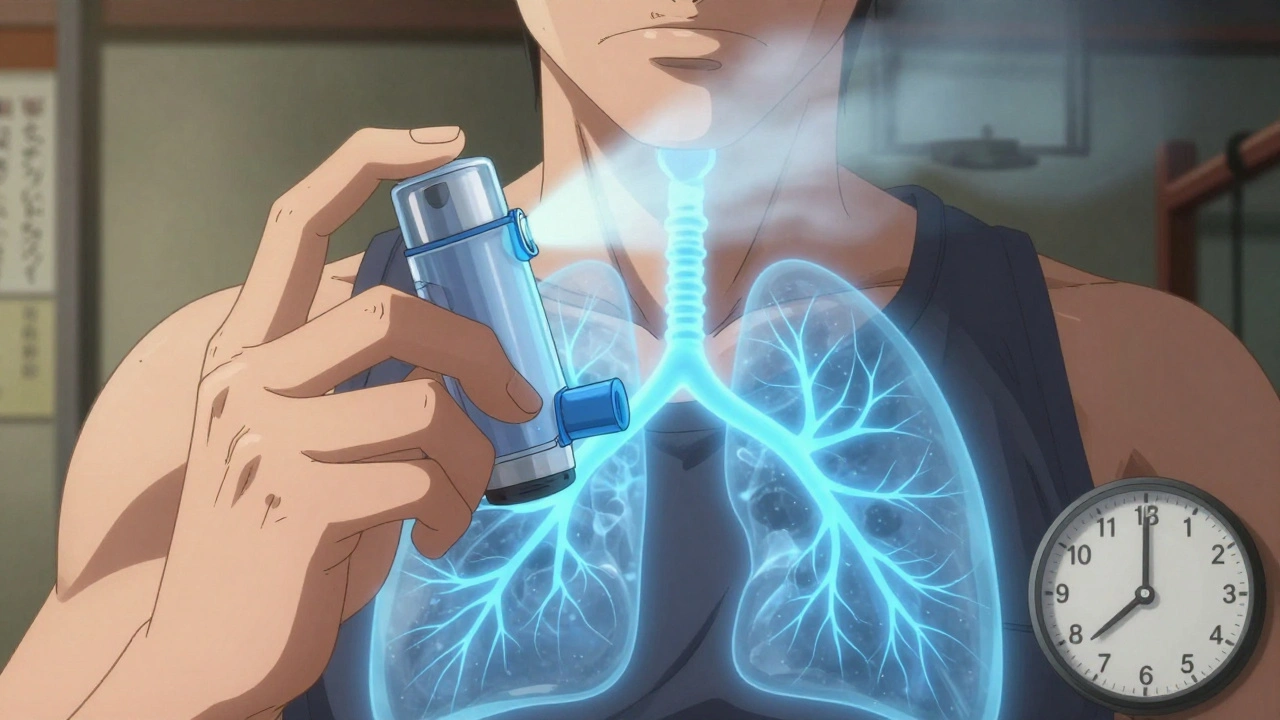
For most people, a quick-relief inhaler is the most effective tool. Short-acting beta-2 agonists (SABAs) like albuterol are the first-line treatment.
How to use it right: Take two puffs (90 mcg each) 5 to 20 minutes before exercise. Hold your breath for 10 seconds after inhaling-it increases lung delivery by 30%. Use a spacer. It boosts medication reaching your lungs by 70% compared to using the inhaler alone. Store your inhaler between 20-25°C. Below 10°C, the propellant loses effectiveness by 40%.
Studies show SABAs work in 80-90% of cases. But timing matters. Taking it too early or too late cuts effectiveness. If you forget, you’ll likely need to stop your workout.
For people who still have symptoms despite using albuterol, daily medications help. Inhaled corticosteroids (ICS), like fluticasone at 200-400 mcg daily, reduce inflammation and cut symptoms by 50-60%. Leukotriene receptor antagonists (LTRAs), like montelukast (10mg daily), offer 30-40% improvement. These are for ongoing control, not just pre-workout use.
Mast cell stabilizers like cromolyn sodium were once common, but they need to be taken 15-20 minutes before exercise and only work in 60-70% of cases. They’re rarely used now because they require frequent dosing and are less effective than SABAs.
Combination Therapy and Advanced Options
If one inhaler isn’t enough, combining treatments works better. Using a SABA with a daily ICS reduces symptom frequency by 78% in athletes, compared to just 55% with SABA alone.
Some newer guidelines, like GINA 2022, suggest using an as-needed combination inhaler-like fluticasone/formoterol-for frequent EIB. This treats both the immediate narrowing and underlying inflammation in one device. But many sports medicine experts still prefer SABAs before activity because they’re fast, predictable, and don’t require daily use.
Emerging options include smart inhalers with Bluetooth tracking (like Propeller Health), which show 47% better adherence in early studies. For severe, unresponsive cases, biologics targeting specific immune pathways are being tested-but these are still experimental for EIB.
Common Mistakes That Make Inhalers Less Effective
Most people with EIB have the right medication. They just don’t use it right.
- Skipping the spacer. Without one, up to 80% of the dose sticks to your throat instead of reaching your lungs.
- Not holding your breath. Exhaling right after inhaling cuts lung deposition by 30%.
- Storing inhalers in the car or gym bag. Cold temperatures ruin the propellant. Keep it in your pocket or inside your jacket.
- Using an old spacer. Plastic spacers degrade over time. Replace them every 6 months-after 12 months, efficiency drops by 25%.
- Assuming one puff is enough. Two puffs are standard. One puff may not be enough for full protection.
Here’s the hard truth: 63% of EIB treatment failures come from poor technique-not the drug not working.
Who Should Be Tested and When
Anyone who has consistent breathing trouble during or after exercise should get checked. This includes:
- Children and teens who avoid gym class or sports
- Adults who get winded faster than peers
- Athletes who plateau despite training harder
- People with allergies or asthma who notice symptoms only during exercise
Don’t wait for a crisis. The Cleveland Clinic reports 41% of adolescents with EIB remain undiagnosed. Many think they’re just "out of shape." They’re not. They’re missing out on fitness, social activities, and even future athletic opportunities.

What to Avoid
Some "natural" fixes sound promising but don’t hold up.
Omega-3 supplements (2-4 grams daily) and vitamin C (500mg daily) showed modest symptom reduction in small studies-31% and 48% respectively. But the Mayo Clinic says there’s not enough evidence to recommend them routinely. Don’t skip your inhaler for fish oil or citrus.
Also avoid overusing SABAs. If you need your rescue inhaler more than twice a week outside of exercise, you likely have ongoing airway inflammation. That means you need daily controller meds, not just quick fixes. Ignoring this can mask worsening asthma.
Can You Still Be an Athlete With EIB?
Yes. Absolutely.
The International Olympic Committee lifted restrictions on EIB medications in 2022. You no longer need a therapeutic use exemption to use albuterol, montelukast, or inhaled steroids. Top athletes across sports-from Olympic swimmers to marathoners-manage EIB successfully.
The goal isn’t to limit you. It’s to let you perform at your best. With the right prevention plan and correct inhaler use, 95% of people with EIB can participate fully in any sport or physical activity.
Final Takeaway
EIB doesn’t mean you can’t run, swim, or play. It means you need to be smarter about how you move. Start with a proper warm-up. Avoid cold, dry air when you can. Use your inhaler correctly-two puffs, 15 minutes before, with a spacer, holding your breath. If symptoms persist, talk to your doctor about daily controller meds.
Don’t let fear of breathing trouble keep you off the field. With the right tools and knowledge, you can breathe easier-no matter how hard you push yourself.
Can EIB happen without asthma?
Yes. About 9% to 30% of people without asthma experience exercise-induced bronchoconstriction. It’s a separate condition triggered by physical exertion and environmental factors like cold or dry air, not chronic airway inflammation.
How long does an inhaler protect you during exercise?
A standard dose of albuterol (two puffs) provides protection for 2 to 4 hours. Timing is key-take it 5 to 20 minutes before starting activity. If your workout lasts longer than 4 hours, you may need another dose, but always follow your doctor’s advice on frequency.
Is it safe to use my inhaler every day for EIB?
You should not use a rescue inhaler like albuterol every day unless directed by a doctor. If you need it daily for exercise, you likely have underlying inflammation that needs daily controller medication, such as an inhaled corticosteroid or leukotriene modifier. Frequent use of SABAs alone can mask worsening airway disease.
Do I need a prescription for an EIB inhaler?
Yes. Short-acting beta-2 agonists like albuterol require a prescription in the U.S. and most countries. Even if you think your symptoms are mild, getting diagnosed and prescribed ensures you’re using the right medication safely and effectively.
Can I use a nebulizer instead of an inhaler for EIB?
Nebulizers deliver medication effectively, but they’re not practical for pre-exercise use. They take 10-15 minutes to administer, require equipment and power, and aren’t portable. Inhalers with spacers are faster, more convenient, and just as effective for EIB prevention.
Why does cold air make EIB worse?
Cold air holds less moisture. When you breathe fast during exercise, your airways lose heat and water rapidly. This triggers inflammation and muscle tightening in the bronchial tubes. Dry air also irritates the lining, making symptoms more likely. Warming and humidifying the air you breathe-through a mask or indoor exercise-helps prevent this.
Comments
Audrey Crothers
I used to think I was just out of shape until I got diagnosed with EIB. Seriously, the difference after using my inhaler with a spacer? Night and day. 🙌 Now I run 5Ks without coughing. Warm-up is non-negotiable. Do the 15-minute light jog. It works.
On December 12, 2025 AT 21:17
Stacy Foster
They don't want you to know this but the government and pharma companies are pushing inhalers to keep people dependent. Cold air doesn't cause bronchoconstriction - it's the 5G towers and fluoridated water messing with your lungs. I stopped using my inhaler and now I breathe deeper than ever. #FreeTheLungs
On December 14, 2025 AT 17:16
Ashley Skipp
People dont even know how to use inhalers anymore two puffs with spacer hold your breath why is this even a thing
On December 14, 2025 AT 20:51
Robert Webb
I've been coaching youth track for over a decade and I can tell you that EIB is wildly underdiagnosed in teens. I had one kid who was always the last to finish sprints - we thought he was lazy. Turned out he had EIB. After a proper warm-up and using his inhaler correctly, he broke his school's 400m record last season. It's not about being out of shape. It's about physiology. And honestly? We need more coaches who understand this. It's not just about performance - it's about letting kids enjoy movement without fear. I've seen kids quit sports because they were told they were 'weak' when really their airways were just hypersensitive. The science is clear. Warm-up, avoid dry air, use the spacer. It's not complicated. But it's not being taught. We're failing our athletes by assuming it's just 'poor conditioning'.
On December 16, 2025 AT 06:43
Lawrence Armstrong
Spacers are underrated. I used to just puff and go. Then I got a plastic one from the pharmacy for $5. My lung delivery went from 'meh' to 'whoa'. 🤫 100% more effective. Also, don't leave your inhaler in your car. I learned that the hard way during a winter race. Propellant froze. Cue panic. Now it lives in my hoodie pocket. Always.
On December 16, 2025 AT 09:31
Nathan Fatal
There's a deeper question here: why do we treat EIB as a medical problem to be fixed rather than a physiological signal to be understood? The body isn't broken - it's reacting to environmental stress. Maybe instead of just masking it with drugs, we should be asking why our modern training environments - indoor gyms with dry AC, outdoor tracks in freezing wind, air pollution - are so hostile to natural breathing. The inhaler is a band-aid. The real fix is rethinking how and where we train. We've optimized for speed and metrics, not for biological harmony.
On December 17, 2025 AT 08:49
Rob Purvis
Wait, so if you're using albuterol more than twice a week outside of exercise, you might have underlying inflammation? That's huge. I've been using mine before every workout - sometimes twice a day - and I thought that was fine. I'm going to talk to my pulmonologist. Also, does anyone know if montelukast affects sleep? I've heard mixed things. I'm trying to avoid anything that makes me drowsy before morning runs.
On December 19, 2025 AT 01:51
Laura Weemering
I mean... the entire paradigm of EIB management is just a capitalist construct designed to monetize breath. The pharmaceutical industry has weaponized the fear of exertion to sell $100 inhalers while ignoring the root causes: systemic neglect of air quality, the commodification of fitness, and the erasure of natural physiological adaptation. My symptoms vanished when I stopped chasing performance metrics and started practicing breathwork in nature. No drugs. No spacers. Just stillness. 🌿✨
On December 20, 2025 AT 03:23
Levi Cooper
Why are we letting foreigners dictate how we treat EIB? The IOC lifted restrictions because they don't understand American athleticism. We built this country on grit - not inhalers. If you need a drug to run, maybe you shouldn't be running. My grandpa ran 10 miles in the snow with no mask, no spacer, no albuterol. What happened to us?
On December 21, 2025 AT 18:38