
The U.S. Food and Drug Administration doesn’t wait for a crisis to act. When a manufacturer crosses the line-whether it’s selling unapproved drugs, mislabeling food, or shipping unsafe medical devices-the FDA has a clear, step-by-step system to shut it down. This isn’t about fines or public shaming alone. It’s about stopping dangerous products before they reach you. And in 2025 and 2026, the FDA is moving faster and harder than ever before.
What a Warning Letter Really Means
A warning letter from the FDA isn’t a suggestion. It’s a legal notice that says: you broke the rules, and we’re watching. These letters are sent after inspections, complaints, or lab tests prove a violation of the Federal Food, Drug, and Cosmetic Act. They list every problem-down to the exact regulation number-and give the company 15 business days to respond with a plan to fix it.
What makes these letters powerful? They’re the first official step before the FDA pulls out the big guns. If you ignore it, the next move could be a product recall, a seizure of your inventory, or even a criminal investigation. The FDA doesn’t always go straight to court. But if you don’t respond properly, they will.
Since 2023, under Commissioner Robert Califf, the agency has returned to the enforcement style of the 1990s: hundreds of warning letters a year, not dozens. In 2024 alone, over 149 were sent to food manufacturers, 37 to animal food producers, and 58 to compounding pharmacies selling fake versions of weight-loss drugs like semaglutide. These aren’t random. They’re targeted.
The FDA’s Enforcement Toolkit
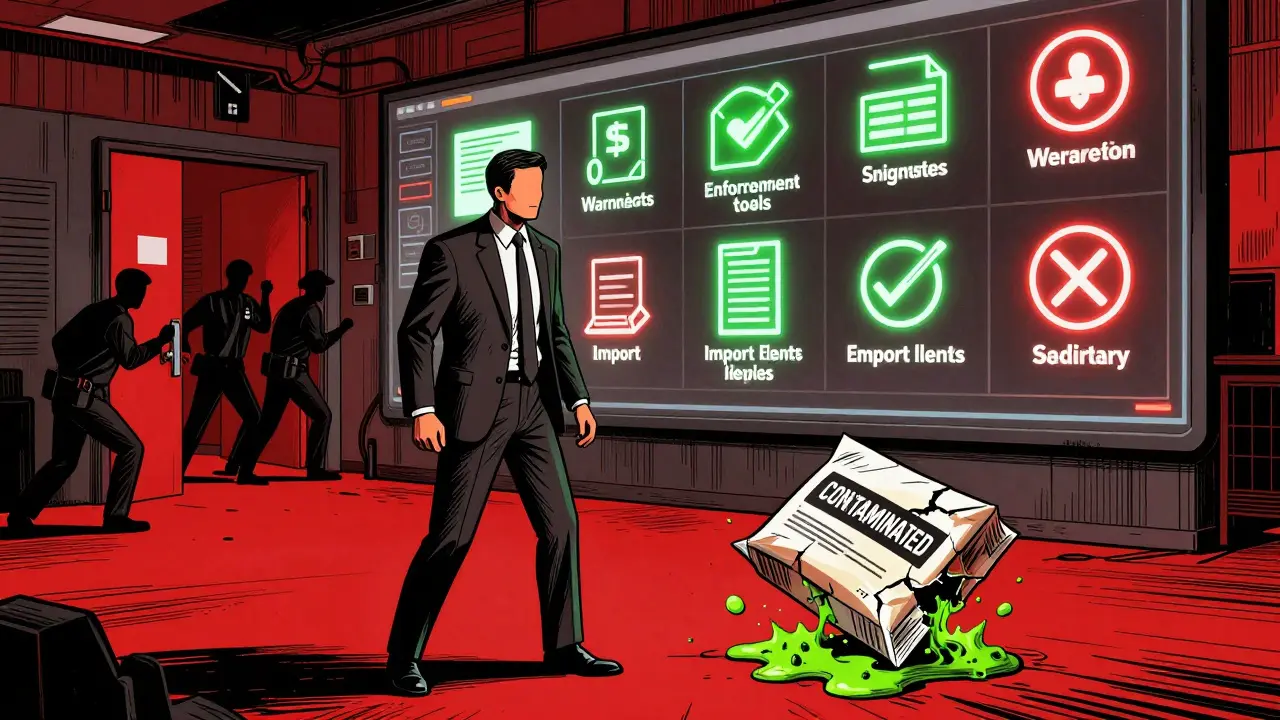
The FDA doesn’t just send letters. It has a full set of tools to enforce the law, each with its own purpose and timing.
- Warning Letters: For serious violations. Must be answered in 15 days. Signed by the director of CDER (Center for Drug Evaluation and Research) or CBER (Center for Biologics Evaluation and Research)-not a junior staffer.
- Untitled Letters: For minor issues. Less formal, but still official. Often used for misleading advertising.
- Form 483: Given during inspections. Lists what the inspector saw. This is the red flag that often leads to a warning letter.
- Import Alerts: If a product is flagged at the border, it gets detained without being opened. The importer has 30 days to prove it’s safe-or it’s refused entry permanently.
- Recall Notices: Voluntary or mandatory. The FDA can force a company to pull a product from shelves.
- Withdrawal of Approval: The nuclear option. If a drug’s manufacturing is unsafe, the FDA can yank its approval. No more sales. Ever.
Each of these tools has legal weight. For example, if a company delays or blocks an FDA inspector from entering a foreign facility, that’s a criminal offense under Section 303(f) of the FDCA. Fines can hit $1 million per violation. And the FDA is now using unannounced inspections more than ever-especially on overseas plants.
Who’s Getting Hit the Hardest?
Not all industries are treated the same. The FDA’s focus has shifted sharply in recent years.
Tobacco products are under siege. Since 2021, over 700 warning letters have gone out to companies selling unauthorized vaping devices, especially those marketed to teens. These aren’t just about nicotine-they’re about stopping youth addiction before it starts. The FDA has made this its top priority, even as some companies challenge its authority in court.
Pharmaceutical compounding is the new frontier. Companies that used to mix small batches of drugs for individual patients are now mass-producing versions of GLP-1 drugs like semaglutide (Ozempic) and tirzepatide (Zepbound). They claim they’re “customized,” but they’re selling them online like branded drugs. The FDA says that’s illegal. In the first half of 2025 alone, 58 warning letters were sent to these companies for misbranding and unsafe production. Many are being investigated for criminal fraud.
Food manufacturers are no longer just being checked for cleanliness. The FDA now cites violations of the Food Safety Modernization Act (FSMA), especially around Preventive Controls. That means if your facility doesn’t have a written plan to stop contamination before it happens, you’re in violation-even if no one got sick.
What Happens If You Don’t Respond?
Ignoring a warning letter is like ignoring a court summons. The FDA doesn’t ask twice.
After the 15-day deadline, the agency reviews your response. If it’s weak, vague, or incomplete, you’ll get a follow-up letter. If you still don’t fix it, you could face:
- Civil Monetary Penalties: $10,000 to $1 million per violation
- Import Detention: Your products are stuck at U.S. ports
- Product Seizure: FDA agents can take your inventory
- Criminal Charges: For obstruction, fraud, or repeated violations
There’s also the reputational damage. Once a warning letter is posted on the FDA’s public website, customers, investors, and regulators see it. Many companies lose contracts, face lawsuits, or see stock prices drop-even if they fix the issue later.
How Companies Are Responding
Smart companies treat these letters like emergencies. They don’t wait. They form response teams within 24 hours-legal, quality control, regulatory affairs, and senior leadership all in one room.
Legal firms like Ropes Gray and McGuireWoods now advise clients to assume every warning letter could lead to criminal charges. The FDA has changed its language too. Older letters said, “We request you stop this.” New ones say, “You must take immediate action.” That’s not just wording-it’s a legal shift. It means the FDA is no longer asking. It’s commanding.
One major change: warning letters are now signed by the director of CDER or CBER, not a mid-level official. That means the letter carries the full weight of the agency’s leadership. It’s not just a memo. It’s a statement from the top.
What You Need to Know If You’re a Manufacturer
If you make, import, or sell FDA-regulated products, here’s what you must do:
- Know the rules. cGMP (Current Good Manufacturing Practices) for drugs, FSMA Preventive Controls for food, and tobacco product standards aren’t suggestions. They’re law.
- Train your team. Inspectors look for trained staff, documented procedures, and clean records. If your employees don’t know the rules, you’re already in violation.
- Don’t delay responses. The 15-day clock starts the moment you get the letter. Don’t wait for legal advice. Start your response the same day.
- Don’t lie or hide. Redacting documents, refusing access, or deleting records can lead to criminal charges. The FDA now has the right to inspect foreign facilities without notice-and they’re using it.
- Assume everything is public. The FDA posts all warning letters online. Your competitors will see them. Your customers will see them.
The FDA’s message is clear: compliance isn’t optional. And in 2026, with $50 million new funding for inspections, the agency is only getting more aggressive. The days of loose oversight are over. If you’re cutting corners, you’re playing with fire.
What happens if I ignore an FDA warning letter?
Ignoring an FDA warning letter almost always leads to escalation. The agency may issue a civil penalty of up to $1 million per violation, detain your products at the border, seize inventory, or initiate a criminal investigation. Companies that delay or obstruct inspections can face felony charges under Section 303(f) of the FDCA. Your products may be permanently banned from the U.S. market.
Can the FDA inspect foreign manufacturing facilities without notice?
Yes. Since May 2025, the FDA has expanded its use of unannounced inspections for foreign facilities producing drugs, biologics, and food for U.S. markets. These inspections are now routine, and refusal to allow access can trigger import alerts, detention of products, or criminal charges. The agency plans to increase these inspections by 300% in 2025-2026.
How long do I have to respond to a warning letter?
You typically have 15 business days to respond to an FDA warning letter. The letter will specify the deadline. Failure to respond adequately can lead to immediate enforcement actions, including product seizures or import detentions. The FDA may extend the deadline only if you request an extension before the deadline and show a valid reason.
Are FDA warning letters public?
Yes. All FDA warning letters are posted on the agency’s public website within days of issuance. They remain accessible indefinitely and are frequently reviewed by customers, investors, competitors, and regulators. Public visibility makes compliance a business imperative, not just a legal one.
What’s the difference between a warning letter and an untitled letter?
A warning letter addresses violations of regulatory significance-such as unsafe manufacturing, false claims, or contamination. An untitled letter is for less serious issues, often related to promotional materials that are misleading but not dangerous. Warning letters require a formal response and carry higher legal consequences. Untitled letters are advisory and rarely lead to further action unless ignored.
What’s Next for FDA Enforcement?
The FDA’s 2026 budget includes $50 million for more inspectors, better lab testing, and digital monitoring of online sales. Expect more warnings targeting social media ads, telehealth platforms, and e-commerce sellers pushing unapproved drugs. The agency is also moving toward centralized decision-making-meaning warning letters will increasingly require approval from the Office of the Commissioner, not just center directors.
This isn’t about bureaucracy. It’s about safety. Every year, people get sick or die because of contaminated food, fake drugs, or unsafe devices. The FDA’s job is to stop that before it happens. And in 2026, they’re not asking for your cooperation. They’re demanding it.
Comments
Milad Jawabra
This is exactly what we need. Too many companies think they can cut corners and get away with it. The FDA’s got teeth now, and they’re not afraid to use them. I’ve seen too many people get sick from fake weight-loss drugs sold online. This isn’t just regulation-it’s protection. Keep going, FDA.
Stop letting snake oil salesmen hide behind "custom compounding". You’re not a pharmacy, you’re a drug factory. And we’re not your lab rats.
On March 5, 2026 AT 20:10
Gretchen Rivas
Import alerts are underused. If a facility gets flagged once, it should be blacklisted permanently unless they pass a third-party audit. Too many companies just wait out the 30 days and reship under a different name.
On March 6, 2026 AT 18:09
Stephen Vassilev
Let me be clear: this entire system is a controlled demolition. The FDA doesn’t care about safety-they care about power. The "unannounced inspections"? That’s a pretext. They’re using them to extort foreign manufacturers into paying for "consultants" who are really just FDA contractors in disguise. And the public posting of warning letters? That’s reputational terrorism. No due process. No appeal. Just public shaming before a trial even begins.
On March 8, 2026 AT 08:33
Mike Dubes
Honestly? I’m impressed. I used to think the FDA was just bureaucratic nonsense, but this? This is actually smart. They’re not just chasing bad actors-they’re changing the game. The fact that they’re going after social media ads now? Genius. That’s where the real scams are happening. Also, glad they’re hitting compounding pharmacies hard. I saw a guy on TikTok selling "Ozempic shots" for $200. Dude had no license. This needs to stop.
On March 9, 2026 AT 03:36
Helen Brown
They’re using this to take over everything. You think they’re protecting you? They’re setting up a monopoly. Who controls the FDA? Big Pharma. Who owns the labs that test the drugs? Big Pharma. Who gets the contracts to fix the violations? Big Pharma. This isn’t safety. It’s a tax on small businesses so the big guys can stay on top. You’re being manipulated.
On March 10, 2026 AT 13:17
John Cyrus
If you dont respond to a warning letter in 15 days you deserve to get shut down period no excuses
On March 10, 2026 AT 16:06
John Smith
The FDA’s playing chess while the rest of us are playing checkers. They’re not just shutting down bad actors-they’re rewriting the rules in real time. And honestly? I love it. The days of shady supplement shops and offshore drug mills selling to Americans? Over. They’re coming for the influencers now. Good. Let’s see who’s still selling "FDA-approved" CBD gummies next month. I’ll be the first to post the screenshot.
On March 11, 2026 AT 15:26
Sharon Lammas
It’s strange how we’ve come to expect safety as a given. We don’t think about it until something goes wrong. The FDA’s actions feel like a quiet kind of love-not loud or flashy, but steady. Someone has to hold the line. And maybe that’s not glamorous. But it’s necessary.
On March 11, 2026 AT 16:09
Aisling Maguire
I work in pharma logistics in Dublin and let me tell you-this is already changing how we handle shipments. We’ve had three import alerts in the last 6 months. The FDA’s not bluffing. If your docs are messy? Your product gets stuck. No warning. No mercy. It’s brutal. But fair.
On March 11, 2026 AT 21:05
Shivam Pawa
The real shift is in the tone. Old letters said "please fix." New ones say "you will fix." That’s not semantics-that’s sovereignty. The FDA is no longer negotiating. They’re commanding. And companies that don’t adapt? They’re not just failing compliance. They’re failing survival.
On March 12, 2026 AT 12:04
Diane Croft
This is the kind of leadership we need. No fluff. No excuses. Just clear rules and real consequences. If you’re doing things right, you’ve got nothing to fear. And if you’re not? Well… better get your paperwork in order. We all win when the system works.
On March 12, 2026 AT 13:56