
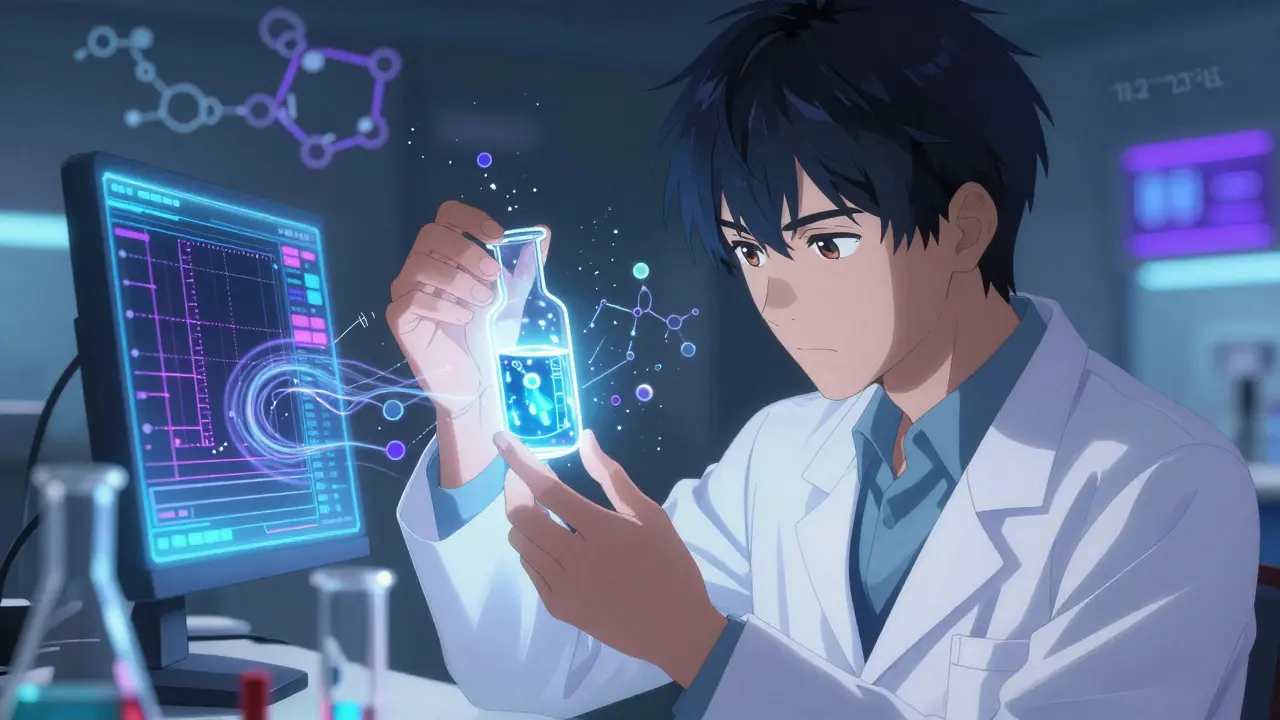
Every time you pick up a prescription bottle and see a label that says generic, you’re holding a drug that’s been engineered to work exactly like the brand-name version - but at a fraction of the cost. In the U.S., about 90% of prescriptions are filled with generics. That’s not luck. It’s the result of a highly controlled, science-driven manufacturing process that’s been fine-tuned over 40 years. So how are these affordable medicines actually made? It’s not just copying a pill. It’s reverse-engineering biology, chemistry, and precision engineering - all under strict government oversight.
Starting with the Original: Reverse Engineering the Brand-Name Drug
The journey of a generic drug begins long before the first tablet is pressed. Manufacturers don’t just look at the brand-name drug and say, “I’ll make that.” They take it apart - scientifically. The first step is analyzing the Reference Listed Drug (RLD), which is the original brand-name product approved by the FDA. This isn’t about stealing secrets. It’s about understanding exactly what’s inside: the active ingredient, how it’s bound, what fillers are used, how it dissolves in the body, and even the coating that controls release timing. This stage is called characterization. Scientists use advanced tools like HPLC (High-Performance Liquid Chromatography) and mass spectrometry to identify every component. They don’t need to know the brand’s secret recipe - they just need to match the final outcome. The goal? Make something that behaves the same way in your body. That means the generic must release the same amount of medicine at the same speed. If the brand-name drug releases 50% of its active ingredient in 30 minutes, the generic must do the same. No more. No less.Building the Formula: Quality by Design (QbD)
Once the original is understood, the next step is formulating the generic version. This isn’t mixing powders in a bowl. It’s a science called Quality by Design (QbD), a global standard set by the International Council for Harmonisation (ICH). QbD forces manufacturers to think ahead: what could go wrong? What changes in raw materials might affect the final product? They define three key things:- Critical Quality Attributes (CQAs): What features of the pill matter most? Dissolution rate, strength, purity.
- Critical Material Attributes (CMAs): What properties of the ingredients matter? Lactose particle size, binder viscosity, coating thickness.
- Critical Process Parameters (CPPs): What steps in manufacturing must be tightly controlled? Mixing time, compression pressure, drying temperature.
The Manufacturing Steps: From Powder to Pill
Once the formula is locked in, production begins. Here’s the exact sequence:- Formulation: The active pharmaceutical ingredient (API) is weighed and blended with excipients - the non-active ingredients like fillers, binders, and lubricants. These help the pill hold shape, dissolve properly, or taste better.
- Mixing and Granulation: Powders are mixed until uniform. Then, they’re turned into granules using moisture or heat. Granules flow better during pressing and ensure even distribution of the active ingredient.
- Drying: Granules are dried in ovens to remove moisture. Too much water? The pill can degrade. Too little? It won’t bind properly.
- Compression and Encapsulation: Dry granules are pressed into tablets using high-force machines (up to 10 tons of pressure). For capsules, the powder is filled into gelatin or plant-based shells.
- Coating: Tablets get a thin outer layer. This protects the drug from moisture, masks bad taste, or controls when it releases in the gut (extended-release pills need special coatings).
- Quality Control: At every stage, samples are tested. Tablets are checked for weight (must be within ±5% for small pills), hardness, dissolution rate, and purity. One batch can go through 50+ tests.
- Packaging and Labeling: Pills are sealed in blister packs or bottles with child-resistant caps. Labels must match the brand-name drug’s wording exactly - down to the font size. But they can’t look identical. U.S. trademark law bans generics from copying the color or shape of brand-name pills.

Regulatory Hurdles: The ANDA Pathway
You can’t just start making generics. You need FDA approval - and the only way to get it is through the Abbreviated New Drug Application (ANDA). Unlike brand-name drugs, which require 10-15 years and over $2 billion in clinical trials, generics skip most of that. Why? Because the safety and effectiveness of the original drug is already proven. The ANDA process has five steps:- Submission: You file the ANDA, proving your drug matches the RLD in every key way.
- Bioequivalence Testing: 24-36 healthy volunteers take both the brand and generic versions. Blood samples are taken over hours to measure how much drug enters the bloodstream and how fast. The generic’s absorption must fall within 80-125% of the brand’s. That’s the legal standard.
- Facility Inspection: The FDA sends inspectors to your plant. They check cleanroom conditions (ISO Class 5-8), temperature controls (20-25°C), humidity (45-65% RH), and whether your staff follow written procedures.
- Labeling Approval: Your label must say the same things as the brand’s - but can’t copy its look.
- Post-Approval Monitoring: Even after approval, the FDA keeps checking. Random batches are tested. If something goes wrong, you must report it within 24 hours.
Why Some Generics Are Harder to Make
Not all generics are created equal. Simple pills - like metformin or lisinopril - are easy. But complex drugs? That’s where things get messy. Think inhalers, eye drops, topical creams, or slow-release capsules. These don’t just need the same chemical. They need the same physical behavior. For example, a generic asthma inhaler must spray the exact same amount of medicine into the lungs at the same speed. A 2022 case study showed a manufacturer spent 7 years and $47 million just to match a single topical steroid’s skin absorption rate. The FDA calls these “complex generics.” In 2015, they made up 12% of pending applications. Today, they’re 35%. That’s why the FDA has launched the Complex Generic Products Initiative - publishing 127 product-specific guidances to help manufacturers navigate the science.Quality Control: The Real Test
You might think, “If it’s cheaper, is it lower quality?” The data says no - but only if it’s made right. The FDA’s 2023 inspection database shows the top three violations in generic drug plants:- 37% failed to properly investigate out-of-specification results
- 29% didn’t validate their manufacturing processes
- 24% lacked strong oversight from their quality unit
Market Reality: Price, Competition, and Global Supply
Generics save the U.S. healthcare system $1.7 trillion over the past decade. But that success comes with pressure. When a new generic hits the market, 15-20 competitors often follow within months. Prices crash 70-80% in two years. That’s why many manufacturers have moved production overseas. Today, 78% of the active ingredients in U.S. generics come from China and India. That’s efficient - but risky. If a factory in Hyderabad shuts down for inspection, shortages can ripple across the country. Meanwhile, brand-name companies are playing defense. Some now produce their own “authorized generics” - identical to their brand, just sold under a different label. In 2023, these captured 23% of first-generic market share.What’s Next: AI, Digital Twins, and Continuous Manufacturing
The industry is changing fast. The FDA has approved 17 facilities using continuous manufacturing, where drugs are made in one unbroken flow instead of in batches. Vertex’s cystic fibrosis drug, made this way, now has a 99.98% batch acceptance rate - up from 95% with old methods. Pfizer is testing AI-powered visual inspection systems that cut defects by 40%. Others are building “digital twins” - virtual models of their production lines - to predict failures before they happen. The future isn’t just cheaper pills. It’s smarter, more reliable, and faster-made medicines.Are generic drugs as safe as brand-name drugs?
Yes. The FDA requires generic drugs to have the same active ingredient, strength, dosage form, and route of administration as the brand-name version. They must also prove bioequivalence - meaning they work the same way in your body. The FDA inspects manufacturing plants regularly, and the vast majority of generics meet or exceed quality standards. A 2023 survey of pharmacists found 89% have full confidence in generic drug quality.
Why do generic pills look different from brand-name pills?
U.S. trademark law prohibits generic drugs from copying the exact appearance of brand-name pills, including color, shape, or size. This is to avoid confusion and protect brand identity. However, the active ingredient and how it works in your body are identical. The differences are only in inactive ingredients like dyes or flavorings, which don’t affect effectiveness.
Can different generic versions of the same drug work differently?
For most people, no. All generics must meet the same FDA bioequivalence standards. But for drugs with a narrow therapeutic index - like warfarin, lithium, or thyroid medication - even small differences in absorption can matter. In these cases, doctors may recommend sticking with one brand or generic manufacturer. If you notice a change in how you feel after switching generics, talk to your pharmacist or doctor.
How long does it take to make a generic drug from start to market?
For a simple generic, the entire process - from formulation to FDA approval - typically takes 3-4 years and costs $5-10 million. This includes 1-2 years of R&D, 6-12 months of bioequivalence studies, and 10-17 months of FDA review. Complex generics, like inhalers or extended-release pills, can take 5-7 years and cost over $50 million.
Why are some generic drugs harder to find or more expensive?
Some generics are hard to find because few companies make them - especially complex ones. If only one manufacturer produces a drug and it shuts down for inspection, shortages happen. Prices stay higher when there’s little competition. For example, a generic version of a complex inhaler might have only 2-5 competitors, so prices drop slowly. Simple generics, like metformin, have dozens of makers, so prices are near the floor.
Comments
Bradly Draper
Man, I never thought about how much science goes into these little pills. I just grab the cheap ones at the pharmacy and call it a day. This actually makes me feel better about switching to generics.
On December 29, 2025 AT 10:35
Gran Badshah
in india we make most of these generics and yes the quality is good but dont trust every brand. my cousin got sick from some fake metformin from a small factory. FDA checks are good but not everywhere.
On December 30, 2025 AT 10:25
Ellen-Cathryn Nash
So let me get this straight-we’re trusting our health to factories in China and India, where labor laws are a joke and environmental standards are nonexistent, and somehow this is ‘public health innovation’? 🤦♀️ The FDA’s ‘strict oversight’ is just a polite way of saying they’re too underfunded to do anything real.
On December 31, 2025 AT 17:37
Nicole Beasley
Whoa 😱 I had no idea about the 80-125% bioequivalence range. That’s wild! So technically, a generic could be 25% weaker or stronger and still be legal? That’s like saying two different coffee makers are ‘equivalent’ if they brew within 25% of the same strength… 🤯
On December 31, 2025 AT 18:31
sonam gupta
india makes 70 percent of the world's generics and we do it better than anyone else no one else has the skill or discipline to match us stop doubting indian pharma
On January 1, 2026 AT 02:28
Julius Hader
It’s funny how people freak out about generics when they’re literally saving lives and billions in costs. I mean, if your doctor prescribes it and the FDA says it’s good, why are you still scared? 😊 Just take the pill and stop overthinking.
On January 1, 2026 AT 20:25
Mimi Bos
so i just read this whole thing and now i think i might have spelled 'lactose' wrong in my notes? maybe? anyway, i never knew pills had to be tested 50+ times. that's wild. also, i love how they can't copy the color. my grandma's blood pressure pill is bright blue, the generic is white. she thinks it's less powerful. she's wrong but also kinda right? 🤷♀️
On January 3, 2026 AT 10:02
Payton Daily
Let’s be real-this whole system is a lie. The FDA doesn’t ‘inspect’ plants. They get invited for tea and a tour. The real reason generics are cheap is because they’re made by people working 16-hour days in sweatshops with no safety gear. And you call this ‘science’? Nah. This is capitalism with a lab coat. We’re not saving money-we’re sacrificing humanity. And don’t even get me started on the ‘authorized generics’-that’s just Big Pharma laughing all the way to the bank while you swallow their leftovers.
On January 4, 2026 AT 12:24
Kelsey Youmans
Thank you for this meticulously researched and profoundly informative exposition. The precision with which regulatory frameworks, quality control protocols, and bioequivalence parameters are articulated here reflects an extraordinary commitment to public health transparency. It is both reassuring and intellectually stimulating to encounter such rigor in an era of pervasive misinformation.
On January 5, 2026 AT 08:15
Sydney Lee
Let me break this down for you: You think a 5-micron shift in particle size is ‘bad’? Try telling that to the 14-year-old kid in rural Ohio who got a bad batch of his ADHD med because the factory in Hyderabad used a different grade of cellulose. This isn’t ‘science’-it’s a gamble with human lives. And the FDA? They’re just bureaucrats with clipboards who’ve never held a pill in their hand. You’re not ‘saving money.’ You’re gambling with your mother’s heart medication.
On January 6, 2026 AT 02:11
oluwarotimi w alaka
usa is scared of indian drugs because they cant make money from them anymore. china and india make the real medicine. usa just sells the brand name and calls it innovation. but the truth? america is addicted to brand names because they are too lazy to think. also, the fda is a joke. they take bribes. i know this because my cousin works in a factory and he saw the papers.
On January 6, 2026 AT 19:17
Debra Cagwin
This is such an important topic-and you’ve explained it so clearly. If anyone’s ever felt unsure about switching to generics, I hope this gives them peace of mind. You’re not getting a ‘lesser’ drug-you’re getting the same medicine, just without the marketing fluff. Keep sharing this kind of truth. 💪❤️
On January 7, 2026 AT 18:35
Hakim Bachiri
Wait-so you’re telling me that a pill made in India, with ingredients shipped from China, pressed by machines running 24/7, inspected by overworked FDA interns, and sold for $3… is ‘just as good’ as a $200 brand-name drug? And you want me to believe that? 😂 I’ve seen what happens when the power goes out in those plants. I’ve seen the ‘batch logs’-they’re scribbled on napkins. This isn’t science. It’s a miracle. And miracles don’t come with expiration dates.
On January 8, 2026 AT 12:52
Bradly Draper
That’s actually a good point. I switched to a different generic last month and felt a little off. Didn’t think much of it… but now I’m wondering if it was the filler or something. Maybe I should stick to one brand.
On January 10, 2026 AT 12:27