

When a mother takes a medication while breastfeeding, it doesn’t just stay in her body. Some of it ends up in her breast milk-and then into her baby. This isn’t something that happens with every drug, and it’s not always dangerous. But understanding how and why it happens can help mothers make smarter choices without giving up breastfeeding unnecessarily.
How Medications Get Into Breast Milk
Most medications enter breast milk through a simple physical process called passive diffusion. This means the drug moves from the mother’s bloodstream, where it’s circulating, into the milk-producing cells in the breast. It’s like water seeping through a sponge: the drug follows the concentration gradient, moving from areas of higher concentration (the mother’s blood) to lower concentration (the milk).
This process accounts for about 75% of all medication transfer. The rest comes from two other mechanisms: carrier-mediated transport (about 15%) and active secretion (10%). These are more specific and involve proteins in the breast cells that actively pull certain drugs into milk. For example, drugs like acyclovir and cimetidine use these pathways because of their chemical structure.
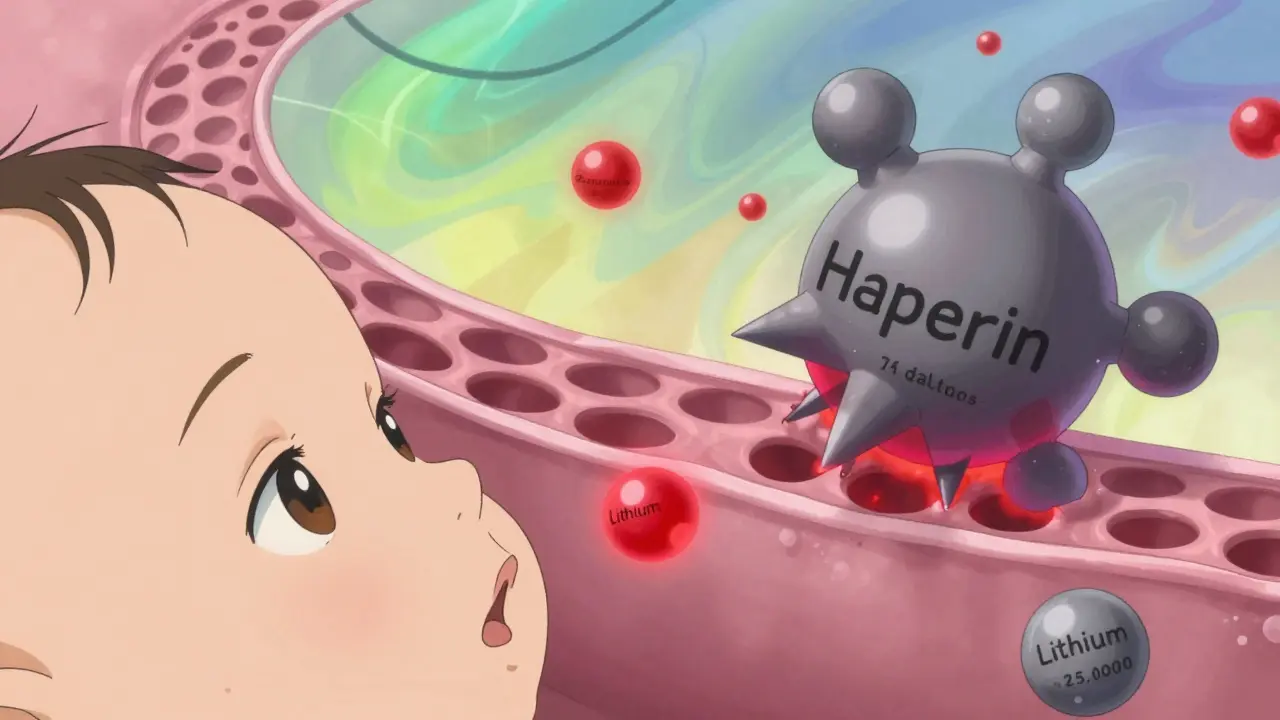
Not all drugs make the trip. Size matters. Medications with a molecular weight over 800 daltons-like heparin (which weighs about 15,000)-are too large to pass through the tiny gaps between breast cells. That’s why heparin is considered safe during breastfeeding. On the other hand, small molecules like lithium (74 daltons) slip through easily, which is why its use requires careful monitoring.
What Makes a Drug More Likely to Transfer
It’s not just size. Three other factors play a big role:
- Lipid solubility: Drugs that dissolve easily in fat (like diazepam) cross cell membranes faster. That’s why diazepam can reach milk concentrations 1.5 to 2 times higher than in the mother’s blood.
- Protein binding: If a drug sticks tightly to proteins in the blood-like warfarin, which binds 99% of the time-it can’t float freely to enter milk. The more protein-bound, the less transfers. For every 10% increase in protein binding, milk transfer drops by about 8.3%.
- pKa and pH trapping: The milk in your breast is slightly less acidic than your blood (pH 7.0-7.4 vs. 7.4). Weak bases like amitriptyline (pKa 9.4) get trapped in milk because they become charged and can’t easily move back out. This can make milk concentrations 2 to 5 times higher than in the blood.
These rules aren’t just theory. They’re why some drugs are safe and others aren’t. A drug that’s small, fat-soluble, poorly protein-bound, and a weak base is the perfect storm for infant exposure.
Timing Matters: When You Take the Pill
It’s not just which drug you take-it’s when. If you take a medication right after feeding, you give your body time to break it down before the next feeding. A 2019 study showed that waiting 3 to 4 hours after taking a dose reduces infant exposure by 30-50%.
For drugs with long half-lives-like diazepam (which can stay in a baby’s system for 30 to 100 hours)-timing becomes even more critical. One dose can linger and build up over days. That’s why doctors recommend monitoring infants on long-acting drugs, especially if the mother is taking more than 10 mg daily. Infant serum levels above 50 ng/mL can cause drowsiness or poor feeding.
For antidepressants like sertraline, the InfantRisk Center recommends checking the baby’s blood levels at 2 weeks after birth. Symptoms like irritability (seen in 8.7% of cases) or poor feeding (5.3%) are red flags. If levels exceed 10% of the mother’s therapeutic dose, it’s time to reconsider.
What’s Safe? What’s Not?
Not all medications are created equal when it comes to breastfeeding. Experts use a simple rating system to guide decisions:
- Level 1: No detectable transfer. Examples: insulin, heparin, penicillin.
- Level 2: Minimal transfer, no known infant side effects. Examples: sertraline, amoxicillin, ibuprofen.
- Level 3: Possible risk, monitor baby. Examples: fluoxetine, codeine.
- Level 4: Potential harm. Examples: lithium, methotrexate.
- Level 5: Contraindicated. Examples: radioactive iodine-131, bromocriptine.
Here’s the good news: 87% of commonly prescribed drugs fall into Levels 1 or 2. That means most mothers don’t need to stop breastfeeding.
Antibiotics? Almost all are safe. Amoxicillin transfers at just 1.5% of the maternal dose. Gentamicin? Only 0.1%. Painkillers like ibuprofen and acetaminophen are low-risk and cleared quickly.
Antidepressants are trickier. Sertraline is the go-to because it transfers at only 1-2% of the maternal dose. Fluoxetine, on the other hand, lingers in the baby’s system longer and has been linked to irritability. The European Medicines Agency warns about serotonin syndrome in rare cases, but the risk is low with proper dosing.
What About Birth Control?
Estrogen-containing contraceptives are a big red flag. Pills with more than 50 mcg of ethinyl estradiol can cut milk supply by 40-60% within 72 hours. That’s why progestin-only pills, IUDs, or implants are recommended instead. They don’t affect milk production and are considered safe.
And then there’s bromocriptine. It’s used to stop lactation after birth, and it works-95% of women stop producing milk within 5 days. But if you’re trying to breastfeed, avoid it. It’s not just ineffective-it actively works against you.

Special Cases: Nuclear Medicine and Imaging
Some tests need special handling. A VQ scan using Tc-99m MAA exposes the baby to about 0.15 mSv of radiation. Experts recommend waiting 12-24 hours before resuming breastfeeding. But an FDG-PET scan? Only 0.002% of the dose ends up in milk. You can feed right after.
For nuclear medicine, always ask: How much gets into milk? How long does it last? What’s the radiation dose to the baby? The answers are usually in the test instructions. If not, call your pharmacy or lactation consultant.
Real Numbers, Real Risks
Here’s what the data shows:
- 56.3% of breastfeeding mothers take at least one medication.
- 12.7% take drugs that are officially listed as contraindicated-often without knowing.
- Antibiotics are the most common (28.5%), followed by painkillers (22.1%) and antidepressants (18.3%).
- Sertraline is the #1 antidepressant prescribed during breastfeeding-3.2 prescriptions per 100 women each month.
- Medication concerns are the third most common reason mothers stop breastfeeding, after perceived low supply and nipple pain.
And yet, 98-99% of medications don’t require stopping breastfeeding. The real danger isn’t the drugs-it’s the fear.
What Should You Do?
If you’re breastfeeding and need medication:
- Don’t stop breastfeeding without checking. Most drugs are safe.
- Talk to your doctor and ask: “Is this safe for breastfeeding?” and “What’s the risk to my baby?”
- Take the drug right after feeding. Wait 3-4 hours before the next feed.
- Watch your baby. Look for drowsiness, poor feeding, irritability, or rash.
- Use trusted resources. The InfantRisk Center’s app (LactMed 3.2) and the AAP guidelines are reliable.
There’s no need to choose between your health and your baby’s. With the right information, you can do both.
Can I take antidepressants while breastfeeding?
Yes, many antidepressants are safe. Sertraline (Zoloft) is the most recommended because it transfers minimally into breast milk-usually 1-2% of the mother’s dose. Fluoxetine (Prozac) is less ideal because it stays in the baby’s system longer and has been linked to irritability in some infants. Always monitor your baby for signs like fussiness, poor feeding, or sleepiness. Blood tests aren’t usually needed unless you’re on a high dose or the baby shows symptoms.
Are antibiotics safe for breastfeeding mothers?
Almost all antibiotics are safe. Amoxicillin transfers at only 1.5% of the maternal dose, and gentamicin at just 0.1%. Neither has been linked to significant side effects in infants. The biggest concern is a change in the baby’s gut bacteria, which may cause mild diarrhea or yeast infections. These are usually temporary and not serious. If you notice a rash or unusual fussiness, contact your pediatrician.
Why do some drugs make babies sleepy?
Drugs like diazepam, phenobarbital, and codeine can cause drowsiness because they cross into milk easily and are slowly cleared by a baby’s immature liver. Diazepam, for example, can accumulate over time if taken daily. Infants under 3 months are especially sensitive. If your baby seems unusually sleepy, has trouble feeding, or has shallow breathing, stop the medication and call your doctor immediately.
Should I pump and dump after taking medication?
Rarely. Pumping and dumping doesn’t speed up drug clearance from your body-it just removes milk that already contains the drug. The best strategy is timing: take the medication right after feeding and wait 3-4 hours before the next one. This lets your body metabolize most of the drug before the next nursing session. Pumping and dumping is only needed in rare cases, like after a single high-dose narcotic or nuclear scan.
Can birth control pills affect my milk supply?
Yes, but only if they contain estrogen. Pills with more than 50 mcg of ethinyl estradiol can reduce milk production by 40-60% within 3 days. That’s why progestin-only pills, implants, or IUDs are recommended for breastfeeding mothers. These don’t affect supply and are considered safe. If you notice your milk drying up after starting birth control, switch to a progestin-only option or talk to your doctor about alternatives.
Comments
Korn Deno
Medications in breast milk aren't some scary monster. It's just physics. Passive diffusion, protein binding, pH trapping-these aren't magic, they're chemistry. The body's got systems. Drugs don't just magically flood the milk. Most are filtered out. The fear is way out of proportion to the actual risk. We overthink everything now.
And yet, 87% of meds are fine. That's not a coincidence. That's biology working as designed.
On March 24, 2026 AT 01:24
Katie Putbrese
I can't believe people still trust pharmaceutical companies enough to believe their 'safe' labels. Who even decides these ratings? Some guy in a lab coat who got paid by Big Pharma? I'm not letting my baby near anything that's not 100% natural. Breast milk should be pure. Period.
My cousin took Zoloft and her kid had seizures. They said it was 'rare.' I say it's a cover-up.
On March 24, 2026 AT 04:36
Chris Crosson
Wait, so you're telling me ibuprofen is safer than some 'natural' herbal tea? Because I just read that chamomile can cause liver toxicity in infants. Who made these rules? Why do we trust a pill more than a plant? It's backwards. We're scared of chemistry but not of grandma's remedy that's been passed down for centuries.
Also, why is sertraline #1? Because it's cheap? Or because the FDA got paid?
On March 25, 2026 AT 02:49
Grace Kusta Nasralla
I just want to say… I took fluoxetine for 8 months while breastfeeding. My son was fine. He’s 12 now. Perfect grades. No issues. But I cried every night for the first three months, terrified I was poisoning him. The guilt… it’s worse than the drug. No one tells you that. No one says: 'It’s okay to need help.'
I wish I’d known then what I know now. You’re not failing. You’re fighting.
On March 27, 2026 AT 00:02
Jacob Hessler
pump and dump is a scam. why do you think they sell those fancy pumps? so you waste time and money. just wait 4 hrs after you take it. duh. also lithium is bad? lol my aunt took it for 20 years and her kids turned out fine. stop scaring people.
On March 27, 2026 AT 10:49
Aaron Sims
So let me get this straight… the same people who scream 'vaccine danger!' are now saying 'meds in breast milk are fine'? Classic double standard. Who's behind this? WHO? AAP? CDC? All the same orgs pushing mask mandates and 5G conspiracies. This is mind control disguised as science. You think you're making a 'smart choice'? You're being programmed.
Also… why is heparin safe? Because it's too big? Or because it's not profitable? Hmm.
On March 29, 2026 AT 03:15
Amber Gray
I took amoxicillin and my baby got a rash 😔 but we kept going! 🤗 turned out it was just a yeast thing from antibiotics. Pumped and dumped once, then kept nursing. My little guy is 3 now and runs like a cheetah 🐆🍼 #breastfeedingwarrior
On March 29, 2026 AT 04:32
Chris Farley
This whole article reads like a corporate brochure. '87% are safe'-yeah, because the FDA lets Big Pharma write the guidelines. Real scientists? They don't work for Merck. Real moms? They're out there in the trenches, watching their babies for tremors, wondering if that 3am scream was the drug or just colic. We're not dumb. We see the pattern. You're not protecting us. You're protecting profits.
And don't get me started on sertraline being 'recommended.' It's the only one left after they pulled the others. That's not safety. That's damage control.
On March 30, 2026 AT 17:00