
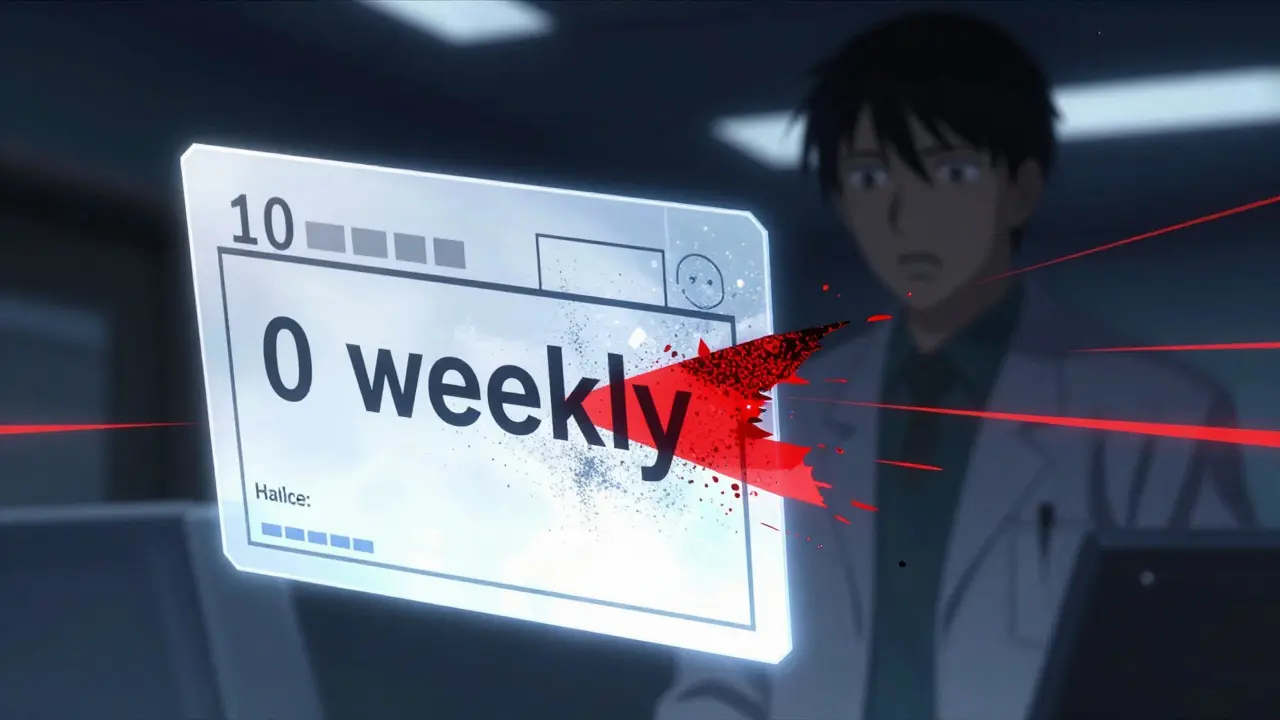
Imagine this: a doctor sends an electronic prescription for methotrexate. The intent is clear-take one tablet once a week. But when it lands in the pharmacy’s system, the formatting glitches. The '1' looks like a '10', or the frequency field drops off entirely. The pharmacist sees 'daily' instead of 'weekly'. By the time anyone notices, the patient has taken a toxic dose. This isn’t a hypothetical nightmare; it’s a real risk that persists even after we moved away from handwritten scripts.
We switched to e-prescribing systems digital platforms that allow healthcare providers to send prescriptions electronically to pharmacies to fix handwriting issues. And yes, they helped. But they didn’t solve everything. In fact, they created new types of mistakes called transcription errors inaccuracies that occur when prescription data is transferred between incompatible software systems or manually re-entered. These happen when systems don't talk to each other properly. If you are a provider, a pharmacist, or just someone who wants their meds handled safely, understanding these hidden traps is crucial. Here is how you can spot them and stop them before they reach a patient.
The Hidden Cost of Digital Handoffs
It feels counterintuitive, right? We digitized prescribing to remove human error, yet errors still slip through. The reason is fragmentation. Your clinic might use Epic a leading electronic health record (EHR) system used by many hospitals and clinics, while the local pharmacy runs on QS/1 a popular pharmacy management software used by independent pharmacies. When these two systems exchange data, they speak slightly different languages. Sometimes, the translation fails.
A study published in the *Pharmaceutical Journal* in 2015 found that transcription errors make up nearly 40% of all prescribing errors in electronic systems. That’s huge. Most of these aren’t about picking the wrong drug. They are about formatting. Think of it like copying text from a PDF into a Word doc-the spacing gets messed up, fonts change, and sometimes characters disappear. In medicine, a missing space or a misread number can be deadly.
The good news? We know exactly why this happens. It’s usually down to three things:
- Unstructured Sig Codes: The "sig" (short for signa, meaning directions) is often free-text. One system writes "Take 1 tab PO daily," another expects "1 TAB ORAL DAILY." If the receiving system doesn’t parse that correctly, chaos ensues.
- System Interoperability Gaps: Not all Electronic Health Records (EHRs) connect seamlessly with every Pharmacy Management System (PMS). About 68% of small practices struggle with full connectivity.
- Manual Re-entry: When the digital handoff fails, staff have to type the info in again. Humans get tired. Humans make typos.
Standardizing the "Sig": The First Line of Defense
If there is one thing you can do today to reduce errors, it is standardizing how you write instructions. Research from *Health Affairs* in 2018 showed that adopting structured sig functionality could cut errors by 28%. What does "structured" mean? It means using standardized codes instead of free-form text where possible.
Instead of typing out "Take one pill by mouth every morning," your system should ideally use standardized abbreviations that both the sending and receiving systems recognize universally. For example:
- Use "PO" for by mouth, not "oral" or "by mouth" interchangeably without checking compatibility.
- Specify units clearly: "mg" not "milligrams" if the system prefers short forms.
- Avoid ambiguous symbols. A period at the end of a number (like "5.") can sometimes be read as a decimal point for the next number if the font is weird.
Dr. David Bates from Harvard Medical School pointed out in a 2020 commentary that incorporating medication indications directly into the e-prescribe process could eliminate 78% of dosing frequency errors. Why? Because if the system knows the drug is for arthritis (usually weekly) versus depression (usually daily), it can flag a mismatch if the frequency doesn’t align with common practice. It adds a layer of logic to what is otherwise just raw data transfer.
Fixing the Workflow: CancelRx and Shared Lists
Another major source of confusion is when a prescriber changes their mind. Maybe they realize the dosage is too high, or the patient is allergic. In older workflows, the doctor would call the pharmacy to cancel. Now, they send a new e-prescription. The problem? The old one hasn’t been canceled electronically. The pharmacist now has two active orders for the same patient. Which one do they fill?
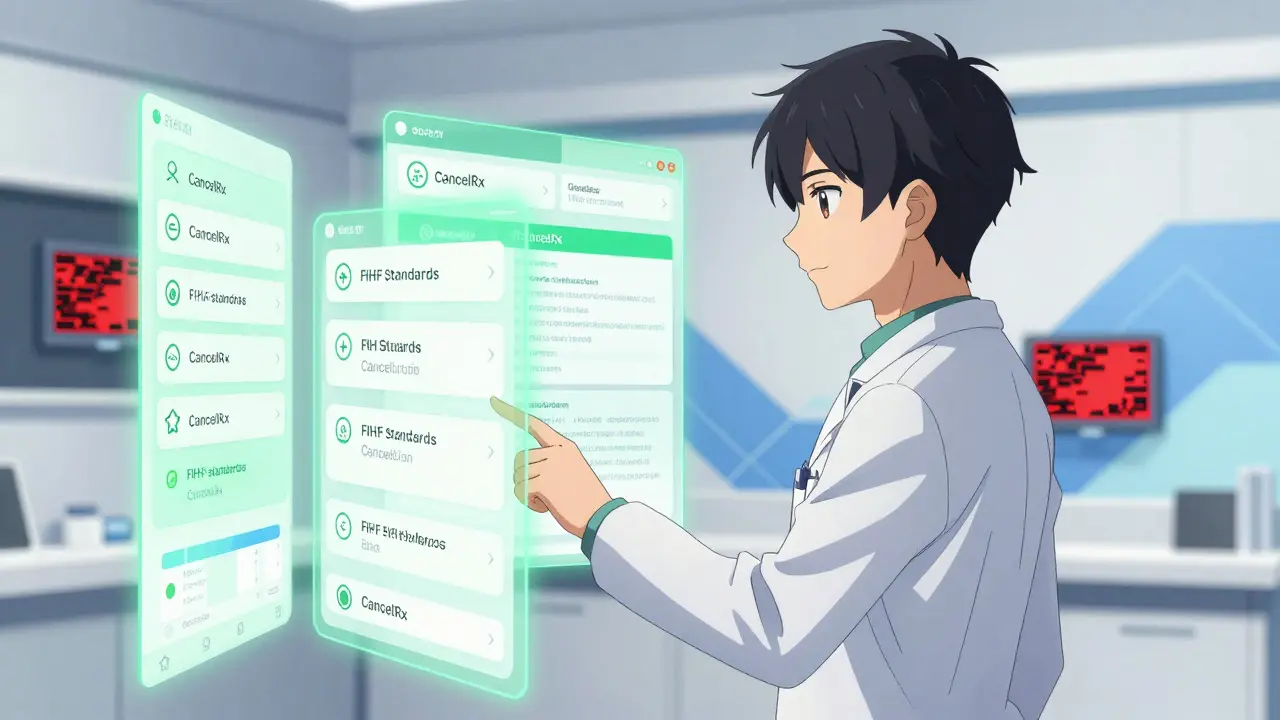
This is where the CancelRx protocol an electronic standard developed by Surescripts that allows prescribers to instantly cancel sent prescriptions comes in. Developed by Surescripts in 2012, CancelRx lets doctors electronically void a prescription the moment they send a correction. It stops the pharmacy from getting confused by back-to-back orders. Studies show implementing this reduces discontinued medication errors by 63%. If your system supports it, use it. Always.
Equally important is the concept of a single shared medication list a unified record of all a patient's medications accessible to both prescribers and pharmacists. When your EHR and the pharmacy’s PMS share a live view of what the patient is currently taking, reconciliation errors drop by over 50%. No more guessing if the patient is already on Warfarin because the last visit was at a different clinic. The data is right there, synced in real-time.

Technology Standards: Why FHIR Matters
You might not be a coder, but you need to know what’s happening under the hood. The current standard for exchanging health data is evolving. For years, we relied on older HL7 versions. Now, the industry is moving toward HL7 FHIR Fast Healthcare Interoperability Resources, a modern standard for exchanging healthcare information electronically.
FHIR Release 4.0.1, updated in late 2021, is designed specifically to handle complex data like prescriptions without losing details. A case study from ISMP Canada in 2017 demonstrated that proper interoperability standards could eliminate 92% of manual re-entry errors. How? By ensuring that when Epic sends a script to Pioneer Rx, every single field-from strength to route to frequency-lands in the correct box automatically. No typing required.
Here is a quick comparison of how different approaches stack up:
| Integration Level | Error Reduction Potential | Primary Benefit | Implementation Difficulty |
|---|---|---|---|
| Standalone E-Prescribing | Low (13-20%) | Cheap, easy setup | Easy |
| EHR-Integrated (Basic) | Medium (40-55%) | Single screen entry | Moderate |
| FHIR-Connected (Advanced) | High (67-92%) | Zero manual re-entry | Complex (requires API work) |
If you are choosing a system for your practice, ask about FHIR compatibility. It’s not just buzzword bingo; it’s the difference between a script arriving intact or needing manual fixes.
Human Factors: Fighting Alert Fatigue
Let’s talk about the people behind the screens. Even the best technology fails if the user ignores it. Dr. Joan Ash from Oregon Health & Science University noted that alert fatigue contributes to 34% of transcription errors. What is alert fatigue? It’s when your computer pops up with warnings for everything-drug interactions, allergies, generic substitutions, insurance checks. Eventually, you click "OK" without reading. You override critical warnings because you’re overwhelmed.
To avoid this, customize your alerts. Turn off the noise. Only keep warnings for life-threatening interactions or true contraindications. If your system warns you every time you prescribe Tylenol to someone who had it last year, you’ll stop paying attention. And when you stop paying attention, you miss the warning that matters-like the one telling you the dose is ten times too high.
Also, train your staff. A 2021 implementation guide from the Agency for Healthcare Research and Quality (AHRQ) suggests providers need about 4.7 hours of training to adapt to new error-resolution protocols. Pharmacists need around 3.2 hours. Don’t skip this. Show them how to spot a malformed sig. Teach them when to call the doctor instead of guessing.
Practical Steps for Implementation
Ready to clean up your prescribing workflow? Here is a phased approach based on evidence-based strategies:
- Weeks 1-4: Standardize Sigs. Audit your most commonly prescribed drugs. Create templates for their instructions. Ensure your system uses standardized terminology (like SNOMED CT codes) for routes and frequencies.
- Weeks 5-8: Enable CancelRx. Check if your e-prescribing vendor supports CancelRx. If so, turn it on. Train staff to always cancel the old order before sending a new one.
- Weeks 9-12: Integrate Indications. Start requiring indication fields for high-risk drugs (like opioids, antibiotics, and methotrexate). This helps catch frequency errors early.
- Ongoing: Monitor Connectivity. Work with your IT team to ensure your EHR is ONC-certified and meets the 2015 Edition criteria. Push for API-based connections with major pharmacy networks like Surescripts.
Don’t underestimate the power of simple communication. If your system fails, pick up the phone. A 30-second call to clarify a weird-looking script is better than a 30-minute delay at the pickup counter-or worse, a harmed patient.
Looking Ahead: AI and Future Standards
The landscape is shifting fast. By 2025, the Office of the National Coordinator for Health Information Technology (ONC) is mandating API-based connectivity for most systems. This means smoother data flow. Plus, new tools like AI-powered validation (such as Epic’s DoseMeRx) are entering pilot phases. These tools scan prescriptions for anomalies before they are even sent. Early pilots suggest they could cut remaining errors by another 65%.
But until universal adoption of FHIR standards happens (projected around 2028), we have to be vigilant. The technology is great, but it’s not perfect. Your awareness, your workflow habits, and your willingness to double-check strange data are the final safeguards. Keep asking questions. Keep pushing for better integration. And never assume the screen is right just because it’s digital.
What causes transcription errors in e-prescribing systems?
Transcription errors usually occur due to lack of interoperability between different software systems (like EHRs and pharmacy management systems), unstructured formatting of prescription instructions (sigs), and the need for manual re-entry when digital transfers fail. Ambiguous abbreviations and system-specific coding differences also contribute significantly.
How does CancelRx help prevent medication errors?
CancelRx is an electronic protocol that allows prescribers to instantly cancel a previously sent prescription. This prevents pharmacists from receiving multiple conflicting orders for the same patient, reducing confusion and the risk of filling an outdated or incorrect prescription by up to 63%.
What is HL7 FHIR and why is it important for e-prescribing?
HL7 FHIR (Fast Healthcare Interoperability Resources) is a modern technical standard for exchanging healthcare data. It ensures that prescription details are transmitted accurately between different systems without losing format or context, potentially eliminating up to 92% of manual re-entry errors.
Can standardized sig codes really reduce errors?
Yes. Research indicates that using structured, standardized sig codes instead of free-text instructions can reduce transcription errors by approximately 28%. It ensures that both the sending and receiving systems interpret dosage and frequency instructions identically.
What should I do if I suspect an e-prescription has a transcription error?
If you are a pharmacist or technician, do not guess. Contact the prescriber immediately to verify the intent. If you are a prescriber, double-check the transmission status and consider using CancelRx if you need to send a correction. Never assume the digital display is accurate if it looks unusual or inconsistent with clinical norms.