
Every morning, hundreds of thousands of children across the U.S. swallow pills, use inhalers, or get insulin shots-right in the middle of math class or recess. These aren’t random acts. They’re carefully planned, legally required, and life-saving routines managed by school nurses. But coordinating this isn’t just about handing out medicine. It’s about making sure the right child gets the right drug, in the right dose, at the right time, every single day-without errors, without delays, and without breaking the law.
Why School Nurses Are the Backbone of Pediatric Medication Safety
School nurses don’t just treat scrapes and fevers. They’re the only licensed medical professionals on-site who can legally oversee medication administration for students with chronic conditions like asthma, diabetes, epilepsy, or ADHD. According to the National Association of School Nurses (NASN), nearly 1 in 7 students in U.S. public schools need daily medication during school hours. That’s over 7 million children relying on school staff to keep their treatment on track.
But here’s the problem: 78% of school districts can’t hire enough nurses to meet the recommended ratio of 1 nurse to 750 students. The national average is 1:1,102. In rural areas, it’s often worse. That means nurses must delegate medication tasks to trained unlicensed staff-teachers, aides, or office workers. And that’s where things get risky if not done right.
The key? A clear, consistent system based on the Five Rights of Medication Administration: right student, right medication, right dose, right route, right time. These aren’t just best practices-they’re federal standards backed by the American Academy of Pediatrics (AAP) and the NASN’s 2022 Clinical Practice Guideline. Skipping even one of these steps can lead to serious harm.
Step 1: Build a District-Wide Policy Using NASN Templates
You can’t wing this. Every district needs a written policy approved by the school board and legal counsel. Start with the free templates from NASN’s Implementation Toolkit. These aren’t suggestions-they’re legally defensible frameworks that align with federal laws like IDEA and Section 504.
Your policy must cover:
- Who can administer medications (only licensed nurses or trained unlicensed personnel under direct supervision)
- How medications are stored (locked cabinets, double-counting for controlled substances)
- How errors are reported (using a non-punitive "Just Culture" model)
- How parents must provide medications (original pharmacy-labeled containers only)
One district in Montgomery County, Maryland, saw parent compliance jump from 52% to 98% after requiring a mandatory 30-minute orientation for families. Parents who brought unlabeled pills or split pills from bottles were told: "We can’t give it. You must get it properly labeled."
Step 2: Screen Students and Classify Their Needs
Not every student who takes medication needs the same level of care. Use the three-tier system from New York State Education Department (NYSED) to categorize students:
- Nurse Dependent: Complex conditions like insulin pumps, feeding tubes, or seizure meds. Requires daily RN assessment.
- Supervised: Asthma inhalers, oral ADHD meds, or EpiPens. Can be given by trained staff under nurse oversight.
- Self-Administered: Older students with stable conditions who can safely take their own meds (e.g., teen with well-controlled asthma). Requires written consent and periodic checks.
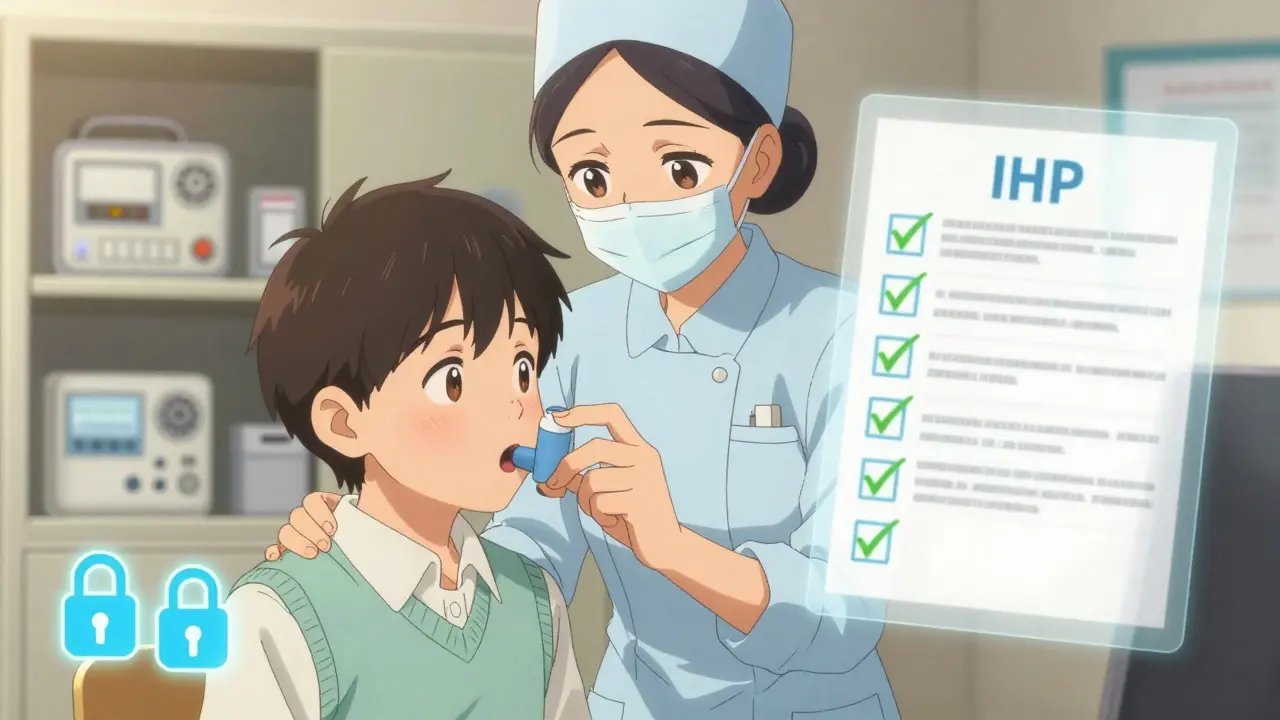
Once classified, create an Individualized Healthcare Plan (IHP) for each student who needs ongoing care. This isn’t a form-it’s a living document signed by the parent, the child’s doctor, and the school nurse. It outlines exact medication times, side effects to watch for, and emergency steps. IHPs improve adherence by 28% compared to simple medication logs, according to NASN data.
Step 3: Train Nurses and Delegate Wisely
Delegation isn’t handing off a clipboard. It’s a legal responsibility. Only licensed school nurses can delegate. And they must assess two things before doing so:
- Is the student’s condition stable and predictable?
- Is the staff member trained, competent, and willing?
Training for unlicensed personnel varies by state. In Virginia, staff must complete 16 hours of training for complex meds like insulin. For simple oral meds, it’s 4 hours. The training must include:
- Reading pharmacy labels
- Verifying the Five Rights
- Recognizing signs of adverse reactions
- Proper documentation
States like Texas treat this as an "administrative task," which is dangerous. A 2022 legal analysis found districts using this model had 14% higher liability risk. Why? Because when a nurse isn’t involved in the decision, they can’t be held accountable for errors.
Step 4: Store and Label Medications Correctly
Medications must arrive in original, pharmacy-labeled containers. No Ziploc bags. No pill organizers. No handwritten notes taped to bottles. Federal law (21 CFR § 1306.22) requires this for all controlled and non-controlled substances.
Controlled substances (like Adderall or Ritalin) need extra safeguards:
- Locked, double-locked cabinet
- Double-counting before and after each dose
- Dual signatures on log sheets
Dr. Jane Murphy from the Texas Department of State Health Services says it plainly: "Administering from unlabeled containers violates federal drug laws. You’re not just risking liability-you’re breaking the law."
Step 5: Document Everything-Immediately
Documentation isn’t busywork. It’s your legal shield. If a child has a reaction, the first thing lawyers ask is: "Was it documented?"
Every time a medication is given, you must record:
- Student’s name
- Medication name and dose
- Time given
- Route (oral, inhaler, injection)
- Staff member who administered
- Student’s response (e.g., "no adverse effects," "reported nausea")
98% of districts use electronic systems now. Fairfax County, Virginia, cut documentation time by 45% and improved accuracy by 31% after switching from paper logs to a digital system that auto-flags missed doses. But if you’re still using paper, make sure logs are stored securely and signed daily by the nurse.
Step 6: Handle Emergencies Like Anaphylaxis or Seizures
Stock epinephrine (EpiPen) is now in 87% of U.S. schools. But having it isn’t enough. You need a plan.
For anaphylaxis:
- Recognize symptoms within seconds (hives, swelling, wheezing, collapse)
- Administer epinephrine within 5 minutes (CDC standard)
- Call 911 immediately after
- Notify parents and document everything
Same goes for seizures. Schools must have standing orders for rescue meds like diazepam nasal spray. Nurses must train staff on when to use them-and when not to. For example, never put anything in a child’s mouth during a seizure. That’s a myth.
Step 7: Review, Improve, and Stay Updated
Medication safety isn’t a one-time setup. It’s a cycle. Hold monthly reviews of near-misses and errors. Use the "Just Culture" model from NASN: focus on systems, not blame. A nurse in Ohio reported a 70% drop in staff anxiety after adopting these templates.
Also, stay current. In January 2024, NASN and the AAP launched the School Medication Administration Standardization Initiative. It’s already been adopted in 12 states and will spread to 45 by 2026. Your district’s policy must evolve with it.
And don’t ignore the human side. Nurses spend an average of 2 hours a day just on documentation. That’s time taken from seeing other students. Technology helps. So does training. And so does listening to the nurses on the front lines.
What Happens When It Goes Wrong?
In 2022, Houston ISD was fined $2.3 million by the Texas Education Agency for failing to follow IEP medication protocols. A child with epilepsy had a seizure because the wrong dose was given-and no one had documented the error.
That’s not an outlier. NASN data shows 1.2% of school-based medication administrations involve errors. That sounds small. But with 7 million kids on daily meds, that’s over 84,000 mistakes a year. Most are minor. But some aren’t.
Every error starts with a gap in coordination: a nurse too busy, a parent not trained, a label missing, a form not signed. Fix those gaps before they become headlines.
What School Nurses Say Works
On Reddit’s r/SchoolNursing, nurses share what actually helps:
- "The NASN Just Culture templates made me feel protected when I reported a near-miss. No one got fired. We fixed the system."
- "We started requiring parents to bring meds in original bottles. We lost a few fights, but zero errors since."
- "Our electronic system auto-reminds staff 15 minutes before meds are due. It’s a game-changer."
- "I trained three aides to give insulin. Now I can focus on the kids with complex needs."
They all say the same thing: consistency saves lives.
Final Checklist for Coordinating Daily Pediatric Medications
Use this before the school year starts-or anytime you’re reviewing your system:
- ☐ District policy aligns with NASN 2022 guidelines
- ☐ All medications are in original, labeled containers
- ☐ Every student with daily meds has an IHP signed by parent, doctor, and nurse
- ☐ Unlicensed staff are trained and competency-assessed
- ☐ Controlled substances are double-counted and locked
- ☐ Emergency meds (EpiPens, seizure rescue) are accessible and staff trained
- ☐ Documentation is electronic or signed daily
- ☐ Monthly error review meetings are held
- ☐ Parents attend mandatory orientation on medication rules
- ☐ Nurse-to-student ratio is tracked and reported to administration
Can a teacher give my child medication if the nurse is out sick?
Only if they’ve been properly trained and the school nurse has formally delegated the task under state law. Teachers can’t just step in. Delegation requires a nurse’s assessment of both the child’s needs and the staff member’s competence. If the nurse isn’t available, the medication should be held until they return-or the child goes home.
What if a parent brings medication in a pill organizer?
The school cannot administer it. Federal law requires all medications to be in original, pharmacy-labeled containers. Pill organizers, even if labeled by the pharmacy, don’t meet this standard. The school should ask the parent to get the medication properly dispensed. Many pharmacies offer free blister packs for school use.
Do schools have to give medication during field trips?
Yes-if the child’s IHP includes it. Schools must ensure continuity of care during all school-sponsored activities. The nurse must plan ahead: assign trained staff, bring extra meds, carry emergency kits, and document everything. Many districts now use mobile apps to verify doses on field trips.
Can a student self-administer their own medication?
Yes, for some students-typically older teens with stable conditions like asthma or type 1 diabetes. But it requires written permission from the parent and doctor, a signed self-administration agreement, and periodic checks by the nurse to ensure safety. The nurse still remains legally responsible for oversight.
How often should medication policies be reviewed?
At least annually, and whenever state laws change. The AAP and NASN update their guidelines regularly. Districts that wait for an incident to trigger a review are playing with liability. Best practice: review policies every fall, after summer break, when new students arrive and staff turnover happens.
What Comes Next?
The future of school medication coordination is digital. By 2026, over half of U.S. districts plan to use smartphone-based systems that scan barcodes on medication bottles, verify student IDs, and auto-log doses. Some even use AI to flag missed doses or potential interactions.
But technology won’t fix poor training or weak policies. The human element-the nurse who knows the child’s history, the aide who notices a child looks pale, the parent who calls to say the dose changed-will always matter most.
Coordinating daily pediatric medications isn’t about checking boxes. It’s about building trust. Trust that the school will keep your child safe. Trust that the nurse has a plan. Trust that no one will cut corners.
And that trust? It’s earned one correct dose at a time.
Comments
jenny guachamboza
lol so now we need a PhD just to give a kid a tylenol? 🤡 I saw a nurse in my kid's school use a ZIPLOC once and no one died... maybe the system is broken because we overthink everything? 🤷♀️💊
On December 22, 2025 AT 08:51
Gabriella da Silva Mendes
This is why America is collapsing. First they tell us we can’t even give our kids aspirin without a 47-page form, then they want us to pay for drone-delivered epinephrine. My kid gets meds at home. Why does the school need to be a pharmacy? 🇺🇸😤 They’re not in the military, they’re in 3rd grade. Let them suffer a little. Builds character. And stop using emoji like you’re texting your therapist.
On December 22, 2025 AT 18:31
Nader Bsyouni
The Five Rights are a myth constructed by bureaucratic capitalism to pacify the fear of liability. The real right is the right to be human. A child with asthma doesn’t need a checklist-they need a breath. A nurse who sees them as more than a case number. The system is not broken. It’s designed to fail. We’re not managing medicine. We’re managing fear. And fear is the only thing that never runs out
On December 23, 2025 AT 18:55
Ajay Brahmandam
I work in a school in Kerala and we give meds to kids without any of this paperwork. Nurse is one for 300 kids, no digital logs, no double-counting. Kids are fine. Maybe the problem isn't the system-it's the fear of trusting people? Simple is better. Trust + training > bureaucracy.
On December 24, 2025 AT 17:34
Aliyu Sani
The real issue here is the epistemological dissonance between policy and praxis. We’re hyper-documenting compliance while under-resourcing the human agents who execute it. The nurse isn’t a cog. She’s the circuit breaker. When you treat her like a clerk, you don’t reduce liability-you amplify systemic fragility. The solution isn’t more forms. It’s more dignity.
On December 26, 2025 AT 01:58
Tony Du bled
I’m from Nigeria and we don’t have school nurses. Parents give meds at drop-off. Sometimes kids forget. Sometimes they don’t. But we don’t have lawsuits because we don’t have lawyers around every corner. Maybe we’re doing it wrong? Or maybe America’s just scared of kids being kids?
On December 27, 2025 AT 06:18
Tarun Sharma
The guidelines outlined are legally sound and clinically appropriate. Deviations risk student safety and institutional liability. Compliance is not optional. Training must be standardized and documented. This is non-negotiable.
On December 27, 2025 AT 09:38
Jim Brown
There is a sacred covenant between caregiver and child. To administer medication is to hold a life in your hands-not as a task, but as a trust. The Five Rights are not bureaucratic checkboxes. They are the sacred syllables of a vow: Right child. Right drug. Right dose. Right time. Right way. To violate one is to betray the silence of a child who trusts you with their breath.
On December 28, 2025 AT 09:16
Jeremy Hendriks
Let’s be real. This guide is 100% correct. But nobody’s doing it. Nurses are drowning. Teachers are terrified. Parents don’t read the forms. And the district? They’ll blame the nurse when something goes wrong. So why bother? Because someone has to. Even if it’s just one person who still cares.
On December 30, 2025 AT 02:23
Kiranjit Kaur
Y’all are overcomplicating this 😤 My cousin’s school just uses a whiteboard and a clipboard. Nurses train aides for 2 hours. Kids get meds. No drama. No lawsuits. Just care. Stop making it a corporate audit. Start making it human. 💪❤️
On December 30, 2025 AT 04:37
Sai Keerthan Reddy Proddatoori
This is all just a cover for the government to control our kids. Why do we need to document every pill? Who’s watching? Who’s tracking? Next thing you know, they’ll be putting microchips in the meds. I saw a video on TruthSocial-school nurses are part of a federal surveillance program. Don’t sign anything.
On December 31, 2025 AT 22:35
Johnnie R. Bailey
I’ve seen this play out in three districts. The ones with digital systems? They sleep better. The ones with paper logs? They’re one misfiled form away from a lawsuit. But the real win? When the nurse knows the kid’s favorite color. When the aide remembers the kid hates grape flavor. That’s the tech that matters. The rest? Just paperwork.
On January 1, 2026 AT 17:01
Kathryn Weymouth
I appreciate the thoroughness of this guide, but I’m curious: how many districts actually enforce the requirement for original pharmacy containers? I’ve seen countless cases where parents bring meds in unlabeled bottles, and schools still administer them out of convenience.
On January 1, 2026 AT 21:56
Julie Chavassieux
I’m a nurse. I’ve been doing this for 22 years. Last week, a kid almost died because the aide gave the wrong dose. The form was signed. The label was there. But no one double-checked. I cried. Not because I got in trouble. Because I failed him. This isn’t about policy. It’s about who’s watching. And right now? Nobody’s watching.
On January 1, 2026 AT 22:17
Vikrant Sura
The entire framework is statistically insignificant. 1.2% error rate? That’s 84,000 mistakes? Out of how many administrations? 7 million kids x 365 days x 1.5 meds = 3.8 billion doses. 84,000 is 0.002%. That’s less than a mosquito bite in a hurricane. Stop sensationalizing. This is not a crisis. It’s a paperwork problem.
On January 3, 2026 AT 11:13