
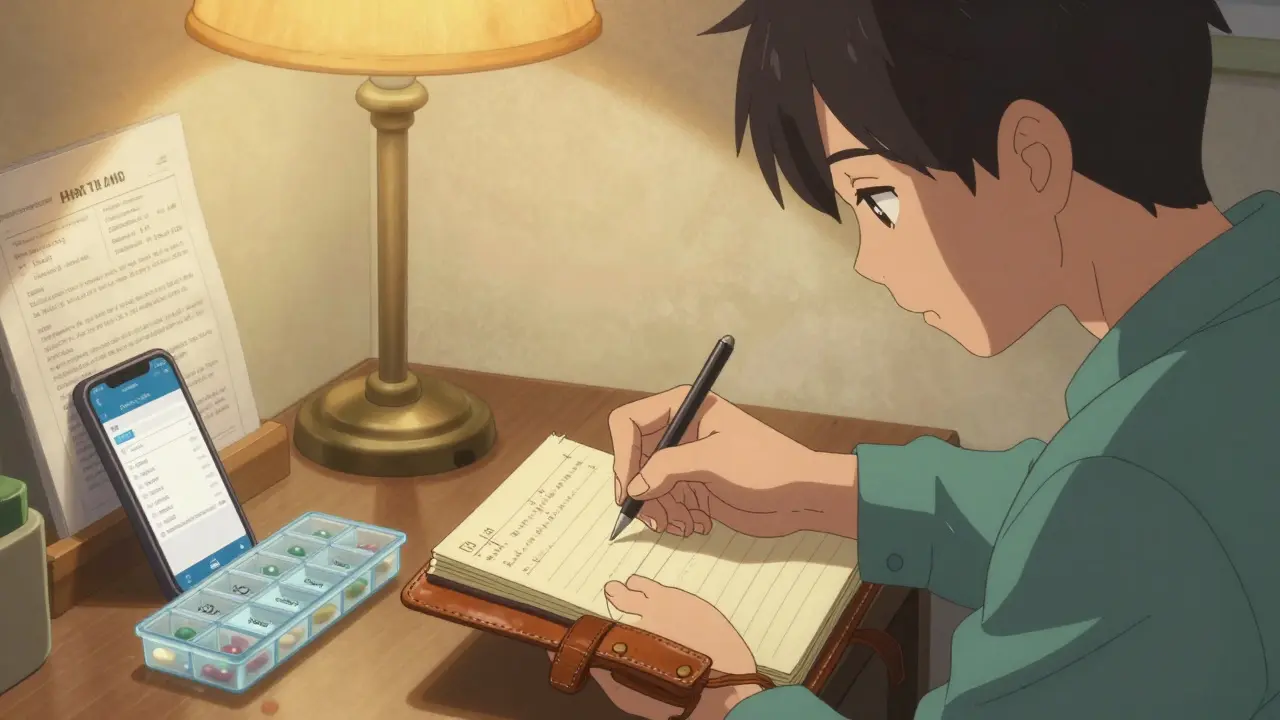
When your doctor or pharmacist gives you advice about your medications, it’s not just a quick chat-it’s critical medical information that could affect your health for weeks, months, or even years. Writing it down isn’t optional. It’s a safety net. Missing one detail-like the right time to take a pill or a warning about food interactions-can lead to side effects, hospital visits, or worse. The good news? You don’t need to be a medical professional to do this right. You just need to be clear, consistent, and thorough.
Why Documentation Matters More Than You Think
Every year, about 7,000 people in the U.S. die from medication errors, according to the Institute of Medicine. Many of these aren’t caused by bad prescriptions. They happen because information gets lost in translation. A nurse doesn’t know you were told to take your blood pressure pill with food. A pharmacist doesn’t know your doctor changed the dose last week. You forget the exact reason your doctor said to stop the antibiotic early. These aren’t just mistakes-they’re preventable. The law and professional standards back this up. The American Medical Association, the Joint Commission, and the Centers for Medicare & Medicaid Services all require clear, dated records of medication advice. If something goes wrong and you end up in court, your documentation (or lack of it) becomes evidence. What you write could be read aloud in a courtroom. That’s why providers are trained to document everything: what was said, who said it, when, and how you responded.What Exactly Should You Write Down?
Don’t just jot down “took medicine.” Be specific. Here’s what to include every single time:- Medication name-both brand and generic. If your doctor says “Lipitor,” write “atorvastatin (Lipitor).”
- Dose and frequency-“Take 10 mg once daily” is better than “take one pill.”
- When to take it-before meals? at bedtime? with water? on an empty stomach?
- Duration-“Take for 14 days” or “Take until refill” or “Take long-term.”
- Number of refills-If you’re told you can refill twice, write it down. Don’t assume.
- Purpose-Why are you taking this? “For high cholesterol” or “To prevent infection after extraction.”
- Side effects to watch for-“Dizziness after standing” or “Stomach upset after meals.”
- Food or drug interactions-“Don’t drink grapefruit juice” or “Avoid ibuprofen.”
- What to do if you miss a dose-“Skip it and take next dose” or “Take as soon as you remember.”
- Any refusals or concerns-If you said, “I don’t want to take this because of the cost,” write that down. It matters.
These aren’t suggestions. They’re the minimum required by the American Dental Association, the American Society of Health-System Pharmacists, and the National Committee for Quality Assurance. If you’re seeing multiple providers, this list becomes your shared language.
How to Keep It Organized
Scattered notes on napkins or phone memos won’t cut it. You need a system that lasts. Here’s what works:- Use a dedicated notebook-Not your planner. Not your phone. A small notebook you carry with you to every appointment. Label each page with the date and provider name.
- Keep a digital copy-Take a photo of your handwritten notes or type them into a note app. Use a folder named “Medications” with subfolders for each drug.
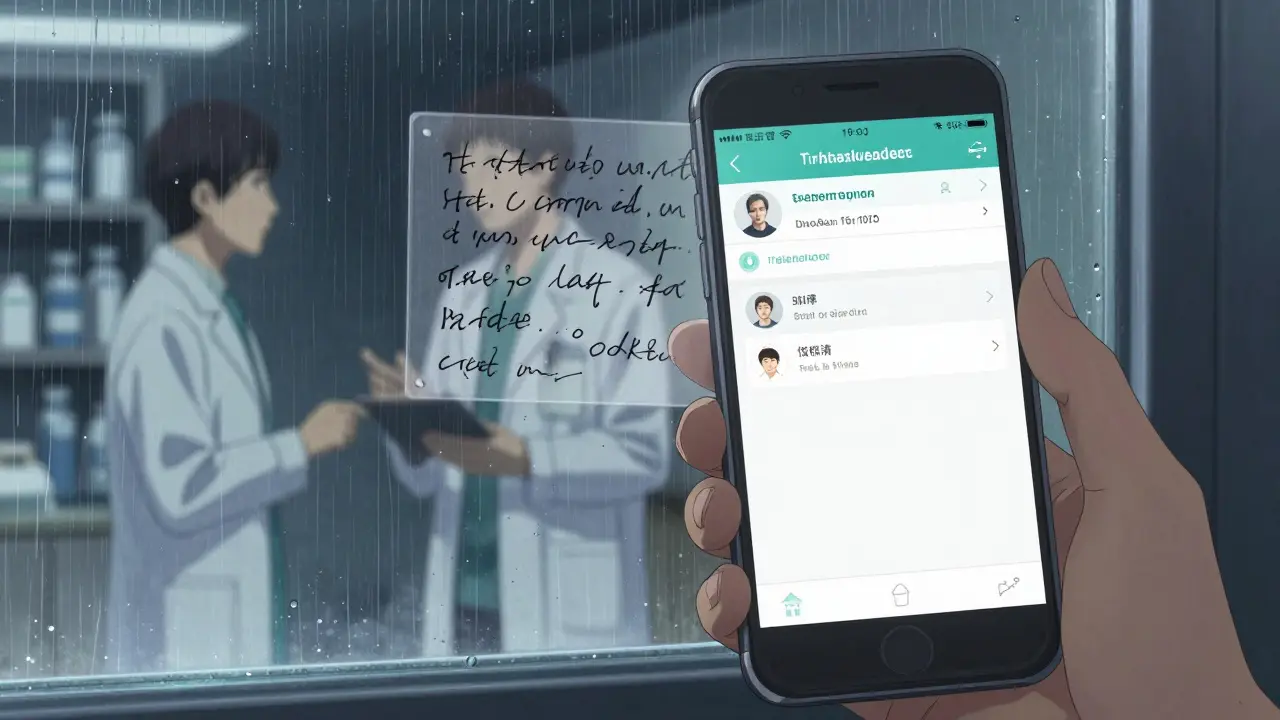
- Sync with your pharmacy-Most pharmacies now offer online portals. Log in weekly and compare what they list to what your provider told you. Discrepancies? Call them.
- Use your EHR portal-If your provider uses an electronic health record (EHR), check your patient portal after each visit. Many now auto-generate medication summaries. If something’s missing, message your provider’s office immediately.
Don’t rely on memory. Even the most organized people forget details after 48 hours. A 2023 study by the Agency for Healthcare Research and Quality found that patients who kept written records were 30% less likely to make a medication error.
What to Do When Advice Changes
Medications change. Doses get adjusted. New ones are added. Old ones are stopped. When this happens:- Mark the old note with a line through it-not erased. Write “Revised on [date]” next to it.
- Write the new instruction clearly, with the same level of detail.
- Ask: “Is this replacing the last one, or adding to it?” Write the answer.
- If you’re switching pharmacies or providers, bring your notebook. Don’t assume they’ll have your history.
Medication reconciliation-the process of comparing your current meds to what’s been prescribed-is required at every transition of care: hospital discharge, clinic visits, nursing home moves. If your records don’t match, someone might give you a duplicate drug or miss a critical interaction.
Special Cases: Telehealth, Phone Calls, and After-Hours Advice
More advice is happening outside the office. You might get a text from your nurse, a voicemail from the on-call doctor, or a Zoom chat with your pharmacist. These count too.- Phone calls-Write down the date, time, who you spoke with, and what they said. Example: “Jan 10, 2026, 4:15 PM, Nurse Patel: ‘Stop aspirin for 5 days before dental cleaning.’”
- Telehealth visits-After the call, send yourself a quick email summarizing what was discussed. Subject line: “Follow-up: Medication advice from 1/10/26 telehealth.”
- Text messages-If your provider sends a text like “Take 2 pills twice daily,” screenshot it and save it in your Medications folder. Then write it in your notebook. Texts can disappear.
The American Dental Association updated its guidelines in 2023 to require documentation of all phone and telehealth advice-even if it’s just a quick tip. That’s because these are the exact moments when errors happen.
What Not to Do
Avoid these common mistakes:- Don’t use abbreviations-“q.d.” instead of “daily” can be misread. “MS” could mean morphine or magnesium sulfate. Spell it out.
- Don’t write “as directed”-That’s meaningless. Who directed it? When?
- Don’t wait until the next visit-Document within 24 hours. Memory fades fast.
- Don’t assume your provider knows you wrote it down-Show them your notes. Say: “I wrote this down-does it match what you said?”
When You’re the Caregiver
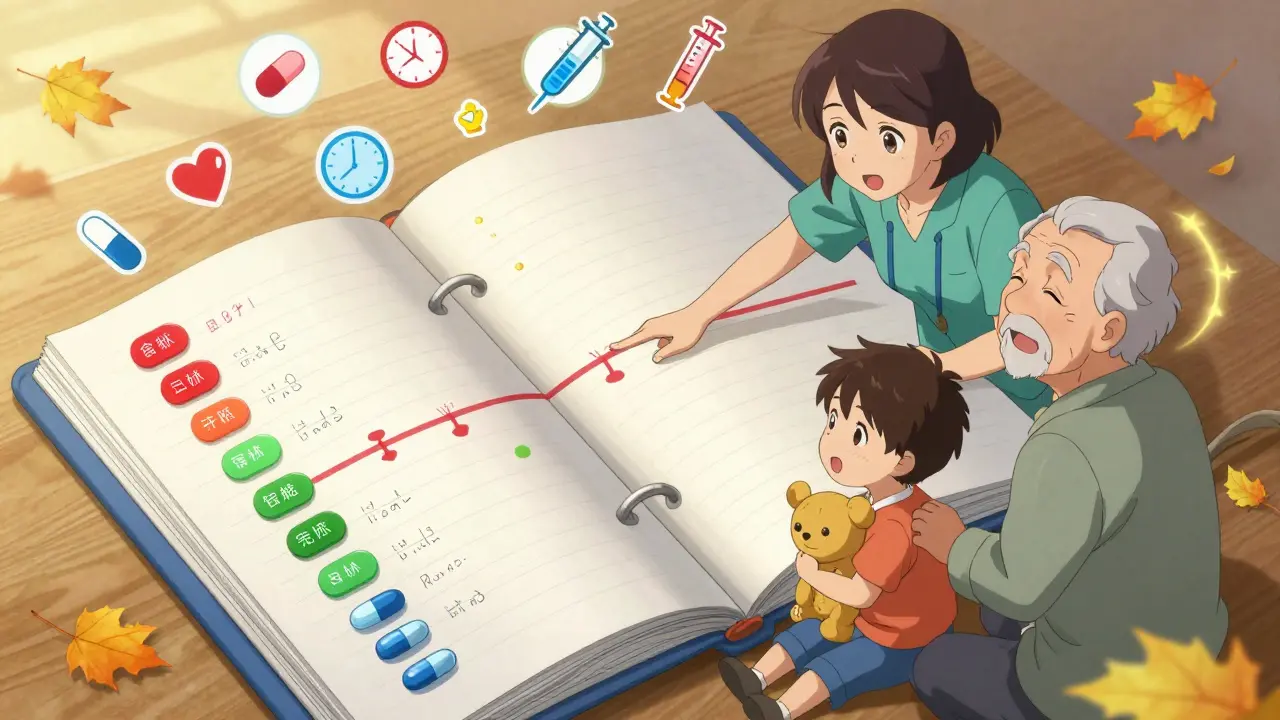
If you’re managing meds for a parent, child, or someone with memory issues, your documentation becomes their lifeline. Add these extra steps:- Include a daily log: “Took pill at 8 AM. Refused evening dose.”
- Keep a list of all providers and their contact info.
- Share your notebook with other caregivers. Use color-coded tabs: red for allergies, green for pain meds, blue for supplements.
- Set phone alarms to remind yourself to update the log.
Studies show that caregivers who document everything reduce hospital readmissions by up to 40%.
The Future: What’s Changing in 2026
The FDA is rolling out standardized Patient Medication Information (PMI) sheets-single-page, easy-to-read guides that come with every new prescription. By 2025, 95% of prescriptions will include them. But even with these, you still need to document your provider’s personal advice.Electronic health records are now required to show medication history across systems. If you switch providers, your meds should follow you. But that doesn’t mean you can skip documenting. You’re still the best person to catch the small, critical details that software might miss.
As of 2024, Medicare and private insurers require documentation of current medications in every visit for billing purposes. That means your provider is legally required to ask-and you’re legally required to answer accurately. Your notes help them do their job.
Your Action Plan
Here’s what to do today:- Grab a notebook or create a digital folder called “Medication Records.”
- Write down every medication you’re currently taking, including doses, times, and why.
- Review your last three provider visits. Did you document the advice? If not, call the office and ask for a summary.
- Next time you’re given new advice, write it down before you leave the room.
- Share your records with your pharmacist and one trusted family member.
Documentation isn’t paperwork. It’s protection. It’s clarity. It’s control over your own health. And it’s something no machine, no app, no provider can fully replace.
What if I forget to write down what my doctor said?
Call your provider’s office within 24 hours. Ask for a summary of what was discussed during your visit. Most clinics now send follow-up notes via patient portals, but if you don’t see it, call. Say: “I’d like a written summary of the medication advice given on [date].” Keep that note with your records.
Can I just rely on my pharmacy’s list?
No. Pharmacies track what they dispense, not what your provider told you. They won’t know if your doctor said to stop a drug, or if you were told to take it with food. Your pharmacy list is a starting point-not the full picture. Always cross-check it with your own notes.
Should I document advice from nurses or pharmacists too?
Yes. Nurses and pharmacists often give the most detailed advice about side effects, timing, and lifestyle changes. The American Society of Health-System Pharmacists requires pharmacists to document all counseling given. Treat their advice like you would your doctor’s-write it down, date it, and keep it.
How long should I keep these records?
Keep them for at least 7 years after your last visit, or longer if you’re managing a chronic condition. Some states require 10 years. Even after you stop taking a medication, keep the record-it may be relevant if symptoms return years later. Store digital copies in the cloud and physical copies in a safe place.
What if my provider won’t let me take notes during the visit?
That’s unusual and not standard practice. Politely say: “I want to make sure I understand everything correctly, so I’m writing this down for my own records.” Most providers welcome it-it shows you’re engaged. If they push back, consider finding a provider who supports patient involvement. Your health is too important to leave to memory.
Comments
Ayush Pareek
Been doing this for years after my dad had a bad reaction from mixing meds. Simple notebook, date-stamped, color-coded tabs. No app beats a physical thing you can flip through in the ER. You're not just organizing-you're saving your life.
Start small. One med at a time. You'll thank yourself later.
On January 15, 2026 AT 14:05
Nilesh Khedekar
Wow. So now we’re supposed to become medical scribes? Next they’ll make us fill out the H&P forms ourselves. This is bureaucratic overkill wrapped in virtue signaling. My doctor’s supposed to DOCUMENT this-not me. If they can’t keep track, that’s THEIR problem, not mine.
Also, who’s paying for the ink? The notebook? The cloud storage? The 47 minutes of my life I just lost writing down ‘take with food’?
On January 15, 2026 AT 22:24
Jami Reynolds
This is exactly how the pharmaceutical-industrial complex manipulates patients into becoming unpaid compliance officers. The FDA’s ‘PMI sheets’? A distraction. They’re not designed to protect you-they’re designed to shield manufacturers from liability. And don’t get me started on EHR portals-they’re hacked weekly, and your medication history is being sold to data brokers.
Real solution? Burn the system. Stop trusting institutions. Write it down on paper. Hide it. Don’t digitize. Don’t share. Your meds are your only leverage now.
On January 17, 2026 AT 20:31
Crystel Ann
I used to think this was overkill until my mom had a stroke and we couldn’t figure out what she was supposed to be taking. Her doctor said one thing, the pharmacy said another, and her notes? Scrawled on a receipt from 2021.
Now I keep a binder. One page per med. I update it every Sunday. It’s not glamorous. But it’s quiet peace of mind. And I’ve never felt more in control of my health.
Do it. Even if it feels silly. You won’t regret it.
On January 19, 2026 AT 08:23
Nat Young
Let’s be real-this whole ‘document everything’ thing is just a way for providers to shift liability onto patients. You think they care if you write down ‘take with food’? No. They care that you signed the consent form. The 7,000 deaths? Mostly from polypharmacy in elderly patients on Medicare Advantage plans. Not because someone forgot to write ‘avoid grapefruit’.
Also, ‘the American Dental Association’? That’s not even a pharmacology body. Did you even proofread this?
On January 21, 2026 AT 04:09
Niki Van den Bossche
Documentation isn’t merely administrative-it’s ontological. In writing down your medication regimen, you are performing an act of existential reclamation against the algorithmic erasure of personal agency in healthcare.
Your notebook becomes a palimpsest of your bodily sovereignty-a sacred text against the commodified, digitized, and depersonalized medical-industrial complex. Each scribble is a quiet rebellion.
When you write ‘take at bedtime’, you are not recording a directive-you are inscribing your dignity into the ephemeral archive of your flesh. The state will forget you. The AI will misclassify you. But your notebook? It remembers. And in remembering, it resists.
On January 22, 2026 AT 10:47
Iona Jane
I once forgot to write down a change and ended up in the hospital for three days. The nurse said I was ‘non-compliant’.
Turns out the doctor changed my dose and never told the pharmacy. Or the nurse. Or the system. Or anyone.
I was almost dead because nobody cared enough to write it down.
Now I carry my meds list in my wallet. On a laminated card. With a QR code that links to my encrypted Google Drive.
They say I’m dramatic.
I say I’m alive.
On January 24, 2026 AT 00:06
Jaspreet Kaur Chana
Bro, in India we’ve been doing this since forever-remember those little handwritten medicine charts your grandma kept in her saree pocket? Same thing. Just add a date. And don’t trust the pharmacist’s handwriting-they write like they’re in a hurry to finish a cricket match.
My uncle took his blood pressure pill with tea once because he forgot it was ‘on empty stomach’. Ended up in the ER. Now he has a sticky note on his mirror. ‘TEA = BAD’. Simple. Works.
Use a notebook. Use your phone. Use your forehead if you have to. Just don’t rely on memory. Your brain is busy remembering cricket scores and memes.
And yeah, show it to your doctor. They’ll be impressed. Or at least pretend to be.
On January 24, 2026 AT 13:20
Tom Doan
Interesting. But let’s interrogate the underlying assumption: that documentation is a neutral, benign act. In reality, it’s a performative compliance ritual designed to absolve institutions of responsibility. The patient becomes the archivist of their own neglect. The provider, relieved of the burden of clear communication. The system, unchallenged.
Why not mandate that providers record and email summaries? Why shift the cognitive labor onto the patient? This isn’t empowerment-it’s institutional evasion dressed as self-care.
On January 25, 2026 AT 21:26
Sohan Jindal
This is why America is falling apart. Now you gotta write down everything your doctor says? What’s next? You gotta sign a waiver before you breathe? This is communist paperwork. We used to trust doctors. Now we gotta be our own nurses. My grandpa took his pills and never wrote anything down. Lived to 92.
Who’s really behind this? Big Pharma. They want you confused so you’ll take more pills.
Just trust your doctor. Or move to Russia.
On January 26, 2026 AT 20:04
Frank Geurts
As a former healthcare administrator with over two decades of experience in clinical documentation standards, I must commend the rigor and precision of this guidance. The alignment with Joint Commission standards, CMS requirements, and ASHP guidelines is not merely appropriate-it is imperative.
Furthermore, the integration of telehealth documentation protocols reflects a forward-thinking, evidence-based approach to patient safety. I have personally witnessed the catastrophic consequences of fragmented records during transitions of care. This document should be disseminated to every patient, provider, and policy-maker in the United States.
Thank you for your unwavering commitment to patient-centered, accountable, and legally defensible healthcare practices.
On January 27, 2026 AT 16:47
Nishant Garg
My cousin in Delhi uses a WhatsApp group with her mom, doctor, and pharmacist. Every time advice changes, she sends a voice note + screenshot of the note. They all reply with ‘got it’. No app. No cloud. Just family + tech.
Also, she uses a red pen for allergies. Blue for pain. Green for vitamins. She says it’s like a visual map of her body’s rules.
Simple. Human. Works.
And yes-she showed her doctor. He said, ‘Why didn’t I think of that?’
On January 28, 2026 AT 04:49
Sarah Mailloux
I started doing this after my anxiety meds got mixed up and I accidentally doubled my dose. I was shaking for hours. Didn’t know why.
Now I keep a small notebook in my purse. I write everything right after the appointment. Even if it’s just ‘no alcohol’. I don’t care if it seems dumb. It’s saved me twice.
Also-my pharmacist knows my notebook exists. She asks me about it. That’s the best part.
You’re not being paranoid. You’re being smart.
On January 29, 2026 AT 21:49
Amy Ehinger
My mom is 78 and has seven meds. She doesn’t use a notebook. She uses sticky notes. One on the fridge. One on the bathroom mirror. One on her pillbox.
She doesn’t care about ‘formal documentation’. She just needs to see it.
And guess what? She’s never had a mistake.
So maybe the system doesn’t need to be perfect. Maybe it just needs to be visible.
Stick it where you’ll see it. That’s the whole point.
On January 31, 2026 AT 07:35