

Forgetfulness is the silent killer of health plans. You buy the prescription, you read the label, and you intend to take it every day. But life happens. A busy morning, a skipped meal, or just losing track of time leads to missed doses. This isn't about laziness; it's about how our brains work. The good news? You don't need expensive apps or complex schedules to fix this. You just need to piggyback on what you already do.
This strategy, often called habit stacking in behavioral psychology, links taking your medication to an existing routine. It turns a conscious decision into an automatic action. Research shows that unintentional nonadherence accounts for 60-70% of all missed doses. By anchoring your meds to daily habits, you can cut those missed doses by up to 50%. Let’s look at how to build these anchors effectively.
The Science Behind Habit Anchors
Your brain loves patterns. When you perform a specific action in response to a consistent cue, you create a neural pathway. Over time, the cue triggers the behavior without you having to think about it. This is known as automaticity. In healthcare, we use this principle to help patients stick to their treatment plans.
A 2015 study by the National Institutes of Health (NIH) involving over 1,200 patients found that pairing medications with established routines significantly improved adherence rates. The key is consistency. If you brush your teeth every morning and night, that is a perfect anchor. If you check your email at 9 AM sharp, that works too. The goal is to find activities you never skip.
Dr. David S. Sobel from Kaiser Permanente notes that this process creates neural pathways that make adherence automatic within 21 to 66 days. The timeline depends on the complexity of the medication regimen, but the mechanism remains the same: link the new (taking meds) to the old (existing habit).
Choosing the Right Daily Anchor
Not all habits are created equal. To be effective, your anchor must be:
- Consistent: You do it every single day at roughly the same time.
- Specific: "Morning routine" is vague. "Brushing teeth" is specific.
- Immediate: The medication should be taken right after or during the habit, not hours later.
Here are the most effective anchors based on clinical data:
| Habit Anchor | Best For | Adherence Impact |
|---|---|---|
| Brushing Teeth | Morning/Evening doses | 43% increase (per UMich study) |
| Eating Meals | Food-sensitive meds (e.g., diabetes drugs) | High effectiveness for timing |
| Making Coffee/Tea | Morning medications | Strong cue for start-of-day |
| Checking Mail/Email | Midday doses | Good for daytime reminders |
For example, if you take blood pressure medication in the morning, pair it with brushing your teeth. Place the pill bottle next to your toothbrush. When you finish brushing, you take the pill. No thinking required. Dr. Jennifer L. Smith from the University of Michigan calls the toothbrushing anchor the "single most effective low-tech strategy" available.
Step-by-Step Implementation Guide
Setting up this system takes less than a week. Follow these four steps to lock in your new routine.
- Identify Your Anchors: Track your daily routine for 3-7 days. Note activities you do without fail. Look for 2-3 strong candidates.
- Match Meds to Activities: Check your medication labels. Some require food, others require an empty stomach. Match the med’s needs to the habit’s timing. For instance, statins often work best when taken in the evening, so pair them with dinner or bedtime hygiene.
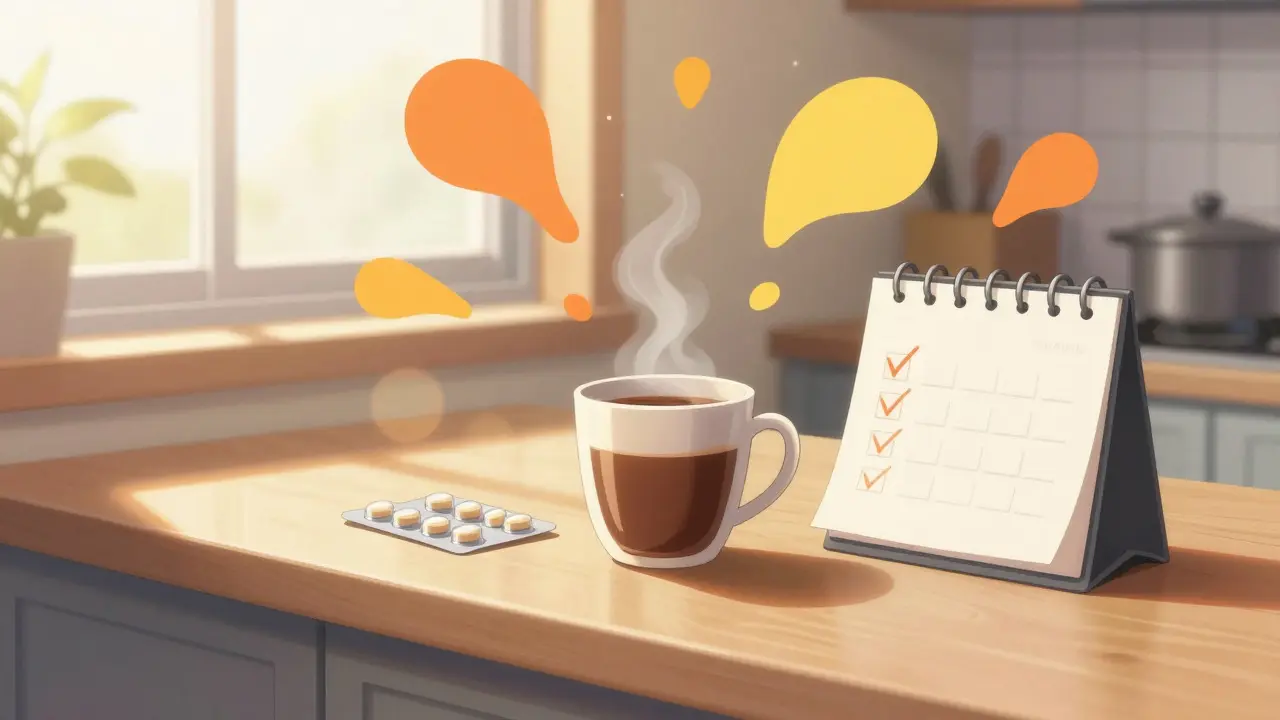
- Create Visual Cues: Move your medication bottles to the location of the habit. If your anchor is breakfast, keep the pills on the kitchen counter, not in the bathroom cabinet. Central Pharmacy data shows this simple move increases initial success by 31%.
- Track for 21 Days: Use a calendar or app to mark each successful dose. The average time to form a new habit is 21 days, according to a 2020 European Journal of Social Psychology study. Consistency here is critical.
Handling Complex Schedules and Multiple Meds
What if you take five different pills at different times? Grouping doses can help. A 2022 study in the Annals of Internal Medicine found that grouping doses within a one-hour window improves adherence by 27%. However, always consult your pharmacist first. Some medications interact or have specific spacing requirements.
If you work shifts or have a variable schedule, traditional habit pairing might struggle. Shift workers show an 18% lower success rate with static anchors. In these cases, combine habit pairing with a physical pill organizer. Use the organizer to pre-sort doses, and then pair the act of opening the compartment with a flexible anchor like "before starting my shift" or "after my first break."
For those with dementia or cognitive decline, self-directed habit pairing may not suffice. Caregiver involvement is essential here. The Alzheimer's Association recommends that caregivers manage the timing and placement of medications directly.
Why Apps Alone Aren't Enough
You’ve probably tried medication reminder apps. They’re helpful, but they have a flaw: they rely on you hearing the alert and acting on it. A 2022 JMIR study found that 68% of users abandon medication apps after three months. Why? Because notifications become background noise.
Habit pairing, on the other hand, builds internal motivation. It doesn’t rely on external alerts. While apps can serve as a backup, the core strategy should be behavioral. Combining both-using an app to remind you to check your habit anchor-can boost long-term adherence by 23% compared to using reminders alone.
Apps like MyTherapy and Medisafe are improving by adding "habit pairing" features that let you link reminders to calendar events. This hybrid approach acknowledges that technology supports behavior, but behavior drives results.

Troubleshooting Common Pitfalls
Even the best systems face disruptions. Here’s how to handle common issues:
- Schedule Disruptions: Travel or holidays can break your routine. Have a backup anchor ready. If you usually take meds with breakfast, switch to "after waking up" if your meal times change.
- Side Effects: Sometimes people miss doses because of side effects, not forgetfulness. Dr. Robert Ridley from Johns Hopkins warns that habit pairing won’t fix intentional nonadherence due to cost or discomfort. Talk to your doctor if side effects are the barrier.
- Multiple Anchors Confusion: Don’t pair two different meds with the same habit if they need to be spaced out. Create distinct cues. For example, take Pill A with coffee and Pill B with lunch.
Remember, perfection isn’t the goal. Consistency is. Missing one dose occasionally won’t ruin your progress. Getting back on track immediately is what matters.
Long-Term Success and Maintenance
Once the habit is formed, maintenance is easy. The neural pathway is established. You no longer need to think about it. However, life changes. New jobs, new family members, or health changes can disrupt even strong habits. Re-evaluate your anchors every six months.
Pharmacists are a valuable resource here. They spend an average of 8.7 minutes per patient explaining optimal pairing strategies. Don’t hesitate to ask them for advice on timing and interactions. Many community pharmacies now offer free counseling on adherence techniques.
The financial impact of better adherence is huge. Nonadherence costs the U.S. healthcare system $300 billion annually. By simply adjusting your daily routine, you contribute to your own health and reduce systemic strain. It’s a small change with massive rewards.
How long does it take to form a medication habit?
On average, it takes 21 to 66 days to form a new habit, depending on the complexity of the medication regimen and individual consistency. A 2020 study suggests 21 days is a baseline, but more complex routines may take longer to become automatic.
Can I use habit stacking for multiple medications?
Yes, but you need distinct anchors for meds that require different timing. For example, take morning meds with breakfast and evening meds with brushing teeth. Grouping doses within a one-hour window can also simplify the process, provided your pharmacist approves.
What if my daily schedule varies frequently?
If you work shifts or have an irregular schedule, static anchors may fail. Combine habit pairing with a pill organizer and flexible anchors like "before starting work" or "after my first break." Backup alarms are also recommended for high variability.
Is habit pairing better than medication apps?
Habit pairing creates automaticity, which lasts longer than app reminders. Apps have a 68% abandonment rate after three months, while habit pairing maintains effectiveness long-term. Using both together yields the best results, with a 23% higher adherence rate than apps alone.
Where should I store my medication for best results?
Store your medication near the activity you’ve chosen as your anchor. If you pair meds with breakfast, keep them on the kitchen counter. Visual cues increase initial success by 31%, according to Central Pharmacy data.