
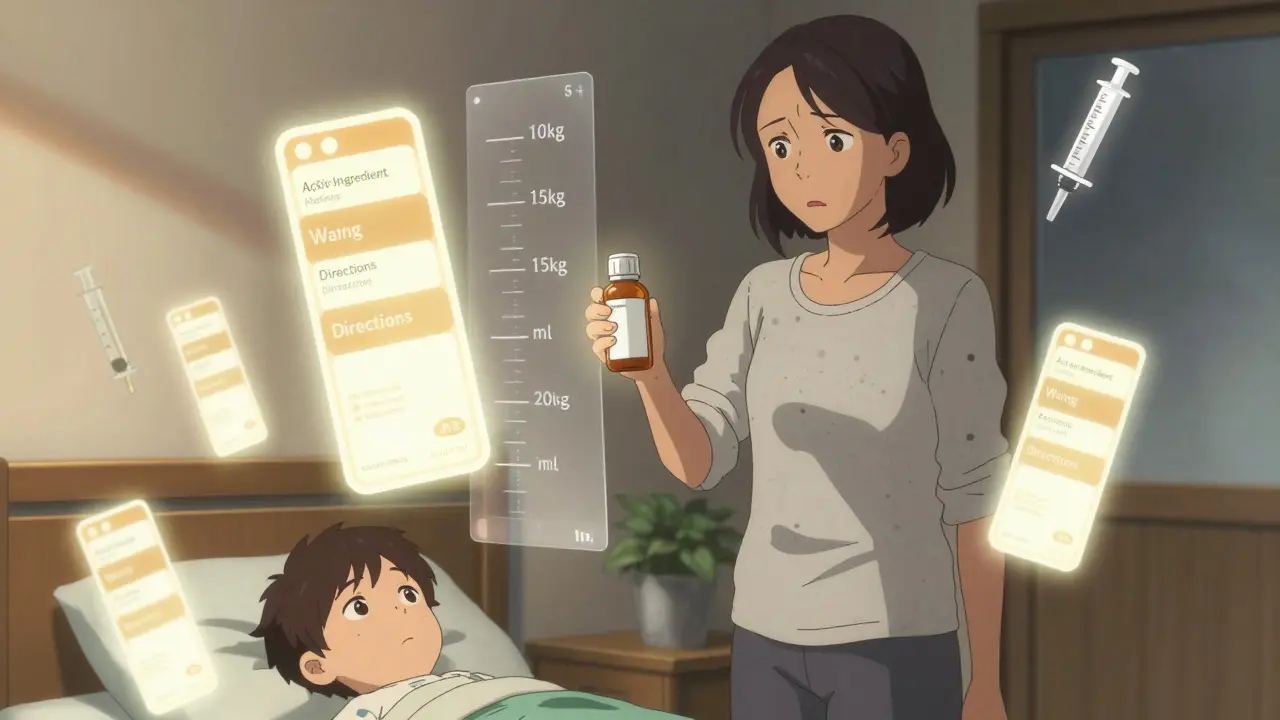
Every year, tens of thousands of children end up in emergency rooms because of medication mistakes. Most of these aren’t accidents caused by carelessness-they’re the result of parents and caregivers misreading labels. The truth is, children’s medicine labels aren’t designed to be easy. They use confusing terms, tiny print, and conflicting instructions based on age or weight. But if you know what to look for, you can avoid dangerous errors and give your child the right dose every time.
Why Weight Matters More Than Age
You’ve probably seen a medicine bottle that says "For children 2-3 years: 5 mL." It seems simple. But what if your 3-year-old weighs 35 pounds, and another 3-year-old weighs only 18 pounds? They’re the same age, but their bodies process medicine differently. That’s why experts say weight-based dosing is the gold standard.The American Academy of Pediatrics (AAP) and the FDA both agree: weight is the most accurate way to determine a child’s dose. A child’s metabolism, how their liver and kidneys handle medicine, and how the drug spreads through their body all depend on body mass-not how old they are. A 2023 study in JAMA Pediatrics found that parents who used both age and weight instructions reduced dosing errors by over half.
Here’s the problem: many labels still list age ranges first. That’s because it’s easier for manufacturers to print. But if you only go by age, you might give too little-or too much. For example, acetaminophen (Tylenol) is dosed at 10-15 mg per kilogram of body weight. A 10 kg child (about 22 pounds) needs 100-150 mg total. A 20 kg child (44 pounds) needs 200-300 mg. Same age group? Totally different doses.
Seven Parts of a Medicine Label You Must Read
Every OTC children’s medicine label has seven key sections. You don’t need to read every word, but you must understand these:- Active Ingredient - This tells you what the medicine is made of. Look for the amount per mL. For example: "acetaminophen 160 mg/5 mL" means each teaspoon (5 mL) contains 160 mg. If the label says "80 mg/1 mL," that’s a different concentration. Mixing them up can cause overdose.
- Uses - What is this medicine for? Fever? Cough? Runny nose? Don’t give a cough medicine for a fever. It won’t help and might add unnecessary chemicals.
- Warnings - This is critical. It tells you when NOT to use the medicine. Look for phrases like "Do not use in children under 2 years" or "Do not give with other medicines containing acetaminophen." Many overdoses happen because parents give multiple products with the same active ingredient.
- Directions - This is where age and weight dosing appear. Always check both. If weight is listed, use it. If not, use age-but be aware it’s less precise.
- Inactive Ingredients - These are fillers, flavors, or dyes. Some kids are allergic to certain ones, like red dye #40 or soybean oil. If your child has allergies, scan this section.
- Purpose - This repeats the use, but sometimes in simpler terms. Helps confirm you’re giving the right medicine.
- Other Information - Includes storage ("keep at room temperature"), expiration date, and manufacturer. Never use expired medicine.
Prescription labels are different. They include the child’s full name, the doctor’s name, the pharmacy’s number, and exact dosing instructions like "Take 5 mL by mouth every 8 hours." Always compare this to the OTC label if you’re using both.
Understanding Concentration: The #1 Mistake Parents Make
One of the most dangerous confusions is concentration. Medicine isn’t just "acetaminophen." It’s "acetaminophen 160 mg/5 mL" or "80 mg/1 mL." The numbers matter.In 2011, the FDA forced manufacturers to standardize concentrations for children’s acetaminophen. Before that, infant drops were 80 mg/0.6 mL, and children’s liquid was 160 mg/5 mL. Parents mixed them up constantly. Now, all children’s acetaminophen is 160 mg/5 mL. But you still need to check. Some brands still sell "infant drops"-they’re just labeled differently.
Here’s what to watch for:
- If the label says "160 mg per 5 mL," that’s standard.
- If it says "80 mg per 1 mL," that’s more concentrated. You’ll need less volume.
- Never assume. Always measure the mL per mg.
A 2020 study found that 43% of parents misread concentration. One parent gave 5 mL of 80 mg/mL thinking it was 160 mg/mL. Result? Half the dose needed. Another gave 5 mL of 160 mg/mL thinking it was 80 mg/mL. Result? Double the dose. Both are dangerous.
How to Measure Liquid Medicine Correctly
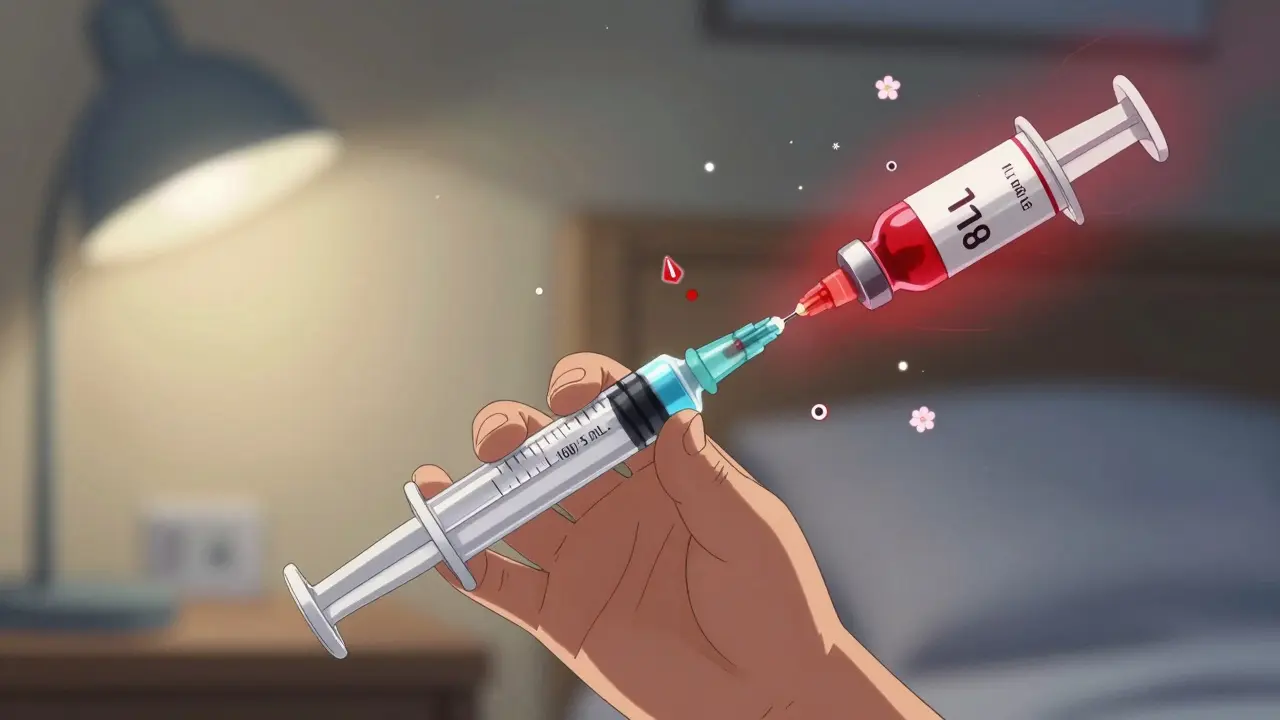
Never use a kitchen spoon. A teaspoon from your drawer might hold 3 mL-or 7 mL. It’s not reliable. The FDA says 68% of dosing errors happen because people use household spoons.Use the tool that came with the medicine:
- Oral syringe - Best for infants and toddlers. Has clear markings in 0.1 mL increments. Draw up the liquid, hold it at eye level, and read the bottom of the curve (the meniscus).
- Measuring cup - Good for older kids. Make sure it has mL markings. Not all cups do.
- Dosing spoon - Only if it’s marked in mL. A "teaspoon" spoon without mL markings is unsafe.
Pro tip: If the syringe doesn’t have enough markings, use a permanent marker to draw lines for your child’s exact dose. One parent on HealthyChildren.org said her pharmacist did this for her-and it eliminated all confusion.
Also, never give medicine in a bottle with a dropper unless it’s designed for that medicine. Droppers can leak or misdeliver.
Age vs. Weight Dosing Charts (Real Examples)
Here’s how dosing breaks down for common medicines, based on 2023 guidelines from the AAP and Children’s Hospital of Philadelphia:| Weight (kg) | Weight (lbs) | Acetaminophen (160 mg/5 mL) | Ibuprofen (100 mg/5 mL) |
|---|---|---|---|
| 5 kg | 11 lbs | 1.5 mL | 1.25 mL |
| 7.5 kg | 16.5 lbs | 2.5 mL | 2 mL |
| 10 kg | 22 lbs | 3.75 mL | 3 mL |
| 15 kg | 33 lbs | 5 mL | 4.5 mL |
| 20 kg | 44 lbs | 6.25 mL | 6 mL |
| 25 kg | 55 lbs | 7.5 mL | 7.5 mL |
| 30 kg | 66 lbs | 9 mL | 9 mL |
For acetaminophen: 10-15 mg per kg every 4-6 hours. Max 75 mg/kg/day.
For ibuprofen: 5-10 mg per kg every 6-8 hours. Max 40 mg/kg/day.
Age-based ranges are still listed on labels for convenience:
- Under 2 years - Always consult a doctor. Their organs are still developing.
- 2-3 years - Usually 10-15 kg (22-33 lbs)
- 4-5 years - Usually 15-20 kg (33-44 lbs)
- 6-11 years - Usually 20-30 kg (44-66 lbs)
- 12+ years - Adult dosing may apply

What You Need to Know Before Giving Medicine
Before you give any medicine, ask yourself these five questions:- Is this medicine for my child? - Check the name on the label. If it’s a prescription, make sure it matches your child’s full name.
- Is this the right medicine? - Compare the active ingredient to what the doctor prescribed. Brand names change. Generic names don’t.
- Is the dose right for their weight? - Calculate their weight in kg (divide pounds by 2.2). Use the chart above.
- Is the route correct? - Is it meant to be swallowed? Applied to skin? Inhaled? Don’t give oral medicine as a nasal spray.
- Is it expired? - Check the date. Expired medicine can lose potency or become unsafe.
The CDC’s 2023 Medication Safety Checklist says these five checks prevent 90% of errors. Write them on a sticky note and stick it to your medicine cabinet.
What to Do If You’re Unsure
If the label is confusing, if your child’s weight falls between two ranges, or if you’re giving more than one medicine-call your pharmacist. Pharmacists are trained to spot these issues. A 2023 survey found that 93% of pharmacists offer free dosing counseling for pediatric prescriptions.You can also use free tools:
- AAP’s Safe Dosage Calculator app - Enter weight, select medicine, and it gives you the exact mL.
- FDAs "Medicine: Play It Safe" toolkit - Downloadable charts and videos.
- HealthyChildren.org - The AAP’s parent site. Search "dosing guide."
And remember: if you give the wrong dose, don’t panic. Call Poison Control at 1-800-222-1222. They’re available 24/7. Don’t wait for symptoms.
Final Tip: Keep a Medication Log
Write down every dose you give: time, medicine, amount, reason. Use a notebook or your phone. Why? Because fevers come and go. You might give acetaminophen at 8 a.m., then again at 2 p.m. and again at 8 p.m. You think you’re following the 4-6 hour rule-but you’ve given three doses in 12 hours. That’s 900 mg. For a 20 kg child, that’s safe. For a 10 kg child? That’s over the daily limit.One parent on Reddit shared: "I kept a log for a week. I realized I was giving ibuprofen too often because I forgot I’d already given it. I stopped overdosing my son. It was that simple."
Reading medicine labels isn’t about memorizing numbers. It’s about learning to ask the right questions. And if you ever feel unsure-ask someone who knows. Your child’s safety is worth the extra minute.
Can I use a kitchen spoon if I don’t have a measuring cup?
No. A kitchen spoon is not accurate. A teaspoon can hold anywhere from 3 to 7 mL. Always use the measuring device that came with the medicine-an oral syringe or dosing cup with mL markings. If you lost it, ask your pharmacy for a replacement. They usually give them for free.
My child is under 2 years old. Do I need to call the doctor before giving any medicine?
Yes. The American Academy of Pediatrics recommends that all medications for children under 2 years be approved by a doctor. Infants have immature livers and kidneys, which means they process medicine differently. Even something as simple as infant acetaminophen can be risky if dosed incorrectly. Don’t guess-call your pediatrician.
What if the label says "use as directed by a doctor" but I don’t have a prescription?
If it’s an over-the-counter medicine, the label should still give clear age or weight instructions. If it doesn’t, or if it only says "as directed by a doctor," don’t use it. This often means the medicine isn’t approved for OTC use in children. Call your pharmacist or pediatrician for advice.
How do I convert pounds to kilograms for dosing?
Divide the weight in pounds by 2.2. For example, a 33-pound child is 33 ÷ 2.2 = 15 kg. Use this number to match the weight-based dosing chart. Most apps do this automatically, but if you’re calculating manually, always double-check the math.
Can I give my child adult medicine if I cut the dose in half?
Never do this. Adult medicines are formulated differently. They may contain ingredients not safe for children, or the concentration may be too high to safely divide. Always use medicine made specifically for children. If your child needs a dose that’s not available in pediatric form, ask your doctor for a prescription.
What’s the difference between "tsp" and "tbsp" on medicine labels?
"tsp" means teaspoon = 5 mL. "tbsp" means tablespoon = 15 mL. Confusing them causes a 300% overdose. For example, if the label says "1 tsp" and you give "1 tbsp," you’ve given three times too much. Always look for "mL" on the label-it’s the most reliable unit.
Are there any new safety features on medicine labels?
Yes. By the end of 2024, all children’s OTC medicines in the U.S. must include both age and weight dosing instructions. Some brands are already adding QR codes that link to instructional videos. Smart bottle caps that record when medicine is taken are being tested. These changes are helping reduce errors-but you still need to read the label carefully.
Comments
Ashley Paashuis
Thank you for this incredibly thorough breakdown. I’ve been a pediatric nurse for over a decade, and I still see parents struggling with the same confusion every week. The weight-vs-age point is so critical-so many don’t realize that a 2-year-old weighing 35 lbs needs nearly double the dose of one at 18 lbs. It’s not about age, it’s about biology.
Also, the concentration warning? Absolute lifesaver. I had a mom come in last month because she used infant drops thinking they were the same as children’s liquid. She gave 5 mL of 80 mg/mL thinking it was 160 mg/mL. Turned out, she’d been under-dosing for three days. We caught it before it became serious, but it could’ve gone so much worse.
Please, everyone: always check the mg/mL. Always. And if you’re unsure, call your pharmacist. They’re paid to help you with this exact thing.
On February 19, 2026 AT 19:08
Oana Iordachescu
Let’s be honest: the pharmaceutical industry has designed these labels to be confusing on purpose. Why? So that parents will keep coming back for refills, or worse-take the wrong dose and need more medication later. The FDA’s standardization? A PR move. The real issue? No regulation on how manufacturers present the information. You can still find 80 mg/mL in "infant" bottles labeled "for ease of use."
And don’t get me started on the "use as directed by a doctor" loophole. That’s not a warning-it’s a legal shield. If you’re reading this and thinking "I’ll just wing it," you’re already in danger. Always verify with a pharmacist. And keep a printed copy of the dosing chart. Paper doesn’t glitch.
On February 20, 2026 AT 22:44
Michaela Jorstad
This is so important. I just want to say: thank you for writing this. I’m a mom of two, and I’ve been terrified of giving medicine since my oldest was a baby. I used to guess. I used spoons. I didn’t know about concentrations. I didn’t even know to check the active ingredient.
After reading this, I printed out the chart, laminated it, and taped it to the medicine cabinet. I also downloaded the AAP app. I even marked my syringe with a Sharpie for my daughter’s exact dose. It sounds silly-but it’s peace of mind.
If you’re reading this and you’ve ever doubted whether you’re doing it right? You’re not alone. And you’re not failing. You’re learning. And that’s everything.
On February 21, 2026 AT 23:51
Chris Beeley
Let me tell you something, folks. This whole system is a farce. You think the FDA cares about your child? They care about liability. The entire pediatric dosing system is a bureaucratic nightmare designed to make parents feel incompetent so they’ll keep paying for prescriptions, consultations, and unnecessary follow-ups. I’ve seen it. I’ve studied it. I’ve read the internal memos.
Here’s the truth: if your child is under 100 lbs, give them half an adult dose. That’s it. The math doesn’t need to be this complicated. Why does a 40-pound child need a chart? Why not just say: "If they weigh less than half of you, give half the dose?"
And don’t get me started on the syringe cult. I’ve given medicine with a turkey baster since 2008. My kids are 17 and 21. Alive. Healthy. No brain damage. So stop the fearmongering. It’s not rocket science. It’s medicine. Use common sense.
On February 23, 2026 AT 20:31
Arshdeep Singh
Bro, you’re overcomplicating this. Everyone’s acting like giving medicine to a kid is brain surgery. It’s not. You got a fever? Give Tylenol. You got pain? Give Advil. You got a label? Read the damn number.
My cousin’s kid took 20 mL of ibuprofen once. He didn’t die. He threw up. That’s it. Kids are resilient. Stop treating them like glass figurines.
Also, why are you even using liquid? Just give them a chewable. Problem solved. No measuring. No syringes. No panic. Just pop a pill. Done.
Stop scrolling. Go give your kid the medicine. You’re overthinking it.
On February 24, 2026 AT 20:40
Jeremy Williams
As someone who grew up in a household where medicine was always "a little bit" and never measured, I can’t express how much this post means to me. My parents gave me cough syrup with a spoon, and I turned out fine. But I also had a sister who had an allergic reaction because of red dye #40-and we didn’t even know it was in there.
This isn’t about fear. It’s about awareness. The fact that I didn’t know to check inactive ingredients until I was 30? That’s not normal. That’s systemic neglect.
I now keep a log on my phone. Every dose. Every time. I even set reminders. It’s not obsessive. It’s responsible. And if you’re not doing this? You’re not being careless-you’re just uninformed. And that’s fixable.
On February 26, 2026 AT 18:09
Maddi Barnes
Okay, but can we talk about how the entire system is designed to make parents feel guilty? Like, "Oh, you used a kitchen spoon? You monster."
Meanwhile, my kid has been on liquid ibuprofen since he was 4 months old. I used a spoon. He’s 8 now. He’s a genius. Plays piano. Reads Shakespeare. No liver damage. So yeah. I’m gonna keep using my spoon.
Also, why is everyone so obsessed with mL? I have a 5 mL measuring cup. It’s marked. It’s fine. Do I need a syringe? No. Do I need a PhD in pharmacology? Also no.
My kid’s not a lab rat. He’s a human. We’re all doing our best. Stop shaming us. 🤷♀️
On February 28, 2026 AT 08:40
Benjamin Fox
USA is the only country that uses pounds and mL together. That’s why this is so confusing. In real countries, everything is metric. You weigh in kg. You dose in mL. Done.
Why are we still using this archaic system? Because Big Pharma likes it. More confusion = more sales.
My cousin in Germany? She just uses the weight in kg. 10 kg = 5 mL. 20 kg = 10 mL. No charts. No apps. No panic.
Stop making this harder than it is. We’re not in the Stone Age. Convert to metric. It’s 2024. 🇺🇸😂
On March 1, 2026 AT 03:12
Jonathan Rutter
I’ve been reading this whole thing and I just want to say-you’re all missing the point. This isn’t about medicine. This is about control. Who gets to decide what your child takes? The FDA? The AAP? The pharmacist? You? Or the company that profits when you give the wrong dose?
I gave my daughter Tylenol once with a spoon. She had a fever for three days. Then I stopped. I gave her ginger tea. I massaged her feet. I held her. She got better. No medicine.
Maybe the real problem isn’t the label. Maybe it’s that we’ve outsourced parenting to pharmaceutical companies. We don’t trust our instincts. We don’t trust nature. We trust a 10-point checklist.
And that’s why we’re all so anxious.
Just love your kid. That’s the real dosage.
On March 2, 2026 AT 20:47
John Cena
I appreciate the effort put into this. I’m not a parent, but I work with kids in after-school programs. I’ve seen teachers give kids medicine with spoons. I’ve seen parents hand me bottles without labels. It’s scary.
I started keeping a small dosing card in my desk drawer. Just the basic chart. Weight in kg, mL for Tylenol and Advil. I print it out for every new kid I work with. No one’s ever complained. Some even ask for copies.
It’s not about perfection. It’s about consistency. One less mistake. One less ER visit. One more kid who makes it home safe.
Thanks for the reminder.
On March 4, 2026 AT 15:54
Robin bremer
bro i just give my kid the whole bottle lmao jk jk
but seriously tho i used to do this thing where i'd just eyeball it like "eh 2 spoonfuls" and then i saw a video of some kid getting hospitalized because of that and now i have this syringe and i'm like a mad scientist measuring out drops
also i wrote "DO NOT GIVE WITH OTHER MEDS" on my fridge in red marker
it's weird but i feel better now 😅
On March 5, 2026 AT 15:28
Scott Dunne
It’s fascinating how American parents have been conditioned to view medicine as a high-stakes scientific endeavor. In Ireland, we simply ask the pharmacist. They hand you the correct dose. No charts. No apps. No panic.
There’s a reason why the UK and Ireland have lower pediatric medication error rates: we don’t overthink it. We trust trained professionals. We don’t need a 12-point checklist to give a child a teaspoon of syrup.
Perhaps the real issue isn’t the label-it’s the cultural obsession with control. Let the experts do their job. You’re not a pharmacist. And that’s okay.
On March 5, 2026 AT 20:58
Caleb Sciannella
This is one of the most thoughtful, meticulously researched pieces I’ve read on pediatric care in years. The way you broke down the seven sections of the label? Brilliant. The concentration warning? Critical. The dosing chart? Essential.
I’ve been a pediatric pharmacist for 18 years. I’ve seen the consequences of every mistake you listed. And I’ve also seen the families who turned things around-because they read the label. Because they asked. Because they measured.
There’s no magic here. Just attention. Just care. Just slowing down long enough to read the fine print.
If you take nothing else from this, take this: Your child’s safety is not a guess. It’s a calculation. And you’re capable of doing it.
On March 6, 2026 AT 02:05
Davis teo
I read this and thought: "This is the most important thing I’ve ever seen."
Then I cried.
Because I gave my son the wrong dose once. I thought I was being careful. I used the syringe. I read the label. But I mixed up the concentration. He was fine. But I didn’t sleep for three nights.
I now have a laminated copy of this guide taped to my fridge. I show it to every new parent I meet. I even made a QR code that links to the AAP app.
It’s not about being perfect. It’s about being prepared.
Thank you. From the bottom of my heart.
On March 7, 2026 AT 23:06
Ashley Paashuis
You’re right to be scared. But don’t let fear paralyze you. The fact that you’re reading this? You’re already doing better than 90% of parents.
And if you ever doubt yourself? Call your pharmacist. They don’t judge. They just help.
One last thing: keep a log. Even if it’s just a note on your phone. You’ll thank yourself later.
On March 8, 2026 AT 17:39