

When you land in Tokyo after a 14-hour flight from London, your body thinks it’s 3 a.m. - even though the sun is high and people are rushing to work. That’s jet lag. It’s not just being tired. It’s your internal clock stuck in the past while the world around you has moved forward. And if you’ve ever tried to fix it with a time-released melatonin pill, you might’ve ended up more confused than before.
Why Jet Lag Happens (And Why It’s Not Just About Sleep)
Jet lag, or desynchronosis, isn’t caused by long flights or bad seats. It’s caused by your circadian rhythm - the 24-hour biological cycle that controls sleep, hormones, body temperature, and digestion. When you cross three or more time zones quickly, your body’s clock doesn’t flip instantly. It takes days to adjust. Eastward travel (like London to Tokyo) is harder because you’re losing hours. Your body wants to sleep when it’s still light out. Westward travel (like New York to Los Angeles) is easier because you’re gaining hours - your body naturally wants to stay up later anyway.
According to the CDC’s 2024 Yellow Book, it takes about 1 day per time zone crossed to adjust westward, and 1.5 days eastward. That means a 7-time-zone flight? You’re looking at roughly 10 days to feel normal - unless you do something about it.
What Melatonin Actually Does (And What It Doesn’t)
Melatonin is not a sleeping pill. It’s a hormone your brain makes naturally when it gets dark. It tells your body, “It’s time to wind down.” But when you travel, your body doesn’t know when to make it - or when to stop. That’s where supplements come in.
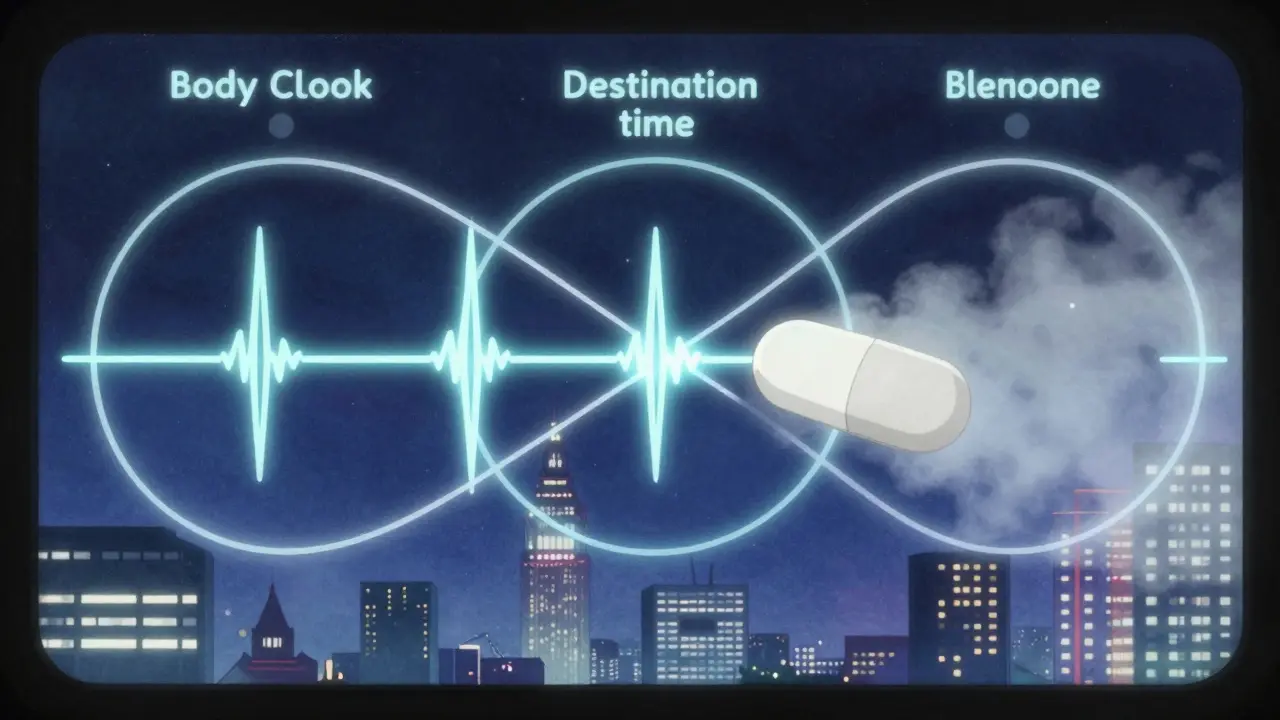
The key is timing. Research from Harvard Medical School and the Journal of Biological Rhythms shows melatonin only shifts your clock if taken during a narrow window: 2-3 hours before or after your body’s natural melatonin release. For eastward travel, you want to shift your clock forward. That means taking melatonin in the evening at your destination time - ideally 30 minutes before you plan to sleep. For westward travel, you need to delay your clock, which means taking it right after waking up in the morning.
Here’s the catch: immediate-release melatonin works because it hits your system fast, peaks within an hour, and clears out in 40-60 minutes. That matches your body’s natural rhythm. Time-released melatonin? It slowly leaks into your bloodstream for 6-8 hours. That’s the problem.
Why Time-Released Melatonin Makes Jet Lag Worse
Time-released melatonin was designed for insomnia - not jet lag. It’s meant to keep you asleep all night. But your circadian clock doesn’t need a long, slow drip of melatonin. It needs a precise signal - like a doorbell, not a foghorn.
Here’s what happens with time-released formulas:
- You take it at 10 p.m. local time, thinking it’ll help you sleep.
- It releases melatonin slowly - so at 2 a.m., your body is still flooded with it.
- But your body thinks it’s morning. Melatonin should be gone by now.
- That confusion delays your adjustment. Your clock gets stuck.
Studies back this up. A 2019 study in Sleep Medicine found that 3 mg of immediate-release melatonin taken at 10 p.m. caused a 1.8-hour phase advance. The same dose in time-released form? Only 0.6 hours. That’s a 67% drop in effectiveness.
And it’s not just numbers. Travelers report real consequences. Amazon reviews for time-released melatonin average 2.8 out of 5 stars. One user wrote: “Woke up at 3 a.m. feeling wired after taking it for my Tokyo trip.” Another: “Felt groggy all morning - like I hadn’t slept at all.”
The American Academy of Sleep Medicine gives a strong recommendation (Level A) for immediate-release melatonin for eastward travel. But for time-released? They say there’s “insufficient evidence.” The European Medicines Agency approved a time-released melatonin product (Circadin) - but only for insomnia in people over 55. Not jet lag.

What Dose Should You Actually Take?
You don’t need a big pill. In fact, more isn’t better. A 2002 meta-analysis by Herxheimer and Petrie showed that 0.5 mg of immediate-release melatonin worked just as well as 5 mg for shifting your clock. Higher doses might help you fall asleep faster, but they don’t help your body adjust to the new time zone.
Here’s what the CDC recommends:
- 5+ time zones eastward: 0.5 mg at 10 p.m. destination time
- 7+ time zones eastward: 3 mg at 10 p.m. destination time
- Take it for 4-5 nights after arrival
For westward travel, take it right after waking up in the morning for 2-3 days. This is less common, but it works. The goal isn’t to sleep - it’s to reset your clock.
What Else Matters (Besides the Pill)
Melatonin alone won’t fix jet lag. Your body responds to light like a switch. If you’re trying to advance your clock (eastward travel), get bright light in the morning. Avoid blue light after 7 p.m. Use sunglasses if you’re out in daylight during your body’s “night.”
Studies show that 30 minutes of 2,000-10,000 lux light exposure - think sunlight or a light therapy box - at the right time can be as powerful as melatonin. Combine it with melatonin, and you cut your adjustment time in half.
Apps like Timeshifter (used by over 1.2 million travelers) help by calculating your personal schedule based on flight time, chronotype, and destination. They don’t just say “take melatonin at night.” They say: “Take it at 9:45 p.m. local time, avoid light until 1 a.m., get sunlight at 7:15 a.m.” That level of precision matters.
Market Reality: What’s Actually Being Sold
The global jet lag market hit $1.74 billion in 2023. Melatonin makes up 68% of that. But here’s the twist: 85% of jet lag-specific melatonin sales are immediate-release. Why? Because people who try time-released versions usually come back frustrated.
And it’s not just consumers. Forty-two of the Fortune 100 companies now give employees immediate-release melatonin and timing instructions for international travel. None recommend time-released. Why? Because they’ve seen the data - and the complaints.
Even the FDA has warned about melatonin supplements. A 2023 warning letter noted that some products contain 83% less or 478% more melatonin than labeled. That’s dangerous if you’re trying to hit a precise dose. Stick to brands that undergo third-party testing - like NSF Certified or USP Verified.
The Future: Personalized Timing and Genetic Differences
Scientists are now looking at genes. A 2024 UCSF trial found that people with certain variants of the CRY1 gene need to take melatonin up to 2.5 hours earlier or later than average. Your chronotype - whether you’re a night owl or early bird - also changes the ideal timing.
That’s why one-size-fits-all labels don’t work. A time-released pill can’t adapt to your biology. But an immediate-release pill, taken at the right moment, can.
The Sleep Research Society predicts time-released melatonin will make up less than 5% of the jet lag market by 2030. The future belongs to precision - not prolonged release.
What to Do Next
If you’re flying east across 5+ time zones:
- Buy immediate-release melatonin (0.5-3 mg, depending on distance)
- Set your phone alarm for 30 minutes before your target bedtime at destination
- Take the pill then. No food. No screens.
- Get outside in natural light the next morning - even if you’re exhausted.
- Repeat for 4-5 days.
If you’re flying west:
- Take 0.5 mg melatonin right after waking up at destination time.
- Avoid bright light in the evening.
- Repeat for 2-3 days.
And if you’ve already tried time-released melatonin and felt worse? You’re not alone. You just used the wrong tool.
Is time-released melatonin ever useful for jet lag?
No. Time-released melatonin is designed for insomnia, not circadian rhythm adjustment. Its prolonged release confuses the body’s internal clock by maintaining melatonin levels during times when it should be low. Studies show it’s significantly less effective than immediate-release for shifting sleep cycles. The CDC, American Academy of Sleep Medicine, and European Medicines Agency all advise against it for jet lag.
How much melatonin should I take for jet lag?
For most people, 0.5 mg to 3 mg of immediate-release melatonin is enough. Lower doses (0.5 mg) are effective for phase-shifting, while higher doses (3 mg) may help with sleep onset. The CDC recommends 0.5 mg for 5+ time zones eastward, and 3 mg for 7+ time zones. Avoid doses over 5 mg - they don’t improve adjustment and may cause grogginess.
When should I take melatonin for eastward travel?
Take immediate-release melatonin 30 minutes before your target bedtime at your destination. For example, if you’re flying from London to Tokyo (9 time zones ahead), and you want to sleep at 10 p.m. Tokyo time, take the pill at 9:30 p.m. Tokyo time. Do this for 4-5 nights after arrival. Taking it too early or too late reduces effectiveness.
Can I use melatonin for westward travel?
Yes, but differently. For westward travel (gaining time), take 0.5 mg of immediate-release melatonin right after waking up in the morning at your destination. This helps delay your internal clock. Combine it with avoiding bright light in the evening. This method is less commonly used but supported by research.
Are melatonin supplements regulated?
In the U.S., melatonin is sold as a dietary supplement, not a drug, so the FDA doesn’t require strict quality control. Testing has shown some products contain 83% less or 478% more melatonin than labeled. Look for brands with third-party verification - NSF Certified or USP Verified - to ensure accurate dosing. In Europe, melatonin is prescription-only for certain uses, but not for jet lag.
Final Thought
Your body doesn’t need a slow drip of melatonin. It needs a signal - sharp, timed, and clean. Time-released pills are the wrong tool for this job. They’re like trying to tune a radio with a sledgehammer. Immediate-release melatonin, taken at the right moment, is the precision instrument. Use it right, pair it with light, and you’ll adapt faster than you think.
Comments
Nandini Wagh
So let me get this straight - you’re telling me I paid $20 for a time-release melatonin pill that basically just turns my body into a confused zombie for a week? I thought I was being smart buying the "long-lasting" version. Turns out I just bought a fancy alarm clock that screams "nap time" at 3 a.m. 🤦♀️
On February 26, 2026 AT 22:36
tia novialiswati
Yessss this is so true!! I used time-release for my Tokyo trip last year and woke up at 2 a.m. feeling like I’d been hit by a truck 😭 Then I switched to 0.5mg immediate-release at 9:30 p.m. local time and BAM - slept like a baby. Light exposure in the morning was the secret weapon 🌞✨
On February 27, 2026 AT 12:38
Lillian Knezek
This isn’t about melatonin. This is about Big Pharma. They want you to take pills forever. Time-release? That’s just the first step. Next they’ll release "jet lag nano-chips" implanted under your tongue. You think this is science? It’s a control system. They’re watching your circadian rhythm. I’ve seen the documents. 🕵️♀️
On February 28, 2026 AT 16:44
Maranda Najar
I AM SO ANGRY. I CRIED IN THE AIRPORT BATHROOM. I TOOK THE TIME-RELEASED PILLS BECAUSE I THOUGHT I WAS BEING CAREFUL. I THOUGHT I WAS BEING SMART. I THOUGHT I WAS DOING THE RIGHT THING. AND THEN - I WAS STUCK IN A LIMBO OF GROGGINESS AND BLUISH LIGHT AND A STRANGER’S BABY SCREAMING IN MY EAR. I FELT LIKE A GHOST IN MY OWN BODY. I DIDN’T KNOW IF I WAS ALIVE OR JUST A DREAM. I STILL HAVE NIGHTMARES ABOUT 3 A.M. IN TOKYO. I NEED A HUG. AND A NEW PILLS.
On February 28, 2026 AT 20:17
Christopher Brown
Americans buy time-release because they don’t want to think. Europeans? They know better. We don’t need apps. We don’t need 3mg pills. We just go to sleep when it’s dark. Simple. Effective. No gimmicks.
On March 2, 2026 AT 05:22
Sanjaykumar Rabari
This is all fake. The government puts something in the air to make you tired. Melatonin is just a cover. If you really want to fix jet lag, you need to unplug your WiFi router for 72 hours. I tried it. I landed in Delhi and didn’t touch my phone. Slept 10 hours straight. No pills. No light therapy. Just silence. They don’t want you to know this.
On March 2, 2026 AT 21:32
Kenzie Goode
I love how this post breaks it down so clearly. I used to think melatonin was just a sleep aid. Now I see it’s more like a tuning fork for your biology. The light thing? Game-changer. I started walking outside at 7 a.m. after my flight and suddenly I wasn’t a zombie anymore. Just small changes. Huge difference.
On March 3, 2026 AT 15:47
Dominic Punch
I’ve flown 200+ times across time zones. I used to rely on melatonin - then I realized the real fix was light exposure and hydration. The pill? Just a nudge. Your body wants to sync. You just have to give it the right cues. No magic. Just biology. And yes - immediate-release is the only way. Time-release is like trying to fix a watch with glue.
On March 5, 2026 AT 10:59
Valerie Letourneau
I found this piece profoundly insightful. The distinction between circadian entrainment and sleep induction is not widely understood, even among healthcare professionals. The pharmacokinetic profile of immediate-release melatonin aligns precisely with the endogenous hormonal rhythm, whereas sustained-release formulations introduce a temporal mismatch that impedes phase-shifting. One might even argue that the commercial proliferation of time-released products constitutes a form of therapeutic misalignment.
On March 7, 2026 AT 07:21
Khaya Street
Honestly? I just drink coffee and stare at my phone until I’m tired. Works every time. Who has time to calculate melatonin doses? I’m not a scientist. I’m a guy who just wants to land and not feel like a zombie. The pill thing? Overrated.
On March 8, 2026 AT 18:18
Brooke Exley
I used to think I was doing everything right - melatonin, light boxes, even sleep masks. Then I tried the 0.5mg at 9:30 p.m. trick and it was like my body finally said, "Oh. Ohhhhh. Okay. You’re serious." No grogginess. No confusion. Just... adjustment. I’m not a nerd about this stuff - but this? This works. Thank you for the clarity 💛
On March 10, 2026 AT 16:15
Lou Suito
You say immediate-release is best? LIES. I took 5mg time-release on my last flight - slept 12 hours - woke up at 8 a.m. sharp - felt amazing. Your "science" is outdated. Also: melatonin isn’t even real. It’s just sugar with a fancy name. And why are you always talking about Tokyo? What about Dubai? Or Buenos Aires? You’re biased.
On March 12, 2026 AT 01:39
lela izzani
This is one of the clearest explanations I’ve ever read on jet lag. The key takeaway for me: melatonin isn’t a sleep aid - it’s a signal. Like a text message saying "it’s bedtime." Time-release is like sending a 30-minute voicemail. Of course it confuses the recipient. I’ve been using 0.5mg for eastward trips for 2 years now. No side effects. Just smooth transitions.
On March 12, 2026 AT 06:01
Christopher Wiedenhaupt
I read this whole thing and i didnt even know i was reading it. my phone died. but i remember something about melatonin and time zones. also i think i saw a word like circadian. but honestly i just take a nap when im tired. its the only thing that works. also i spelled everything wrong on purpose. lol.
On March 14, 2026 AT 01:30
John Smith
Of course time-release doesn’t work. You think your body is some delicate orchestra? It’s a machine. A biological steamroller. You don’t need precision. You need volume. Take 5mg. Sleep. Wake up. Repeat. The rest of this? Overthinkers with spreadsheets. I’ve flown 47 times. I don’t need Harvard. I need a pillow.
On March 15, 2026 AT 18:21