

When a new drug hits the market, the clock starts ticking on its profitability. The standard 20-year patent clock begins when the patent is filed-often years before the drug even enters human trials. By the time the FDA approves it, a drug might have already lost 7 to 10 years of patent life. That’s where patent term restoration comes in. It’s not a loophole. It’s a legal fix built into U.S. law to balance innovation and access.
Why Patent Term Restoration Exists
The system was created by the Hatch-Waxman Act of 1984. Before this law, drug companies faced a brutal reality: they spent 10 to 15 years getting FDA approval, but their patent clock kept running. By the time the drug was approved, they had only a few years left to recoup billions in R&D costs. Generic manufacturers, meanwhile, could jump in as soon as the patent expired-even if the brand-name drug had barely been on the market. The solution? Give innovators back some of the time lost during regulatory review. The law didn’t stop generics. It just made sure innovators weren’t punished for following the rules. Today, about 95% of new molecular entities approved by the FDA get some form of patent term restoration. For drugs like Humira, Enbrel, or Stelara, this extension meant an extra 3 to 5 years of market exclusivity-time that directly affected billions in revenue.How It Works: The Legal Mechanics
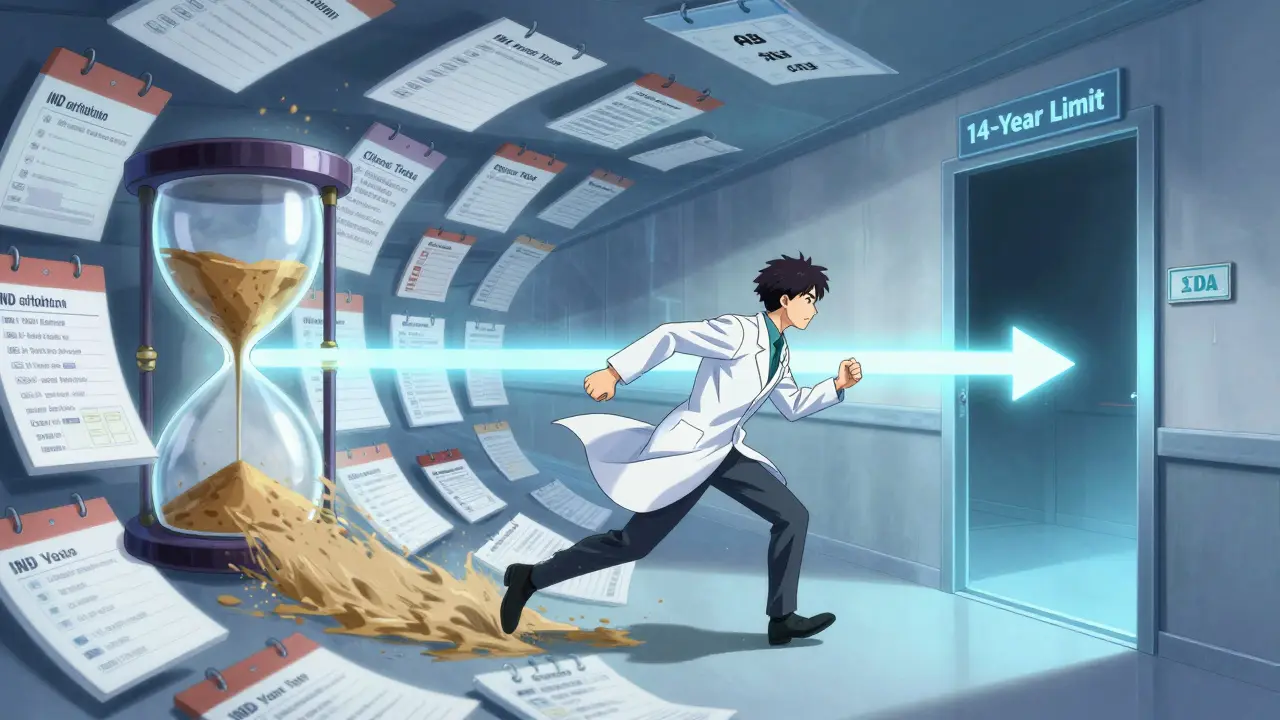
Patent term restoration isn’t automatic. It’s a two-step legal process. First, the FDA calculates how much time was lost during regulatory review. Then, the USPTO grants the actual extension under 35 U.S.C. § 156. The formula is strict: half the testing phase + the entire approval phase. Testing phase means from the first IND submission to the NDA filing. Approval phase is from NDA submission to FDA approval. The total extension can’t exceed five years, and the total patent life after restoration can’t go beyond 14 years from FDA approval. For example, if a drug spent 6 years in clinical trials and 3 years under FDA review, the extension would be 3 years (half of 6) + 3 years = 6 years. But since the cap is 5 years, the company gets 5. If the drug had only 2 years left on its patent before approval, the extension would be capped so the total patent life doesn’t exceed 14 years after approval. Only one patent per product can be extended. If a company holds five patents covering the same drug, they must pick the one that gives them the most strategic advantage. That’s why patent attorneys spend months analyzing claim language, expiration dates, and potential generic challenges before filing.What’s Covered During the Extension
The extension doesn’t give the patent holder full control over everything the patent originally covered. The law limits protection to any use approved by the FDA. If a patent claims a drug for treating arthritis and depression, but only arthritis was approved, then the extended patent only protects the arthritis use. This is a key point. Companies can’t use the extension to block generics from making the same drug for off-label uses. Courts have consistently ruled that the extended patent rights are tied strictly to the FDA-approved indication. That’s why many companies file multiple patents covering different uses, formulations, or delivery methods-to maximize the chances that at least one will cover the approved use.Patent Term Restoration vs. Other Exclusivity Tools
Many people confuse patent term restoration with other exclusivity mechanisms. They’re not the same.- Patent Term Restoration (PTR) extends the actual patent. It’s granted by the USPTO. It allows the patent holder to sue generics for infringement.
- Data Exclusivity is a separate FDA rule. It prevents generics from relying on the innovator’s clinical data for 5 years (for new chemical entities) or 3 years (for new clinical studies). No patent needed. But generics can still launch once this period ends-even if the patent hasn’t expired.
- Patent Term Adjustment (PTA) compensates for delays at the USPTO, not the FDA. If the patent office takes too long to examine your application, you get extra days added to the patent term. This is unrelated to drug approval delays.
Who Applies? And When?
Only the patent owner or their authorized agent can apply. Most big pharma companies have dedicated PTR teams. Smaller biotechs often hire specialized law firms like Fish & Richardson or Sterne Kessler. The deadline is brutal: you have 60 days from FDA approval to file with the FDA. Miss it, and you lose the chance forever. According to FDA data, 37% of denied PTR applications are due to late filing. That’s not a technical error. It’s a procedural failure. The application must include:- The patent number and claims covering the approved product
- Proof of regulatory review period
- A statement that the product was subject to regulatory review
- Identification of the approved use
Common Pitfalls and How to Avoid Them
Even experienced teams mess up. Here are the top mistakes:- Wrong patent selected - Picking a patent that doesn’t cover the approved use. The USPTO will reject it.
- Incorrect calculation - Miscounting the testing or approval phase. Many companies use software like Patexis to avoid this. One study showed it cuts errors by 78%.
- Missing documentation - No proof of IND submission date? No extension. Keep every email, meeting note, and regulatory correspondence.
- Ignoring due diligence - If a competitor files a petition claiming you dragged your feet during trials, you must prove otherwise. This is the most unpredictable part of the process.
The Economic Impact
Patent term restoration isn’t just legal-it’s financial. A 2019 study by Duke University found PTR increases the net present value of a new drug by 11% to 15%. For a blockbuster drug with $2 billion in annual sales, that’s hundreds of millions in added revenue. But it’s not free for society. The Congressional Budget Office estimated PTR extensions cost Medicare $5.2 billion per year by delaying generic competition. The FTC has flagged 12% of PTR applications between 2015 and 2019 as part of “product hopping” strategies-where companies make tiny changes to a drug (like switching from a pill to a liquid) to reset the clock. Still, without PTR, pharmaceutical R&D would collapse. The PhRMA 2022 report says the average return on investment for new drugs drops by 18% without patent restoration. That’s not a threat to profits-it’s a threat to future cures.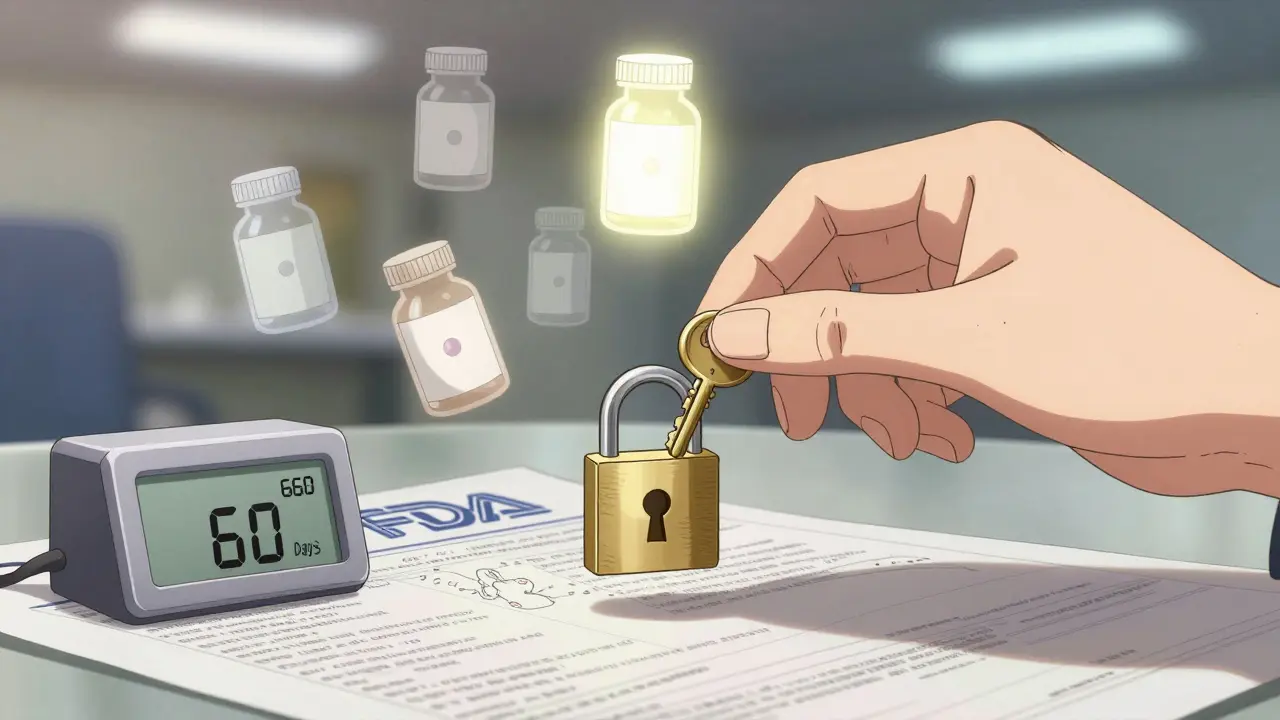
What’s Changing Now?
As of January 2023, all PTR applications must be filed electronically. Processing time dropped from 90 to 60 days. The USPTO also updated its guidelines after the Amgen v. Sanofi Supreme Court case in 2021, tightening how patent claims are interpreted for extension eligibility. There’s political pressure to cap extensions at 3 years, but no law has passed. Meanwhile, applications for combination products-like drug-eluting stents or inhalers with built-in sensors-are up 300% since 2015. Oncology and orphan drugs are the fastest-growing sectors for PTR. The future of PTR isn’t about abolishing it. It’s about refining it. Better transparency. Stronger due diligence reviews. Clearer rules for complex products. The system works-but only if you follow it exactly.What Happens After the Extension Ends?
Once the extended patent expires, generics can enter. But they don’t always come right away. If data exclusivity is still active, generics can’t even start their application. If there’s a pediatric exclusivity period, they wait even longer. Some companies try to extend their dominance with “secondary patents”-new formulations, delivery systems, or dosing schedules. These are legal, but they’re under scrutiny. The FTC and Congress are watching closely. When the exclusivity finally ends, price drops of 80% to 90% are common. That’s the trade-off: long exclusivity for innovation, then sudden affordability for patients.Can any patent be extended under patent term restoration?
No. Only patents covering a product that went through FDA regulatory review can be extended. The product must be a human drug, medical device, food additive, or color additive. Animal drugs are covered under a separate law. The patent must claim the product, its method of use, or its manufacturing process-and it must be the patent that was in force during the regulatory review period.
How long does patent term restoration last?
The maximum extension is five years. But the total patent life after restoration cannot exceed 14 years from the date of FDA approval. The actual extension is calculated as half the time spent in clinical testing plus the entire time spent in FDA review, with both phases adjusted for delays caused by the patent holder.
Can multiple patents for the same drug be extended?
No. Only one patent per product can be extended, even if the company holds multiple patents covering the same drug. Companies must strategically choose the patent that offers the strongest legal protection for the approved use. This is why patent attorneys spend months analyzing claim scope before filing.
What happens if I miss the 60-day filing deadline?
You lose the right to apply for patent term restoration forever. The 60-day window starts on the day the FDA approves the product. There are no exceptions. This is the most common reason applications are denied-37% of rejections are due to late filing.
Does patent term restoration apply to biologics?
Yes, but less frequently. Biologics are eligible for patent term restoration, but only about 82% of approved biologics receive an extension, compared to 98% for small-molecule drugs. This is because biologics often rely more on data exclusivity and complex manufacturing patents that are harder to align with the statutory requirements for extension.
Can generics challenge a patent term restoration?
Yes. After the FDA publishes its calculation of the regulatory review period, third parties have 60 days to request a revision. They can also file a due diligence petition, claiming the patent holder didn’t act with reasonable effort during clinical trials or regulatory submissions. These challenges have increased by 22% since 2018 and are now a standard part of the process.
Next Steps for Companies
If you’re developing a drug and plan to file for patent term restoration:- Start tracking your regulatory timeline from day one-keep records of IND submission, trial start/end dates, and FDA correspondence.
- Identify which patent will be extended before the NDA is submitted. Don’t wait until approval.
- Work with a law firm experienced in PTR. The process requires knowledge of both FDA regulations and patent law.
- Use validated software tools to calculate the extension. Manual calculations are risky.
- File within 60 days of FDA approval. No exceptions. No extensions.
Comments
Joe Bartlett
This is why America still leads in pharma. Other countries just cry about drug prices while their labs sit empty.
On December 17, 2025 AT 01:24
Anu radha
So people in my country can't afford these drugs because of this? It feels wrong.
On December 18, 2025 AT 09:09
Peter Ronai
Oh wow, you actually read the Hatch-Waxman Act? Most people think this is a 'pharma scam' without knowing the first thing about clinical trial timelines. The 5-year cap? It's a compromise. The real scam is how some companies game PTA to stack extensions. You think this is bad? Wait till you see patent thickets in oncology.
On December 18, 2025 AT 18:51
Steven Lavoie
The structural balance struck by the Hatch-Waxman Act remains one of the most elegant pieces of regulatory engineering in modern American law. While critics decry extended exclusivity, they often overlook the fact that without this mechanism, the capital-intensive nature of drug development would collapse. The 14-year post-approval cap ensures that innovation is incentivized without perpetual monopolies.
On December 20, 2025 AT 11:46
Nishant Desae
I just want to say thank you for explaining this so clearly. I'm from India and we see the prices of these drugs and it's heartbreaking. But hearing how much time and money goes into making them... it makes me understand why it's so complicated. I hope one day we can make these medicines affordable without killing innovation. We need both, you know? 💛
On December 20, 2025 AT 14:29
Sachin Bhorde
Bro, PTR is legit but the real game is in the secondary patents-formulation tweaks, salt forms, delivery systems. Pharma’s playing 4D chess while the FDA’s still checking if the IND form had the right signature. Saw a biotech lose 18 months because their IRB approval got delayed by a typo in the consent form. Wild.
On December 21, 2025 AT 15:41
Kaylee Esdale
So they get extra time because the government takes forever to approve stuff? Makes sense. But then why do some drugs cost $700k a year? That's not innovation. That's greed wrapped in a lab coat.
On December 22, 2025 AT 19:32
Michael Whitaker
It is worth noting that the statistical probability of a small-molecule drug achieving FDA approval after Phase I is approximately 12%. The regulatory review period is not merely bureaucratic delay-it is the necessary consequence of safeguarding public health. One must consider the ethical weight of approving a molecule without exhaustive safety data. The patent term restoration mechanism is not a subsidy; it is a recognition of the societal contract between innovator and citizen.
On December 23, 2025 AT 08:05
Donna Packard
I appreciate this breakdown. It's easy to hate pharma, but I never realized how much of this is about timing and paperwork. It's like they're racing against a clock that started before they even got to the starting line.
On December 23, 2025 AT 11:02
Jody Patrick
America invented this. Europe doesn't have it. That's why we lead. Stop whining.
On December 23, 2025 AT 11:52
Raven C
I'm appalled. This is not 'fairness'-it's a legalized monopoly racket. The public funds the research through NIH grants, then pays twice: once in taxes, again at the pharmacy. And now we're supposed to applaud the 'compromise'? The 14-year cap is a joke. Look at Humira's 13-year exclusivity. That's not innovation. That's extortion.
On December 24, 2025 AT 07:37
Chris Van Horn
You people don't get it. This isn't about 'fairness.' This is about survival. I've seen startups die because they missed the 60-day window. One comma out of place, one missing IND log, and $200M down the drain. The system is fragile. It's not broken-it's a scalpel. And you're waving a sledgehammer and calling it reform. The FTC doesn't understand patent claims. They just want to blame someone. Don't fix what works. Just stop pretending you know how it works.
On December 25, 2025 AT 12:20
Brooks Beveridge
I really appreciate how you laid this out-it’s easy to get angry at big pharma, but this shows how much thought, time, and risk goes into every pill. It’s not just profit-it’s people betting their careers on a molecule that might never get approved. Keep pushing for transparency, but don’t forget the human cost behind the headlines. We need innovation, not just lower prices. 💪❤️
On December 27, 2025 AT 05:01
Jigar shah
Interesting. So if a company files multiple patents, they pick the one with the best extension potential. But what if they pick the wrong one? Is there any recourse? Or is it a one-shot deal?
On December 28, 2025 AT 15:44