
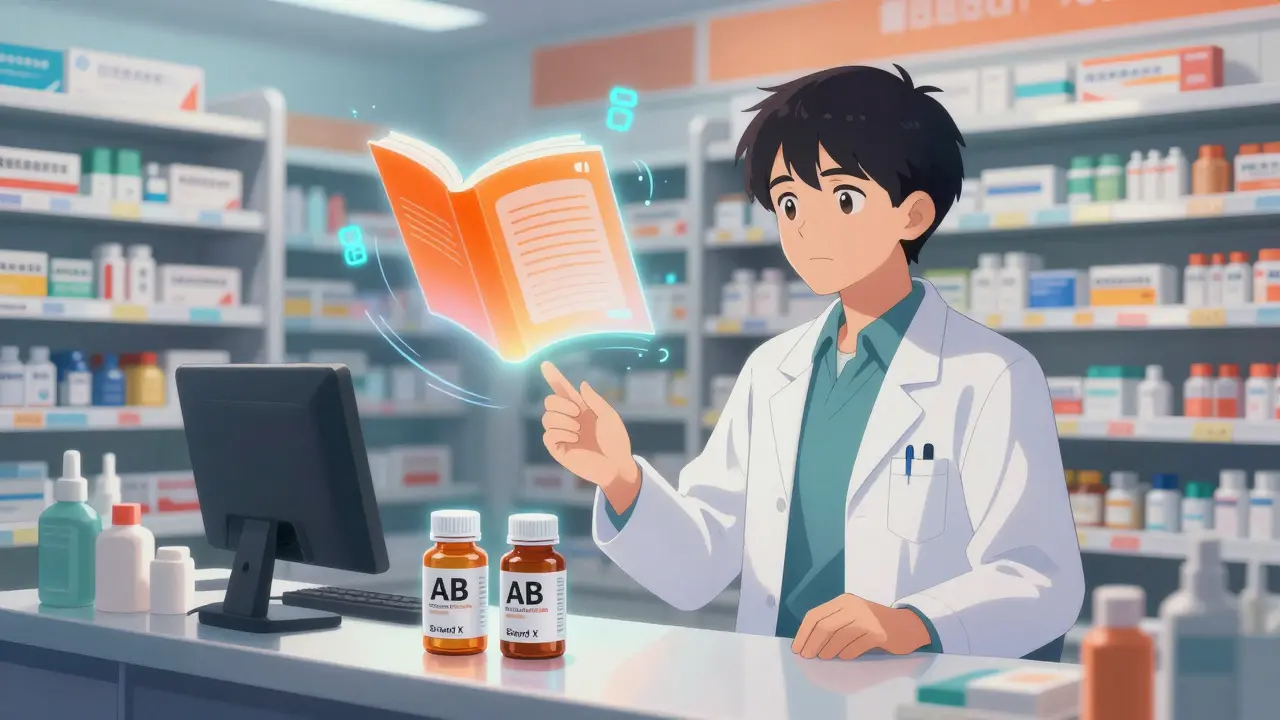
When you pick up a prescription at the pharmacy, you might not realize that behind the scenes, a detailed scientific system is deciding whether the pill in your hand can legally replace the brand-name version your doctor wrote. That system is the therapeutic equivalence (TE) code - a simple-looking label, like AB or B, that tells pharmacists whether a generic drug is safe to swap in place of the original. It’s not just paperwork. It’s what keeps millions of Americans from paying hundreds of dollars extra for the same medicine.
The FDA created this system in 1980 through the Orange Book, officially called Approved Drug Products with Therapeutic Equivalence Evaluations. It’s updated every month. Right now, over 14,000 drug products are listed, and 90% of them carry an ‘A’ rating. That means they’re approved for automatic substitution. But what does that actually mean? And why do some generics get a ‘B’ instead?
What Therapeutic Equivalence Really Means
Therapeutic equivalence isn’t about being chemically identical. It’s about being clinically the same. The FDA says a generic must meet three standards:
- Pharmaceutical equivalence: Same active ingredient, strength, dosage form, and route of administration as the brand-name drug.
- Bioequivalence: The body absorbs the drug at the same rate and to the same extent as the original. This is proven through blood tests in healthy volunteers.
- Same clinical effect and safety: No difference in how well it works or how safe it is under the conditions listed on the label.
It’s not enough for a generic to have the same pills. If your body doesn’t absorb it the same way, it could underdose or overdose you. That’s why the FDA doesn’t just rely on chemical formulas - they test how the drug behaves in real people.
The Code System: A, B, and What Comes After
The TE code is a one- or two-letter label you’ll find next to every generic in the Orange Book. The first letter tells you the big picture.
A-rated means the product is considered therapeutically equivalent to the brand-name drug. These are the ones pharmacists can swap without asking your doctor. But even within ‘A’, there are subcategories:
- AB: The most common. The generic has been tested and proven bioequivalent to the brand. It’s a direct substitute.
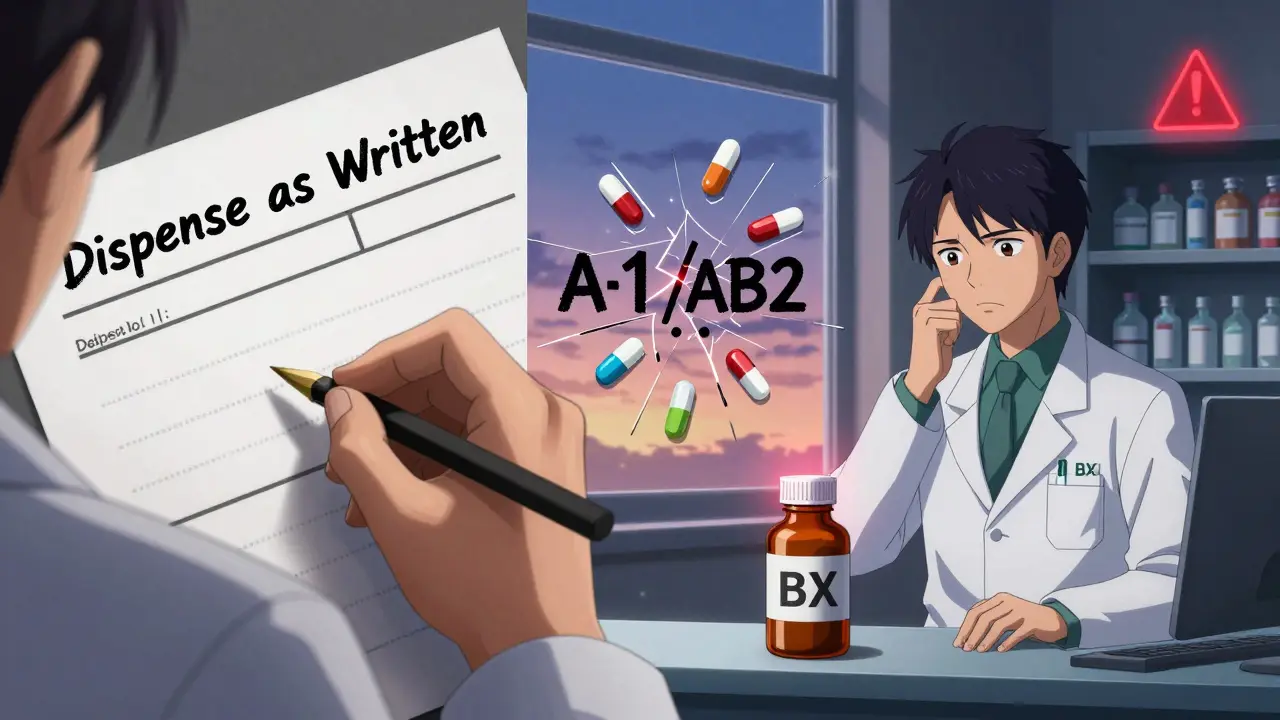
- AB1, AB2, AB3, AB4: These appear when multiple brand-name drugs (called Reference Listed Drugs or RLDs) exist for the same active ingredient. For example, if Drug X has two different brands on the market, the generics will be labeled AB1 (matches Brand A) and AB2 (matches Brand B). You can’t swap between AB1 and AB2 unless they’re both approved for the same RLD.
B-rated means the FDA hasn’t confirmed therapeutic equivalence. This doesn’t mean the drug is unsafe. It means there’s not enough data - or the data is complicated. Common B-codes include:
- BC: Extended-release tablets or capsules where bioequivalence is hard to prove.
- BD: Active ingredients with known bioequivalence issues.
- BT: Topical creams or ointments where absorption varies too much between products.
- BX: Not enough data to make a call. These are often new generics still under review.
Some B-rated products are still used - and even preferred - by doctors. But pharmacists can’t substitute them without a specific order from the prescriber. In 49 states, laws require that substitution only happens for A-rated drugs unless the doctor says otherwise.
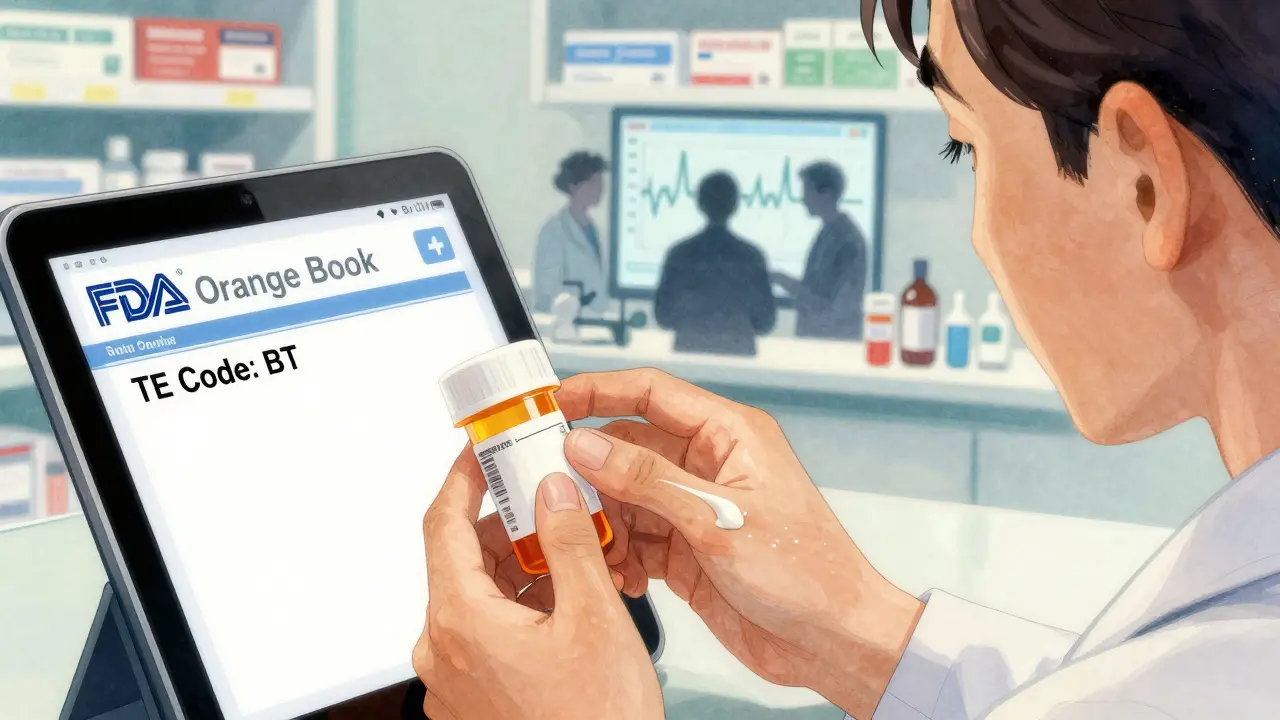
Why Some Generics Get a B - Even When They Should Work
You might wonder: if the generic has the same active ingredient, why wouldn’t it work? The answer lies in complexity.
Take a simple tablet: aspirin 325mg. The ingredients dissolve the same way. Bioequivalence is easy to prove. But what about an inhaler? Or a cream that needs to penetrate skin? Or a long-acting injection that releases medicine over weeks? These aren’t just about the chemical. They’re about how the drug is packaged, how it’s released, how it interacts with your body over time.
That’s where the system breaks down. The FDA’s current tests - mostly based on blood levels - don’t always capture what happens in the body. A 2022 study in the Journal of Generic Medicines found that some topical creams with identical ingredients showed different healing rates in patients. But because they passed the standard blood test, they still got an ‘A’ rating. Meanwhile, other creams with better clinical results got a ‘B’ because their absorption curves didn’t match the brand perfectly.
Dr. Duxin Sun from the University of Michigan says this is a real problem. “We’re using 1980s tools to judge 2020s drugs,” he told researchers. “For complex products, we need better tests.” The FDA agrees. Their 2022 draft guidance proposes using real-world data - like patient outcomes and pharmacy records - to supplement traditional bioequivalence studies.
How Pharmacists Use TE Codes Every Day
Every time a patient walks in with a prescription, the pharmacist checks three things:
- Is the drug listed in the Orange Book?
- What’s its TE code?
- Does state law allow substitution?
According to a 2022 survey of 1,200 independent pharmacists, 87% said TE codes make their job easier. They check the Orange Book website at least once a week - sometimes multiple times a day. The site had 1.7 million visitors in just three months in 2023.
But confusion still happens. A 2022 American Medical Association survey found that 42% of physicians didn’t understand what a ‘B’ code meant. Some thought it meant the drug was inferior. Others didn’t know they could override the substitution block by writing “Dispense as Written” on the prescription.
And pharmacists? They’re caught in the middle. One pharmacist in Ohio told a reporter: “I had a patient come back angry because I didn’t switch their inhaler. They thought I was trying to save money. But the code was BT. I couldn’t risk it.”
The Big Picture: Savings, Substitution, and Safety
Without TE codes, generic drugs wouldn’t be interchangeable. That’s the whole point. In 2023, generics made up 90% of all prescriptions filled in the U.S. - but only 23% of total drug spending. That’s $370 billion saved in one year.
Each time a pharmacist swaps a brand-name drug for an A-rated generic, the system saves money - and it’s safe. Dr. Steven Kessler, a former FDA official, says there’s never been a documented case of a patient harmed because an FDA-approved generic was substituted. That’s because the system works.
But the future is tricky. As more complex drugs enter the market - think biologics, injectables, and smart delivery systems - the current code system struggles. The FDA reports a 22% increase in B-rated applications for complex generics between 2018 and 2022. That’s not a failure. It’s a sign the system is being pushed to its limits.
The FDA’s 2023-2027 plan aims to reduce B-rated products for complex generics by 30%. That means better testing, more data, and smarter rules. The goal isn’t to make everything A-rated. It’s to make sure every A-rated product truly works the same - and every B-rated product gets the scrutiny it deserves.
What You Should Know as a Patient
You don’t need to memorize AB1 or BX. But here’s what matters:
- If your doctor writes a brand-name drug, the pharmacist can swap it for a generic - if it has an ‘A’ code.
- If you’re switched to a generic and you feel different - worse side effects, less relief - tell your doctor. It’s rare, but it can happen.
- If your prescription says “Do Not Substitute,” that’s your right. The pharmacist must follow it.
- Don’t assume a ‘B’ code means the drug is bad. It just means the FDA needs more proof. Ask your pharmacist if it’s safe for you.
The system isn’t perfect. But it’s the best we have. And it’s saving billions while keeping people healthy.
What does an AB code mean on a generic drug?
An AB code means the generic drug has been proven bioequivalent to the brand-name drug and is considered therapeutically equivalent. It can be substituted without any change in safety or effectiveness. AB1, AB2, etc., indicate which specific brand-name drug it matches when multiple reference products exist.
Can a B-rated generic be used instead of a brand-name drug?
Yes - but only if your doctor specifically prescribes it and allows substitution. A B rating means the FDA has not confirmed therapeutic equivalence, so pharmacists cannot substitute it automatically. Some B-rated products are still safe and effective, but they require more oversight.
Why do some generics get a B code even if they have the same ingredients?
Because therapeutic equivalence isn’t just about ingredients - it’s about how the drug behaves in your body. For complex products like inhalers, creams, or extended-release pills, standard blood tests may not capture differences in absorption or release. A B code signals that more data is needed before the FDA can say it’s interchangeable.
Are over-the-counter (OTC) drugs given TE codes?
No. TE codes only apply to prescription drugs listed in the FDA’s Orange Book. OTC medications are regulated differently and do not receive therapeutic equivalence ratings.
How often is the Orange Book updated?
The Orange Book is updated monthly. New drug approvals, code changes, and withdrawn products are added every month. Pharmacists and prescribers rely on this regular update to ensure accurate substitution decisions.
Comments
Charity Hanson
I love how this breaks down something so technical into plain English. As a pharmacist in Lagos, I see generics every day and this system is a lifesaver for patients who can't afford brand names. The AB code is basically the green light we need to keep things moving without asking for permission every time. Seriously, thank you for writing this.
On February 27, 2026 AT 05:49
Lisa Fremder
The FDA is overregulating again. All these codes are just bureaucracy. If it has the same chemical it should work. Stop making it harder for people to save money. We pay enough taxes already.
On February 27, 2026 AT 08:58
Brandon Vasquez
This is one of those topics that flies under the radar but impacts everyone. I’ve been on generics for years and never had an issue. The fact that the FDA tests bioequivalence with real human data instead of just lab numbers is why I trust the system. It’s not perfect but it’s built on science not profit.
On February 27, 2026 AT 18:39
Vikas Meshram
Actually the Orange Book has been updated since 1980 but the methodology is still rooted in pharmacokinetic modeling which was developed in the 70s. You need to understand that bioequivalence is measured via Cmax and AUC parameters which are statistically derived from 24-36 subjects. This is inadequate for complex drug delivery systems. The FDA’s 2022 draft guidance acknowledges this but implementation is slow due to regulatory inertia.
On March 1, 2026 AT 13:09
Ben Estella
B-rated drugs are a scam. They let companies slip in cheap junk and call it generic. I had a cousin who got a B-rated blood pressure med and ended up in the ER. The FDA is too cozy with Big Pharma. They don’t want you to know that most generics are made in China and tested by third parties with zero oversight.
On March 2, 2026 AT 10:57
Jimmy Quilty
You know what they dont tell you? The TE codes arent even used by all states. Some pharmacies just swap based on cost. And the Orange Book? It’s a joke. I saw a guy get a B-rated inhaler that was actually better than the brand. The FDA just doesn’t want to admit they got it wrong. They’re scared of liability. This whole system is rigged.
On March 3, 2026 AT 12:38
Miranda Anderson
I’ve been reading through this and honestly it’s one of the clearest explanations I’ve seen. I used to think generics were just cheaper versions of the same thing but now I get that it’s about how the body processes it. Like that example with topical creams - it makes total sense that two creams with identical ingredients could behave differently because of the base or how it’s applied. It’s not about the molecule, it’s about the whole delivery system. Kinda wild when you think about it.
On March 4, 2026 AT 23:39
Gigi Valdez
The therapeutic equivalence framework is a remarkable achievement in regulatory science. Its foundation in bioequivalence standards grounded in clinical pharmacology ensures patient safety while enabling cost containment. The monthly updates to the Orange Book reflect a commitment to dynamic evidence-based policy. It is imperative that stakeholders recognize the rigorous methodology underpinning these evaluations.
On March 5, 2026 AT 04:27
Angel Wolfe
They’re hiding something. Why are 90% of drugs A-rated but only 30% of complex ones? Because they don’t want you to know that the blood tests they use don’t even measure what matters. The real data? It’s in the VA hospitals and Medicaid records. They’ve been quietly collecting it for years but won’t release it. Why? Because if they did, you’d realize half the generics are just as good as the brand - and they’d lose billions. This is a cover-up. Wake up people.
On March 5, 2026 AT 22:27
Sophia Rafiq
AB1/AB2 distinctions are critical when dealing with multi-RLD products. If you’re on a generic that’s AB1 and switch to AB2 without knowing they’re not interchangeable, you risk therapeutic failure. Pharmacists need better tools to flag this. I’ve seen patients confused when they get a different-looking pill and assume it’s the same. The system works but the communication doesn’t.
On March 6, 2026 AT 12:01
Ajay Krishna
This is a great breakdown. I teach pharmacology in Mumbai and I use this exact framework to explain generics to students. The key is helping them understand that equivalence isn’t about chemistry - it’s about clinical outcomes. I always say: ‘It’s not the pill that matters, it’s what the pill does in your body.’ Simple, but true.
On March 7, 2026 AT 10:52
Noah Cline
B-rated doesn’t mean inferior. It means insufficient data. That’s not a failure - it’s a scientific boundary. Most people don’t realize that the FDA requires 90% CI for Cmax and AUC within 80-125% for bioequivalence. That’s a tight margin. If a generic falls outside even slightly - and it often does with extended release - it gets a B. This isn’t about cost. It’s about statistical rigor.
On March 8, 2026 AT 13:07
Justin Ransburg
I’ve been on generic meds for over a decade. Never had a problem. The system works because it’s built on real science, not guesswork. The fact that we save $370 billion a year without a single documented harm? That’s proof it’s doing its job. Let’s keep improving it, not tearing it down.
On March 8, 2026 AT 22:03