

Topical Steroid Safety & Potency Guide
Potency Level:
Have you ever stared at a tube of cream and wondered if it’s strong enough to help your itch-or too strong to be safe? You aren’t alone. Millions of people use topical corticosteroids, which are medicated creams or ointments used to reduce inflammation and itching on the skin every day for conditions like eczema and psoriasis. But using the wrong strength can lead to thinning skin, visible blood vessels, or even a rebound effect that makes your rash worse. This is where a potency chart becomes your best friend. It’s not just medical jargon; it’s a practical guide to getting relief without paying the price in side effects.
Understanding the Potency Classes
To use these medications safely, you first need to understand how they are ranked. Think of potency like volume on a stereo. You don’t blast the bass for a quiet conversation, and you shouldn’t use a super-strong steroid for a mild itch. In the United States, the Food and Drug Administration (FDA) uses a seven-class system. Class I is the loudest-superpotent-and Class VII is the softest-least potent.
In the UK, the National Eczema Society simplifies this into four categories: mild, moderate, potent, and very potent. Both systems aim to do the same thing: match the drug’s strength to the severity of your condition and the sensitivity of the skin area.
| US FDA Class | UK Category | Common Examples | Best For |
|---|---|---|---|
| Class I (Superpotent) | Very Potent | Clobetasol propionate 0.05%, Halobetasol propionate 0.05% | Thick plaques (psoriasis), short-term severe flares |
| Class II-III (High Potency) | Potent | Betamethasone dipropionate, Mometasone furoate | Moderate eczema, body areas with thicker skin |
| Class IV-V (Moderate Potency) | Moderate | Triamcinolone acetonide 0.1%, Hydrocortisone valerate | General body eczema, maintenance therapy |
| Class VI-VII (Low/Mild Potency) | Mild | Hydrocortisone 0.1-2.5%, Desonide | Face, groin, children, sensitive areas |
The key takeaway here is specificity. A study published in Dermatologic Therapy found that using these charts reduced medication errors by 18% in clinical settings. Why? Because it stops doctors from prescribing a tank when a bicycle will do the job.
Why Your Body Location Matters More Than You Think
This is the part most people miss. The skin on your back is thick and tough. The skin on your eyelids is paper-thin. If you apply a Class I steroid to your eyelid, you aren’t just treating an itch; you’re risking permanent damage. According to data from the National Psoriasis Foundation, applying high-potency steroids to facial areas increases the risk of skin atrophy (thinning) by 65% compared to using mild potency options.
Here is a simple rule of thumb:
- Face, Groin, Armpits: Stick to Class VI-VII (Mild). These areas absorb medication rapidly due to thinner skin and higher moisture levels.
- Arms, Legs, Torso: Class IV-V (Moderate) is usually safe and effective for standard eczema.
- Palms, Soles, Thick Plaques: Class I-III (Potent/Superpotent) may be necessary because the skin barrier is so thick that weaker steroids can’t penetrate.
Dr. Peter Lio from Northwestern University noted in a 2022 review that appropriate potency selection based on location reduces cutaneous side effects by 58%. That’s nearly six out of ten side effects avoided just by choosing the right spot for the right strength.
The Hidden Factor: Vehicle Formulation
You might think the active ingredient is all that matters, but the base-the "vehicle"-plays a huge role. Is it a cream, an ointment, a gel, or a foam? Research shows that ointments allow for 15-20% higher absorption than creams because they create a better seal over the skin (occlusion). This means a mild steroid in an ointment base might act like a moderate steroid in a cream base.
If you have dry, cracked skin, an ointment helps heal the barrier while delivering the drug. If you have sweaty, weeping eczema, a cream or lotion absorbs faster and feels less greasy. Always check the label. The FDA updated its labeling requirements in 2023 to ensure potency classification is clear on all prescription products, helping patients make smarter choices.

How Much Should You Actually Apply?
Most people use way too much. A 2022 study found that 35% of patients apply two to three times the recommended amount. This doesn’t make it work faster; it just increases your risk of systemic absorption, where the steroid enters your bloodstream and affects your whole body.
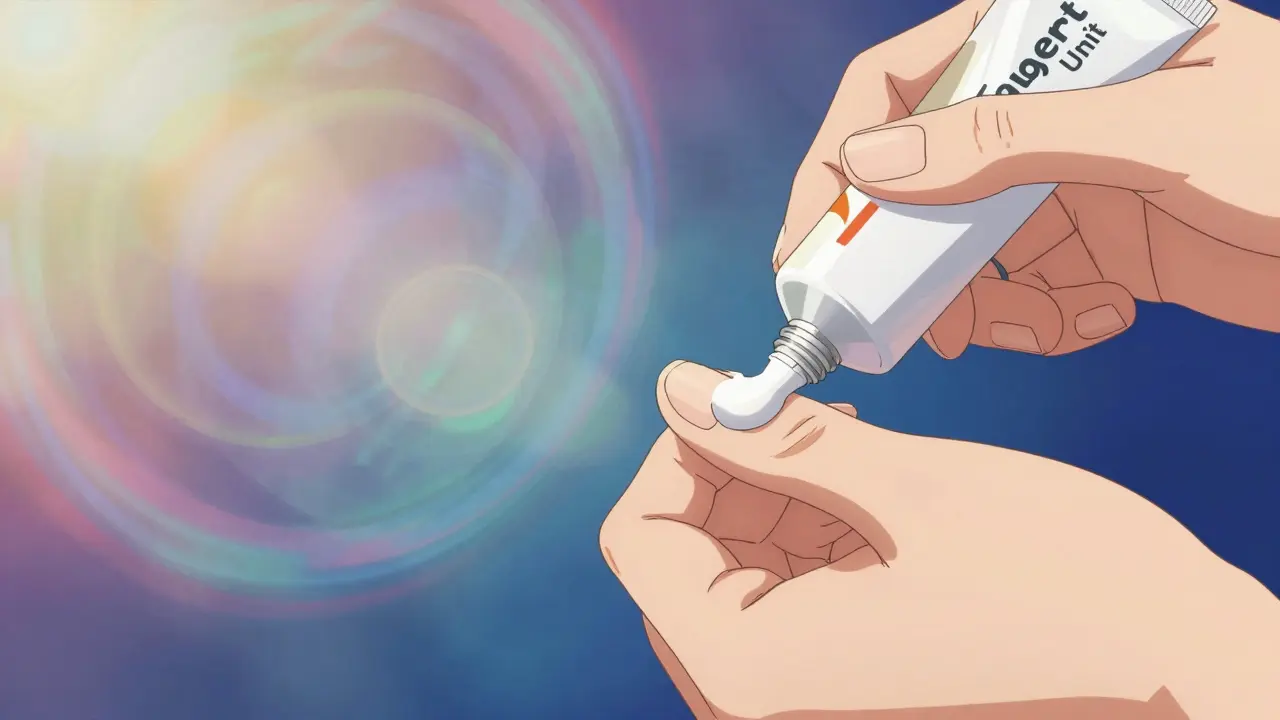
Use the Fingertip Unit (FTU) method. One FTU is the amount of cream squeezed from the tip of your adult index finger to the first crease. One FTU covers an area equal to two adult palms put together.
- Mild potency (Class VI-VII): Apply twice daily for 2-4 weeks.
- Moderate potency (Class IV-V): Apply once daily for 1-2 weeks.
- High potency (Class II-III): Apply once daily for only 3-7 days.
Never leave high-potency steroids on continuously for more than three weeks unless specifically directed by a specialist. The American Academy of Family Physicians strongly advises against this to prevent long-term damage.
Special Considerations for Children
Kids aren’t just small adults. Their skin has a higher surface-area-to-body-weight ratio, meaning they absorb up to five times more medication than an adult relative to their size. Dr. Lawrence Eichenfield, a pediatric dermatologist, warns that improper use of high-potency steroids in children can suppress the HPA axis (the system that controls stress hormones).
For children under 12, guidelines mandate reducing doses by 50-75% and limiting treatment duration to 7-14 days even for moderate potency steroids. Always start with the mildest effective option. If hydrocortisone 1% works, don’t jump to betamethasone. Proactive therapy-applying a mild steroid twice weekly to previously affected areas-can reduce flares by 68% over time, according to the British Journal of Dermatology.
Avoiding Steroid Withdrawal and Rebound
There is a growing concern about "topical steroid withdrawal" (TSW), reported in 20-30% of cases involving improper usage. This happens when the skin becomes dependent on the steroid to control inflammation. When you stop abruptly, the symptoms flare up worse than before. While TSW is controversial and not fully understood, minimizing risk involves tapering off rather than stopping cold turkey.
If you’ve been using a potent steroid for a few weeks, switch to a milder one for another week, then move to non-steroidal moisturizers or calcineurin inhibitors (like tacrolimus) for maintenance. This step-down approach keeps the skin calm while allowing it to regain its natural resilience.
When Charts Fail: Individualized Care
Charts are guides, not laws. About 20% of eczema patients have compromised skin barriers that increase absorption by 40-50%. If you have open wounds or severe cracking, even a mild steroid might act like a potent one. In these cases, listen to your doctor. They may adjust the potency downward despite the chart suggesting otherwise. Also, newer formulations like foams or enhanced delivery systems can change traditional potency rules. For example, hydrocortisone valerate foam has 35% higher bioavailability than traditional creams. Always ask your pharmacist if your specific formulation behaves differently.
What is the safest topical steroid for the face?
The safest options for the face are low-potency steroids, such as hydrocortisone 0.5-1% (Class VII) or desonide (Class VI). These minimize the risk of skin thinning and visible blood vessels, which are common side effects of stronger steroids on delicate facial skin.
How long can I use a potent topical steroid?
Generally, potent (Class II-III) and superpotent (Class I) steroids should not be used continuously for more than 2-3 weeks. Long-term use increases the risk of skin atrophy, telangiectasia (spider veins), and systemic absorption. Always follow your doctor's specific timeline.
What is a fingertip unit (FTU)?
A fingertip unit is the amount of cream squeezed from the tip of an adult index finger to the first webbing. One FTU weighs approximately 0.5 grams and covers an area equivalent to two adult palms. It is the standard measure to prevent over-application.
Can topical steroids cause systemic side effects?
Yes, especially in children or when large amounts of high-potency steroids are used over large body areas for extended periods. Systemic side effects can include suppression of the adrenal glands (HPA axis suppression), leading to fatigue, weight changes, and other hormonal imbalances.
Is there a difference between US and UK potency charts?
Yes. The US uses a 7-class system (I-VII), offering more granularity. The UK uses a 4-category system (Mild, Moderate, Potent, Very Potent). Both aim to guide safe usage, but the US system is often considered more detailed for specialist care, while the UK system is simpler for general practice.