

Feeling tired for no reason? Gaining weight despite eating less? These are classic signs that your thyroid gland, a small butterfly-shaped organ in your neck, might be struggling. But here is the catch: you can’t just feel your way to a diagnosis. You need blood work. Specifically, two key tests: TSH and T4. Understanding these numbers is the difference between guessing what’s wrong with your body and getting a precise treatment plan that actually works.
Most people think of thyroid testing as a single check-up. In reality, it’s a conversation between two hormones. One comes from your brain (the pituitary gland), and the other comes from your thyroid. When one speaks up, the other responds. If you don’t understand how they talk to each other, you might miss early signs of disease or end up on the wrong medication dose. Let’s break down exactly what these tests mean, why doctors order them together, and how your dosage gets calculated.
The Basics: What Are TSH and T4?
To understand your results, you first need to know who the players are. The thyroid produces hormones that control your metabolism-basically, how fast your body burns energy and generates heat. The main hormone it makes is called Thyroxine, often abbreviated as T4.
But the thyroid doesn’t act alone. It takes orders from the pituitary gland at the base of your brain. This gland releases Thyroid-Stimulating Hormone, known as TSH. Think of TSH as the manager and T4 as the worker. If the worker (T4) is slacking off, the manager (TSH) shouts louder to get things done. If the worker is overactive, the manager quiets down.
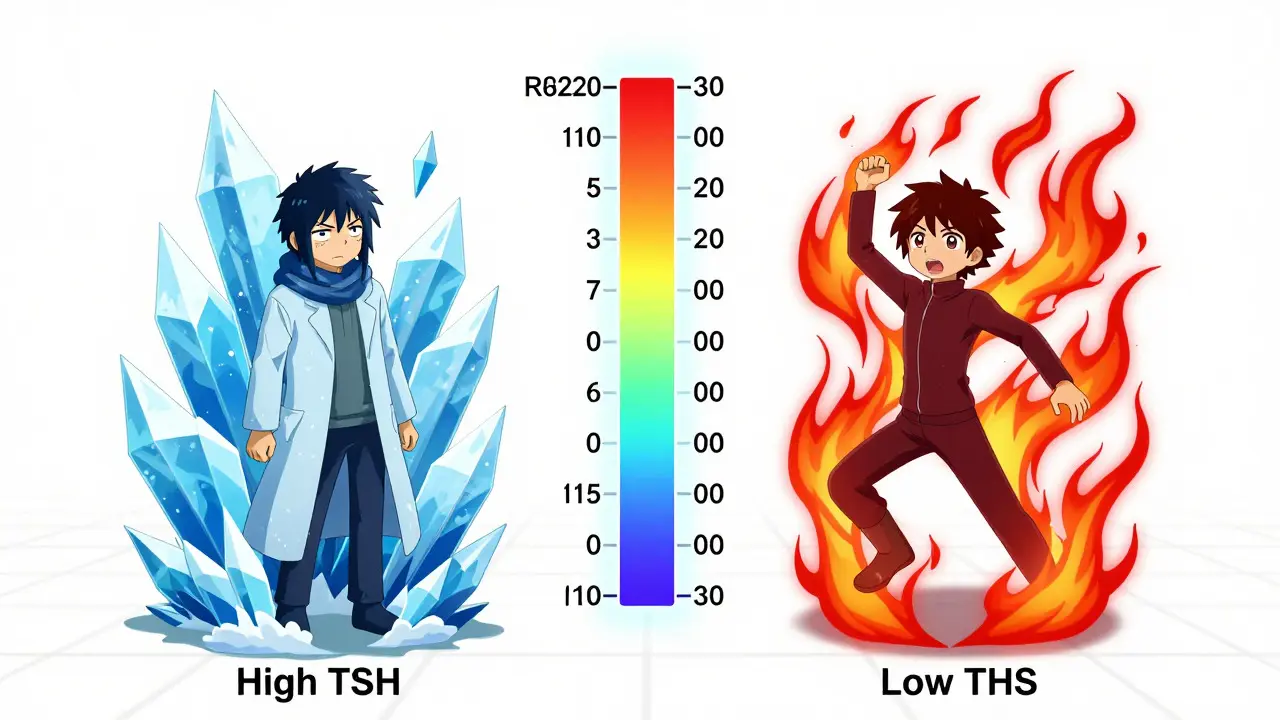
This inverse relationship is crucial. A high TSH usually means your thyroid isn’t producing enough T4 (hypothyroidism). A low TSH usually means your thyroid is producing too much (hyperthyroidism). Doctors look at both because relying on just one gives you only half the picture.
Reading Your Lab Results: Normal vs. Abnormal
When you get your lab report, you’ll see ranges next to your numbers. These aren’t universal laws; they vary slightly by laboratory. However, there are general benchmarks that most clinicians use.
| Test | Normal Range (Adults) | High Result Indicates | Low Result Indicates |
|---|---|---|---|
| TSH | 0.5 - 5.0 mIU/L | Hypothyroidism (Underactive) | Hyperthyroidism (Overactive) |
| Free T4 | 0.7 - 1.9 ng/dL | Hyperthyroidism | Hypothyroidism |
Note that "Free" T4 is different from "Total" T4. Most of the T4 in your blood is bound to proteins and inactive. Free T4 is the unbound portion that actually enters your cells and does the work. That’s why doctors prefer measuring Free T4-it gives a more accurate picture of your metabolic status.
If your TSH is elevated but your Free T4 is still within the normal range, you have Subclinical Hypothyroidism. This is a gray area. You might have mild symptoms like fatigue or brain fog, or you might feel fine. Doctors often monitor this closely before starting medication, depending on your age and symptom severity.
Why Context Matters: Pregnancy and Age
Your "normal" range changes based on your life stage. Using standard adult ranges for everyone leads to misdiagnosis. Two groups need special attention: pregnant women and the elderly.
During pregnancy, your body’s demand for thyroid hormone skyrockets to support fetal brain development. The Endocrine Society recommends stricter targets. For example, in the first trimester, a TSH above 2.5 mIU/L might warrant intervention, even though 2.5 is well within the standard adult normal range. Ignoring this can increase risks for miscarriage and developmental issues.
On the flip side, older adults naturally have higher TSH levels. Research published in JAMA Internal Medicine suggests that strict normalization of TSH in patients over 70 can lead to unnecessary medication and side effects like heart palpitations. For seniors, a TSH up to 6.5 mIU/L might be considered acceptable if they have no symptoms. Always discuss your specific context with your doctor.
How Thyroid Medication Dosing Works
If your tests confirm hypothyroidism, the standard treatment is Levothyroxine, a synthetic form of T4. Getting the dose right is tricky because the therapeutic window is narrow. Too little, and you stay sick. Too much, and you risk damaging your heart and bones.
Doctors typically start with a calculation based on your body weight. The general rule of thumb is about 1.6 micrograms per kilogram of body weight per day. So, if you weigh 70 kg, your starting dose might be around 112 mcg. However, this is just a starting point.
- Elderly Patients: Often start lower, around 1.0 mcg/kg or even less, to protect their hearts.
- Children: Require much higher doses relative to weight, sometimes 10-15 mcg/kg, because their bodies are growing rapidly.
- Pregnant Women: Usually need a 20-30% increase in dose as soon as pregnancy is confirmed.
After starting medication, you won’t get retested immediately. It takes about 6 weeks for your blood levels to stabilize and for your TSH to reflect the new dose. Testing sooner than that wastes money and causes confusion. Once stable, many patients only need annual checks.

Common Pitfalls and Patient Frustrations
Despite clear guidelines, many patients struggle. A survey on ThyroidChange.org found that nearly 70% of respondents experienced diagnostic delays. Why? Because some doctors rely solely on TSH and ignore symptoms when TSH is "borderline."
Another major issue is lab variability. Different laboratories use different machines and reference standards. A TSH of 4.0 mIU/L at one lab might read as 4.5 at another. This inconsistency can lead to unnecessary dose adjustments. If you switch labs, always inform your doctor so they can interpret the results in context.
Also, remember that non-thyroidal illness affects these tests. If you’re hospitalized with a severe infection or trauma, your TSH and T4 levels may drop temporarily due to stress, not thyroid failure. This is called "euthyroid sick syndrome," and treating it with thyroid meds can be harmful. Doctors usually wait until you recover before interpreting thyroid tests again.
What Comes Next? Emerging Trends
The field of thyroid medicine is evolving. Recent studies suggest that for some patients on Levothyroxine who still feel tired despite normal TSH, adding Triiodothyronine, or T3, might help. While controversial, clinical trials are exploring this combination therapy. Additionally, AI tools are being tested to help doctors interpret complex cases by analyzing TSH, T4, age, and BMI together, potentially reducing misdiagnosis rates.
For now, the TSH and Free T4 combination remains the gold standard. By understanding how these two markers interact, you can have more productive conversations with your healthcare provider and ensure your treatment plan is tailored to your unique biology.
Should I take my thyroid medication in the morning or night?
Consistency is key. Most doctors recommend taking Levothyroxine on an empty stomach, either 30-60 minutes before breakfast or at bedtime, at least 3-4 hours after your last meal. Food, coffee, calcium, and iron supplements can significantly block absorption, making your dose less effective.
Can stress affect my TSH levels?
Yes, chronic stress can impact the hypothalamic-pituitary-adrenal axis, which interacts with thyroid function. While stress alone rarely causes permanent thyroid disease, it can temporarily alter TSH levels and exacerbate symptoms of existing thyroid conditions.
What is the difference between Total T4 and Free T4?
Total T4 measures all thyroxine in your blood, including what is bound to proteins. Free T4 measures only the unbound hormone available for your cells to use. Free T4 is generally more accurate for diagnosing thyroid dysfunction, especially in pregnant women or those on certain medications that alter protein binding.
How long does it take for thyroid medication to work?
You may notice some improvement in energy levels within a few weeks, but it takes about 6 weeks for your body to fully adjust and for your TSH levels to stabilize. This is why doctors wait 6 weeks before retesting and adjusting the dose.
Is subclinical hypothyroidism dangerous?
Subclinical hypothyroidism (high TSH, normal T4) carries a slightly increased risk of developing overt hypothyroidism and cardiovascular issues over time. However, many people remain asymptomatic. Treatment depends on your age, cholesterol levels, and presence of symptoms. Regular monitoring is essential.