
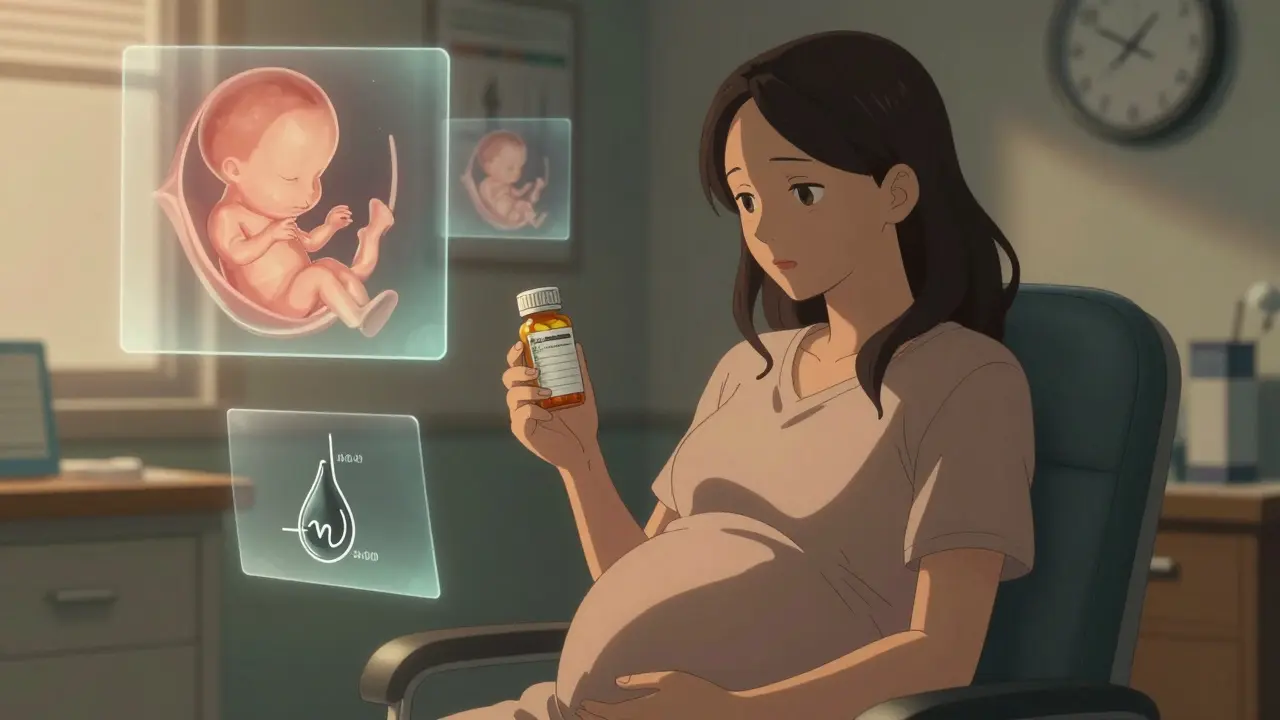
When you’re pregnant, every pill, supplement, or over-the-counter remedy feels like a gamble. You want to feel better - maybe manage depression, control high blood pressure, or treat an infection - but you’re terrified of hurting your baby. That fear isn’t irrational. Medication use during pregnancy is one of the most complex, confusing, and high-stakes decisions in modern healthcare. And the system meant to protect you? It’s full of gaps, delays, and mixed messages.
Why Safety Alerts Exist
For decades, doctors relied on a simple letter system - A, B, C, D, X - to tell pregnant women if a drug was safe. It sounded clear. But it wasn’t. A “C” didn’t mean “maybe dangerous.” It meant “we don’t have enough human data.” Many women stopped taking needed medications because they thought “C” meant “harmful.” That’s why the FDA scrapped the letter system in 2015. Now, labels have real stories: what’s known, what’s not, what the risks actually are. The goal of today’s safety alerts is simple: stop harm before it happens. Some drugs, like isotretinoin (Accutane), are known to cause severe birth defects in 20-35% of cases. Others, like certain antidepressants, have unclear risks - but stopping them can lead to worse outcomes than staying on them. Safety alerts try to cut through the noise. They’re not about scaring you. They’re about giving you real information so you can make a choice with your doctor.How the System Works - and Where It Fails
The FDA and EMA run separate but similar systems. In the U.S., drug makers must now include detailed sections in labels about pregnancy, breastfeeding, and reproductive risks. In Europe, companies must actively track pregnancies in women taking high-risk drugs and report back. Both require companies to set up registries - databases that collect data from women who take medications while pregnant. But here’s the problem: only 22% of drug companies actually run these registries. And even when they do, they capture less than 1% of all pregnancies where medication is used. That means for most drugs, we’re flying blind. A 2020 study found that only 5-10% of FDA-approved drugs between 2003 and 2012 had enough human data to judge safety during pregnancy. That’s not a small gap. It’s a canyon. Even when data exists, it’s slow. Pregnancy exposure registries take years to build up enough cases to spot a pattern. One study found safety alerts are delayed by an average of 7.2 years. That means a drug could be harming babies for over half a decade before anyone knows.What You’re Really Up Against
About 70-90% of pregnant women take at least one medication. Half take four or more. And here’s the kicker: 40-80% of pregnancies are unplanned. That means a lot of women are already taking drugs when they find out they’re pregnant. That’s not a failure. It’s reality. The biggest danger isn’t the drugs themselves - it’s the panic. A 2021 survey found 68% of obstetricians say they regularly face medications with no clear safety data. And 29% of women with chronic conditions stop their meds as soon as they get pregnant - even when stopping could be riskier than staying on them. One Reddit user wrote: “My doctor told me to stop my antidepressant immediately. Now I’m in withdrawal and worse than before. Why isn’t there clearer guidance?” That’s not an outlier. It’s the norm. On Drugs.com, 42% of negative reviews about pregnancy medication info say the advice contradicts itself. One site says “safe,” another says “avoid.” No wonder pregnant women feel lost.
What’s Actually Safe - And What’s Not
Some drugs are known to be dangerous. Isotretinoin (Accutane) for acne? Avoid. Valproate for seizures? Increases neural tube defect risk from 0.1% to 1-2%. Thalidomide? Never. These are black-and-white. But most drugs aren’t that clear. Take SSRIs like sertraline or citalopram. Studies show they don’t increase major birth defects. But they might slightly raise the risk of preterm birth or temporary newborn symptoms. For many women, the risk of untreated depression - including suicide, poor prenatal care, or low birth weight - is far greater. Folic acid? Take 800 mcg daily, starting before conception and continuing through at least 12 weeks. It cuts neural tube defect risk by up to 70%. It’s one of the few things in pregnancy medicine that’s a no-brainer. And here’s something most women don’t know: you don’t need to stop all your meds. A 2022 study from Massachusetts General Hospital found that 78% of calls to their pregnancy medication hotline were about anxiety or depression drugs - and 63% of the time, the advice was to keep taking them.What You Can Do Right Now
You don’t have to wait for perfect data. Here’s what works:- Do a medication review at your first prenatal visit. Bring every pill, supplement, and herbal tea. Include OTC meds like ibuprofen or allergy pills. ACOG says this should take about 22 minutes - make sure it does.
- Check the label. Look for the “Pregnancy” section. It’s not a letter anymore. It’s a story. What’s known? What’s unknown? Are there animal studies? Human data?
- Don’t stop cold turkey. Stopping antidepressants, seizure meds, or thyroid drugs suddenly can be dangerous. Talk to your doctor about tapering or switching.
- Use trusted sources. The FDA’s “Medicine and Pregnancy” page got a 4.3/5 rating from users. Mass General’s hotline handled over 12,000 calls in 2022 - and most of them ended with women being told to continue treatment.
- Join a registry if you can. If you’re on a drug with a pregnancy registry, sign up. Your data helps the next woman.

The Bigger Picture
The market for pregnancy medication safety tools is growing fast - projected to hit $2.8 billion by 2029. Big pharma is building apps. The NIH just launched a $25 million project to track 100,000 pregnancies in real time. AI might soon predict risks with 70% accuracy. But money isn’t the only problem. The system still relies on women remembering to check labels, doctors having time to review meds, and companies actually reporting data. Right now, only 28% of U.S. hospitals can automatically flag risky drugs in electronic records. That means most safety alerts depend on you - and your doctor - noticing the problem.Final Thought
There’s no such thing as a 100% safe drug in pregnancy. But there is such a thing as a 100% unsafe decision: letting fear make the choice for you. The goal isn’t to avoid all meds. It’s to use the right ones, at the right time, with the right support. You’re not alone in this. Millions of women have walked this path. And the system - flawed as it is - is trying to catch up. Your job? Ask questions. Demand clarity. And never assume silence means safety.Are all medications dangerous during pregnancy?
No. Many medications are safe or have manageable risks. Folic acid, certain antidepressants like sertraline, insulin for diabetes, and thyroid medications are routinely used during pregnancy with no increased risk of major birth defects. The key is knowing which ones and why. Most risks are small, and untreated conditions like high blood pressure or depression can be far more dangerous to both mother and baby.
What should I do if I took a medication before knowing I was pregnant?
Don’t panic. Most medications taken in the first few weeks of pregnancy - before you even know you’re pregnant - either have no effect or cause an all-or-nothing outcome (the pregnancy continues normally or ends in miscarriage). Contact your provider to review what you took, when, and at what dose. For most drugs, especially those taken early, no action is needed. Only a few, like isotretinoin or certain seizure meds, require immediate follow-up.
Can I trust online pregnancy medication checkers?
Some are helpful, but many are outdated or oversimplified. Avoid sites that use the old A-B-C-D-X letter system. Look for sources that cite FDA or EMA guidelines, like the FDA’s own “Medicine and Pregnancy” page or Mass General’s Pregnancy Medication Safety Program. If a site gives you a simple “safe” or “not safe” verdict without context, it’s not reliable. Always confirm with your doctor.
Why do different doctors give me different advice about the same medication?
Because the data is often incomplete. For many drugs, there’s no clear consensus. One doctor might err on the side of caution. Another might weigh the risks of stopping treatment. This is why it’s important to ask: “What’s the evidence behind this recommendation?” and “Are there studies on this specific drug in pregnant women?” If your provider can’t answer, ask for a referral to a maternal-fetal medicine specialist.
Is it safe to take herbal supplements during pregnancy?
Many are not. Unlike prescription drugs, herbal products aren’t tested for safety in pregnancy. Some, like black cohosh or goldenseal, may trigger contractions. Others, like high-dose vitamin A or certain essential oils, can harm fetal development. Always tell your provider about every supplement - even “natural” ones. Just because it’s sold in a health store doesn’t mean it’s safe for your baby.
What’s the most common mistake women make with medications during pregnancy?
Stopping needed medications out of fear. A 2021 survey found nearly one-third of women with chronic conditions stop their meds as soon as they find out they’re pregnant. For conditions like epilepsy, asthma, or depression, this can lead to serious complications - including preterm birth, preeclampsia, or even death. The best rule: never stop a medication without talking to your doctor first. The risk of stopping is often higher than the risk of continuing.
Comments
Mussin Machhour
Just wanted to say this post saved my sanity. I was about to quit my antidepressant because some random Reddit thread said it was 'dangerous' - turns out the real danger was stopping cold turkey. My OB literally told me to keep taking sertraline after I showed her this. Thank you for the clarity.
On December 26, 2025 AT 04:57
sagar patel
70 of pregnant women take meds and 40 of pregnancies are unplanned so the system is broken not the women. No one should be guessing with their unborn child's life. Pharma needs to be forced to fund registries or lose approval. Simple.
On December 27, 2025 AT 14:21
Katherine Blumhardt
OMG I took ibuprofen for a headache at 6 weeks and now I'm terrified 😭 I read somewhere it causes heart defects but my friend said its fine?? I dont even know who to trust anymore. I just want to be a good mom
On December 27, 2025 AT 20:13
Bailey Adkison
Stop crying about safety alerts. If you dont know what you're taking dont be pregnant. People take weed and alcohol and dont even think twice but freak out over a Zoloft pill. Wake up. The real problem is women who treat pregnancy like a magic spell that cancels all consequences
On December 29, 2025 AT 15:12
Ben Harris
Let me tell you something real - I had a friend who stopped her blood pressure meds because she 'didn't want to poison the baby' and ended up in the ICU with preeclampsia. The baby lived but she almost didn't. This isn't about fear. It's about responsibility. If you're going to bring a life into this world you better do your homework. Not just read a Reddit post and call it a day.
On December 29, 2025 AT 21:12
Sophie Stallkind
Thank you for the comprehensive breakdown. As a healthcare provider, I see daily how the absence of clear, accessible data leads to harmful decisions - both in stopping necessary medications and in continuing unsafe ones. The shift from letter categories to narrative labeling was a critical step, but the implementation remains inconsistent. I encourage every clinician to treat medication review as a non-negotiable part of the first prenatal visit - not a formality, but a foundational act of care.
On December 31, 2025 AT 03:12
Oluwatosin Ayodele
Most of you are missing the point. The real issue is not the drugs or the labels - it's the complete absence of standardized global pregnancy registries. The US and EU are barely scraping by. In Nigeria, India, Brazil - no one tracks anything. Women are given pills by pharmacists with no guidance. This isn't a healthcare gap - it's a human rights failure. Until there's a mandatory international database, nothing changes.
On January 1, 2026 AT 05:13
Rick Kimberly
The data gap is indeed staggering. But I'd like to add a nuance: the 7.2-year delay in safety alerts isn't just about bureaucracy - it's about statistical power. Pregnancy outcomes are rare events, and detecting a signal requires thousands of exposures. We need incentivized participation, not just passive reporting. Imagine if every woman who took a medication during pregnancy could opt into a secure, anonymized registry with a simple app - and get real-time feedback on emerging trends. That’s not science fiction - it’s scalable public health infrastructure we're not building.
On January 2, 2026 AT 11:50
Jason Jasper
My wife took lamotrigine through both pregnancies. No issues. But when she told her OB, he said 'we don't know enough' and wanted to switch her to something else. We went to Mass General’s hotline - they said keep it. She’s fine. The system fails when doctors don't consult the actual evidence. This post should be required reading for every OB-GYN.
On January 3, 2026 AT 10:29