
Why Your Weight Matters for Sleep Apnea and CPAP
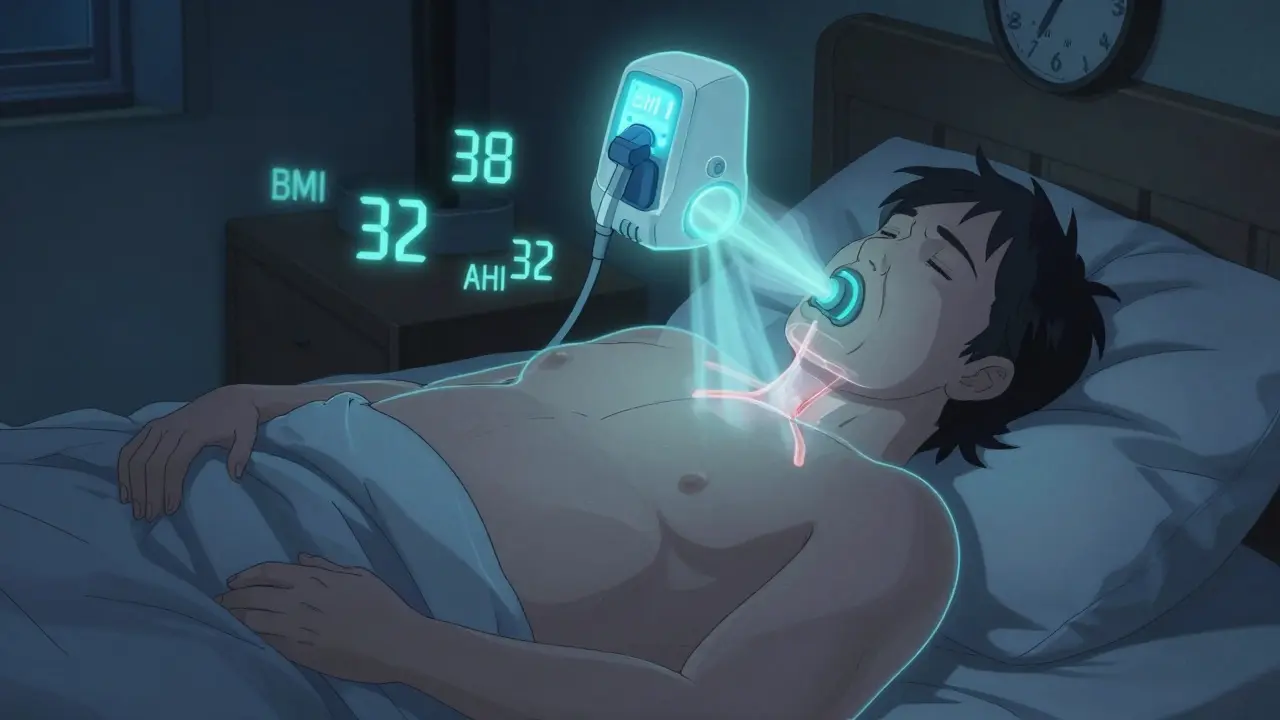
If you’re using a CPAP machine and still feel tired in the morning, the issue might not be the machine-it could be your weight. For most people with obstructive sleep apnea (OSA), body mass index (BMI) is the biggest factor in how severe their sleep apnea is and how much pressure their CPAP needs to work. It’s not just about being overweight. It’s about how fat tissue physically blocks your airway while you sleep.
Every extra pound of fat around your neck, chest, or abdomen adds pressure on your throat. When you lie down, that pressure makes your airway collapse more easily. That’s what causes those pauses in breathing-the hallmark of sleep apnea. Studies show that for every 1-point drop in BMI, your apnea-hypopnea index (AHI), which measures how many times you stop breathing per hour, drops by about 6.2%. For someone in the 25-40 BMI range (which covers most OSA patients), that number climbs to 7.1%. That means if you lose 7 pounds, you can expect a 7% reduction in breathing interruptions. It’s not magic. It’s physics.
How BMI Directly Changes Your CPAP Pressure
CPAP machines don’t guess how much pressure you need. They’re set based on your sleep study results. But here’s the key: higher BMI almost always means higher pressure settings. Most machines deliver air pressure between 4 and 20 cm H₂O. People with a normal BMI often need just 8-10 cm H₂O. But if your BMI is over 35, you’re likely on 14-20 cm H₂O. Why? Because more tissue means more resistance. The air has to push harder to keep your throat open.
Research from Fattal et al. (2022) found that for every 1-point increase in BMI, CPAP pressure needs to rise by about 0.5 cm H₂O on average. So if you go from BMI 30 to 35, your pressure may need to jump from 10 to 12.5 cm H₂O. That’s not a small change. Higher pressure can feel uncomfortable. It can make mask leaks worse. It can make you want to quit using the machine. And that’s exactly what happens for many people with obesity-related OSA.
The CPAP Weight Gain Paradox
Here’s the twist: using CPAP can sometimes make you gain weight. It sounds backwards, but it’s real. Multiple studies, including one from Tachikawa et al. (2016), found that people who started using CPAP gained an average of 1.2 kg (2.6 lbs) over six months-even if they didn’t change their diet or exercise.
Why? Two reasons. First, better sleep makes you hungrier. Untreated sleep apnea raises ghrelin (the hunger hormone) and lowers leptin (the fullness hormone). When CPAP fixes your sleep, your body starts regulating these hormones again… but not always in your favor. One study showed CPAP users ate 287 extra calories a day after starting therapy. Second, your metabolism slows down. Tachikawa’s team found basal metabolic rate dropped by 5.3% after CPAP use. You burn fewer calories at rest.
This isn’t true for everyone. A 2020 analysis of over 2,400 people in the SAVE trial found no significant weight gain. But the difference? Adherence. People who used CPAP less than 5 hours a night gained weight. Those who used it 6+ hours a night didn’t. Consistent use seems to reset your metabolism. But if you’re only using it sporadically, your body doesn’t get the full benefit-and may even store more fat.

How Weight Loss Can Reduce or Even Eliminate CPAP Use
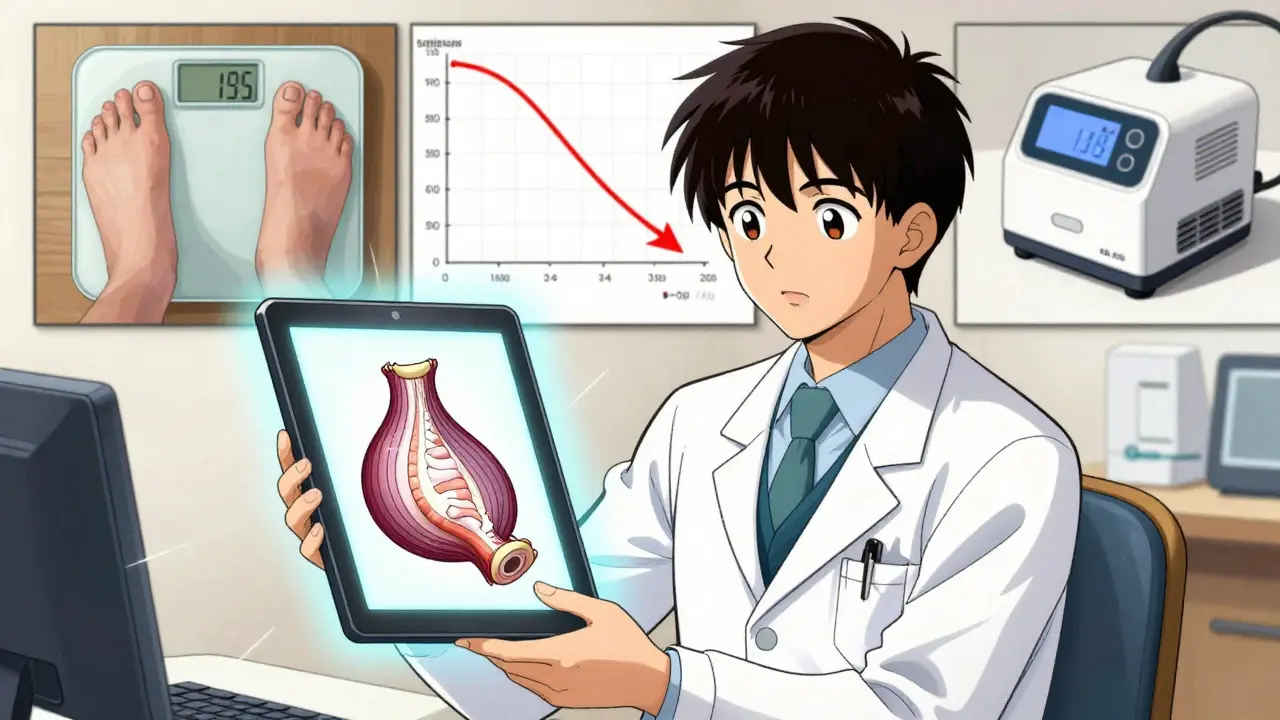
Losing just 10% of your body weight can cut your AHI by half. That’s not a guess. It’s backed by data from the Obesity Medicine Association and multiple clinical trials. For someone weighing 200 pounds, that’s 20 pounds. For someone with a BMI of 38, that’s often enough to drop from severe OSA (AHI >30) to mild (AHI <15).
Real people are seeing this happen. One Reddit user, u/SleepWarrior42, lost 45 pounds and went from a CPAP pressure of 14 cm H₂O to 9 cm H₂O. His AHI dropped from 32 to 9. He no longer needs CPAP when he sleeps on his side. Another survey of 1,200 CPAP users found that 31% of mild OSA patients were able to stop using CPAP entirely after losing weight.
And it’s not just about the machine. Lower pressure means fewer mask leaks, better comfort, and higher adherence. One study found that people who lost 10% of their weight reduced their CPAP pressure by an average of 2.3 cm H₂O within six months. That small change can make a huge difference in how easy it is to stick with therapy.
Why Losing Weight Is Harder With Untreated Sleep Apnea
It’s a cycle. Sleep apnea makes weight loss harder. Weight gain makes sleep apnea worse. If you’re not using CPAP-or not using it enough-your body is stuck in a bad loop.
- You’re too tired to exercise. Studies show OSA patients move 22% less during the day.
- Your hunger hormones are out of whack. Ghrelin is 27% higher than normal.
- Your metabolism slows. Your body doesn’t burn fat efficiently.
- Your insulin sensitivity drops. That makes it harder to control blood sugar and store fat.
That’s why just telling someone with OSA to “eat less and move more” rarely works. You need to break the cycle first. Start with CPAP. Use it consistently. Then, the energy to change your diet and move more will come. That’s the order that works.
What Works: Real Strategies for Weight Loss With OSA
There’s no one-size-fits-all solution, but the most effective approaches share three things:
- Start with CPAP. Get your sleep under control before trying intense dieting. You need energy to change habits.
- Target 5-10% weight loss. That’s enough to see major AHI improvements. For most, that’s 15-30 pounds. It’s more realistic than losing 50.
- Get support. People who worked with a sleep specialist, dietitian, and obesity medicine doctor lost 42% more weight than those who went it alone.
Some people need medication. FDA-approved drugs like semaglutide (Wegovy) and tirzepatide (Zepbound) have shown strong results in reducing AHI when combined with CPAP. But insurance often won’t cover them unless you have diabetes or severe obesity. Only 41% of commercial insurers cover these drugs as of 2023.
For those with BMI over 40, bariatric surgery is the most effective option. Studies show 78% of patients who had gastric bypass saw their OSA resolve completely within a year. That’s far better than lifestyle changes alone (37% resolution). But surgery isn’t for everyone-and it’s not a quick fix. It’s a tool, used when other methods fail.
What the New Tech Is Doing
Manufacturers are finally catching up. In 2023, ResMed launched the AirSense 11 AutoSet for Her, with pressure algorithms built for people with BMI over 35. Philips’ DreamStation 3 now tracks your weight and automatically adjusts CPAP pressure if you lose or gain. These aren’t gimmicks. They’re responses to real data.
The NIH is funding $12.7 million in new research to understand how different diets affect fat deposits in the upper airway. Maybe low-carb works better for some. Maybe protein-rich diets shrink neck fat faster. We’re just starting to learn.
And there’s emerging tech like hypoglossal nerve stimulation-implants that keep your tongue from blocking your airway. It’s not for everyone, but for those with BMI 35-40 who can’t tolerate CPAP, it’s a game-changer, with 71% success rates.
What You Should Do Next
If you’re using CPAP and your BMI is over 30:
- Get your pressure setting checked. Ask your sleep doctor if it’s too high.
- Track your weight monthly. Even a 5-pound drop can make your machine easier to use.
- Use CPAP at least 6 hours every night. That’s the threshold where metabolic benefits kick in.
- Ask your doctor about a referral to an obesity medicine specialist. This isn’t a “willpower” issue-it’s a medical one.
- If you’ve lost 10% of your weight, schedule a repeat sleep study. You might be able to lower your pressure-or even stop CPAP.
The science is clear: weight loss doesn’t just help with sleep apnea. It can cure it. But you don’t have to lose 50 pounds to see results. Start small. Be consistent. Let your CPAP give you the energy to change your life. Then, let that change help your CPAP work better.
Can losing weight eliminate the need for CPAP?
Yes, in many cases. Losing 10% of your body weight can reduce your apnea severity enough to stop CPAP therapy entirely, especially if you had mild to moderate OSA. Studies show 31% of mild OSA patients were able to discontinue CPAP after significant weight loss. However, a follow-up sleep study is required to confirm if your AHI is below 5 before stopping therapy.
Why does CPAP sometimes cause weight gain?
CPAP can cause weight gain because improved sleep resets appetite hormones. Ghrelin (hunger hormone) drops, but leptin (fullness hormone) doesn’t always rise enough, leading to increased appetite. Some users report eating nearly 300 extra calories per day after starting CPAP. Additionally, basal metabolic rate can drop by 5.3%, meaning you burn fewer calories at rest. This effect is strongest in people who use CPAP less than 5 hours per night.
How much weight do I need to lose to see a difference in my sleep apnea?
Losing just 5-10% of your body weight leads to meaningful improvements. For someone with a BMI of 35, that’s about 15-30 pounds. This often reduces AHI by 50% or more. Research shows each 1-point drop in BMI reduces AHI by 6-7%, so even modest weight loss makes a measurable difference in breathing during sleep.
Does CPAP pressure change if I lose weight?
Yes. For every 1-point decrease in BMI, CPAP pressure typically needs to drop by about 0.5 cm H₂O. Many users report reducing their pressure by 2-3 cm H₂O after losing 10-15 pounds. If you’ve lost significant weight, you should have a repeat sleep study to confirm whether your pressure setting can be lowered safely.
Is bariatric surgery worth it for sleep apnea?
For people with BMI over 40 and severe OSA, yes. Studies show 78% of patients who had gastric bypass saw their sleep apnea resolve within a year. That’s far more effective than diet and exercise alone (37% resolution). Surgery isn’t for everyone, but when other methods fail, it’s one of the most reliable ways to treat obesity-related OSA permanently.
Comments
Aaron Pace
This is so true 😅 I started CPAP last year and gained 3 lbs without even trying. Now I’m stuck between ‘feeling better’ and ‘looking worse’.
On March 7, 2026 AT 09:55
Joey Pearson
You’re not alone. But here’s the win: every pound you lose = less pressure = better sleep = more energy to move. It’s a cycle. Start small. Walk after dinner. You got this.
On March 9, 2026 AT 03:32
phyllis bourassa
I can’t believe people still act like CPAP is some magic fix. You think a machine fixes the root cause? Nah. It’s just putting a bandaid on a broken leg while you keep eating fries at 2 a.m. 🙄
On March 9, 2026 AT 19:09
Roland Silber
The 0.5 cm H₂O increase per BMI point is fascinating. I wonder if there’s a threshold where pressure becomes counterproductive-like, if it’s too high, does it cause more mask leaks or even air swallowing? Has anyone studied that?
On March 11, 2026 AT 10:19
Patrick Jackson
Man... I just realized I’ve been using CPAP for 4 years and I’ve never once considered losing weight. I thought the machine was doing the work for me. Turns out, I was just outsourcing my health to a box. 🤦♂️
On March 12, 2026 AT 00:42
Pranay Roy
You know what they don’t tell you? The sleep apnea industry profits from you staying overweight. CPAP machines, masks, replacements-they’re a cash cow. Weight loss? No recurring revenue. Coincidence? I think not.
On March 12, 2026 AT 19:25
Joe Prism
In my culture, food is love. So when my doctor said ‘lose weight,’ it felt like ‘stop loving yourself.’ But now I see: taking care of my body *is* love. Just… different kind.
On March 12, 2026 AT 20:12
Ian Kiplagat
Interesting. I’ve been on 16 cm H₂O for 5 years. My BMI dropped from 37 to 32. Still no change in pressure. Maybe the machine just… remembers?
On March 12, 2026 AT 23:00
Amina Aminkhuslen
So let me get this straight-you’re telling me the machine that’s supposed to save my life is also quietly turning me into a blob? And the docs just shrug? I’m out. I’m getting a naturopath and a juicer. 🍏💥
On March 13, 2026 AT 06:02
Adebayo Muhammad
The data is skewed. They don’t account for cortisol spikes from chronic stress. CPAP reduces apneas, but if your cortisol stays elevated from work, trauma, or social isolation-you’ll still gain weight. It’s not the machine. It’s the system.
On March 13, 2026 AT 13:24
Bridget Verwey
Oh honey, you think you’re the only one? I lost 18 lbs, went from 18 cm H₂O to 10, and my husband said I snore louder now. Turns out, I just… breathe better. He’s jealous.
On March 14, 2026 AT 07:18
Weston Potgieter
I’m 200 lbs. Lost 10. AHI dropped from 42 to 19. CPAP pressure stayed the same. Machine didn’t auto-adjust. So now I’m stuck with 16 cm H₂O for mild OSA. Why? Because the system doesn’t care.
On March 15, 2026 AT 14:55